Mississippi Science CHE.6.1
The Standard
- CHE.6
- Students will demonstrate an understanding of the types, causes, and effects of chemical reactions.
Develop and use models to predict the products of chemical reactions (e.g., synthesis reactions; single replacement; double displacement; and decomposition, including exceptions such as decomposition of hydroxides, chlorates, carbonates, and acids). Discuss and/or compile lists of reactions used in everyday life.
2026 Mississippi College- and Career-Readiness Standards for Science · Chemical Reactions
Teacher's field guide
What This Standard Means
What Students Need to Do
- Students use models to predict products for combination, replacement, ion exchange, and breakdown reactions. They check activity and solubility charts and use special breakdown patterns for carbonates, chlorates, hydroxides, and acids. They balance equations and identify reactions in everyday life.
What Mastery Looks Like
- Students predict ZnSO4 + Cu from Zn + CuSO4 and explain why zinc replaces copper. They use a solubility chart to predict the solid formed when AgNO3 and NaCl mix. They predict CaO + CO2 from heated CaCO3 and balance each equation.
Common Misconceptions
- Students may swap ions without fixing charge ratios or assume copper can replace zinc. They may split heated carbonates into separate elements instead of a metal oxide and carbon dioxide. Some forget that carbonic acid breaks down into water and carbon dioxide.
How to Assess It
- Exit ticket: Predict and balance the products of Zn + CuSO4 and heated CaCO3. Name the clue you used for each prediction.
Lesson moves
Ways to Teach It
Give pairs paper atom tiles to model Zn + CuSO4 and heated CaCO3, then count atoms and balance each equation.
Provide an activity series and ask: Why does Zn replace Cu in CuSO4, but Cu cannot replace Zn in ZnSO4?
Run a product-prediction relay with cards for Mg + O2, Zn + CuSO4, AgNO3 + NaCl, heated KClO3, heated Cu(OH)2, and H2CO3.
Show a catalytic converter diagram; have students predict and balance carbon monoxide reacting with oxygen to make carbon dioxide.
Free download
Printable CHE.6.1 Worksheet
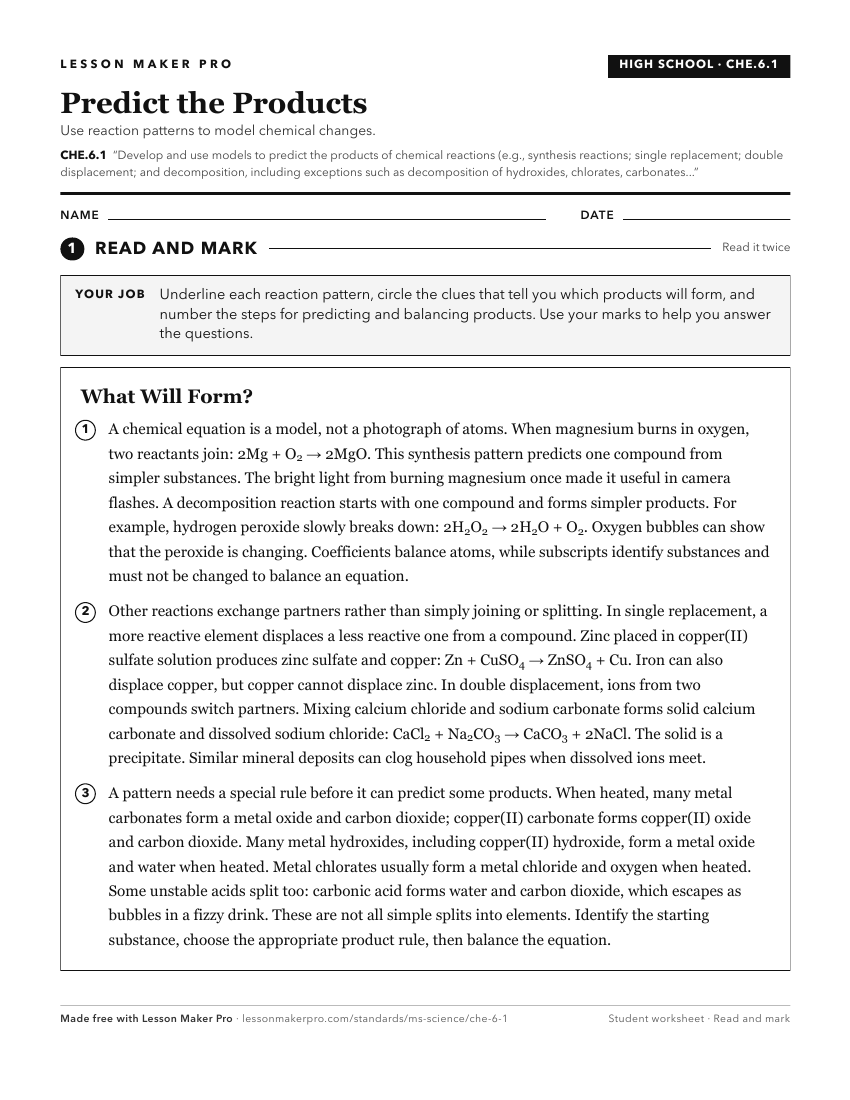
A ready-to-print activity worksheet aligned to CHE.6.1, with an answer key for the teacher on its own page. No account needed.
PDF, US Letter, prints cleanly in black and white.
Download the worksheetKeep exploring
Related Standards
- P.7.5D.1
Analyze evidence from scientific investigations to predict likely outcomes of chemical reactions.
- P.7.5D
Students will demonstrate an understanding of chemical formulas and common chemical substances to predict the types of reactions and possible outcomes of the re...
- P.7.5D.4
Build a model to explain that chemical reactions can store (formation of bonds) or release energy (breaking of bonds).
- CHE.5.2
Generate formulas of ionic and covalent compounds from compound names. Discuss compounds in everyday life and compile lists and uses of these chemicals.
Turn this exact standard into a lesson
Grade, subject, topic, and the complete standard are prefilled. Create one free, no account needed.
Also for this standard:Make a WorksheetMake a QuizMake a Sub Lesson