Mississippi Science CHE.5.2
The Standard
- CHE.5
- Students will investigate and understand the accepted nomenclature used to identify the name and chemical formulas of compounds.
Generate formulas of ionic and covalent compounds from compound names. Discuss compounds in everyday life and compile lists and uses of these chemicals.
2026 Mississippi College- and Career-Readiness Standards for Science · Naming Compounds
Teacher's field guide
What This Standard Means
What Students Need to Do
- Students write formulas from compound names by balancing ion charges or using covalent prefixes. They also list familiar compounds and explain what each is used for.
What Mastery Looks Like
- A student writes CaCl₂ for calcium chloride, Fe₂O₃ for iron(III) oxide, and N₂O₄ for dinitrogen tetroxide. They can name an everyday compound and give an accurate use for it.
Common Misconceptions
- Students may read a Roman numeral as an atom count rather than a metal charge. They may use prefixes for ionic compounds or write ion charges as subscripts without balancing them.
How to Assess It
- Exit ticket: Write formulas for magnesium chloride, iron(III) oxide, and dinitrogen tetroxide. Name one household compound and give its use.
Lesson moves
Ways to Teach It
Give students Ca²⁺, Cl⁻, Al³⁺, and O²⁻ ion cards; have them build neutral compounds and write each formula.
Ask students to explain in writing why calcium chloride is CaCl₂ but carbon dioxide is CO₂, using charges and prefixes.
Play formula bingo: call out magnesium oxide, iron(III) chloride, and sulfur dioxide while students mark matching formulas on prepared cards.
Set out table salt and baking soda packages with a formula sheet; students record each compound, its formula, and one use.
Free download
Printable CHE.5.2 Worksheet
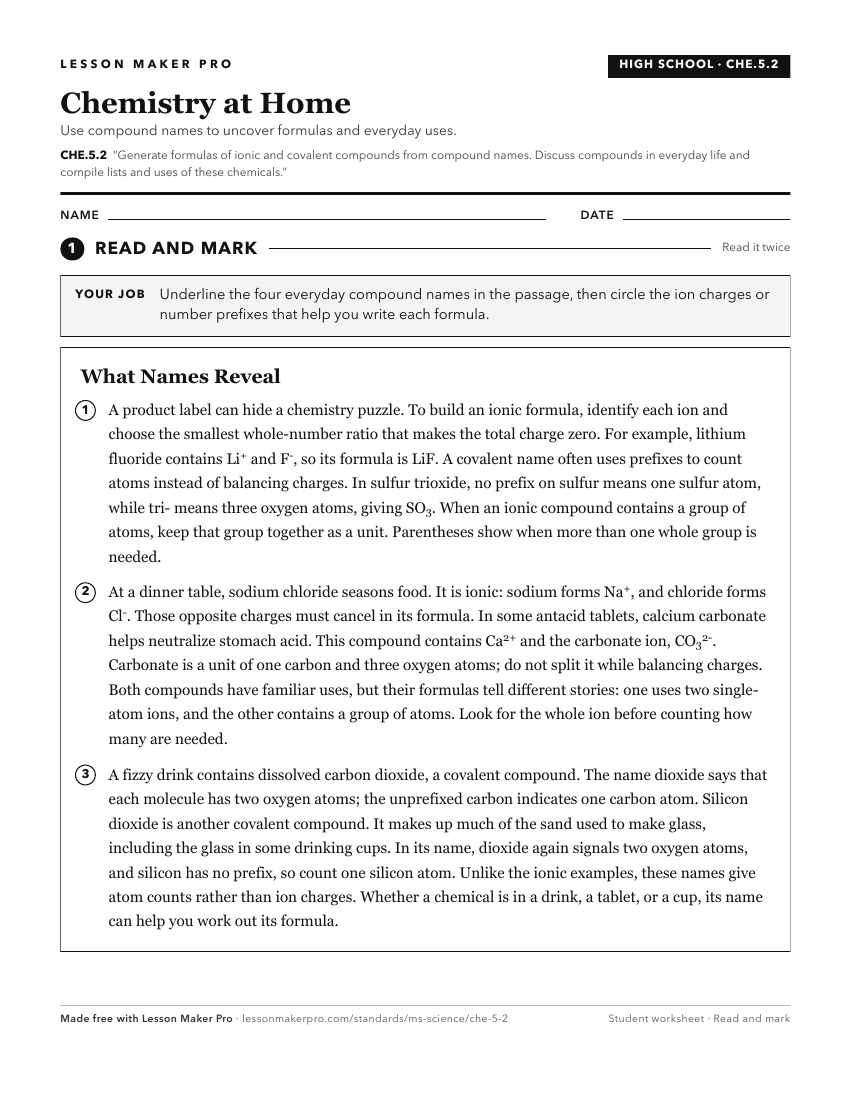
A ready-to-print activity worksheet aligned to CHE.5.2, with an answer key for the teacher on its own page. No account needed.
PDF, US Letter, prints cleanly in black and white.
Download the worksheetKeep exploring
Related Standards
- CHE.5.3
Generate names of ionic and covalent compounds from their formulas. Name binary compounds, binary acids, stock compounds, ternary compounds, and ternary acids.
- CHE.5
Students will investigate and understand the accepted nomenclature used to identify the name and chemical formulas of compounds.
- CHE.5.1
Use the periodic table and a list of common polyatomic ions as a model to derive chemical compound formulas from compound names and compound names from chemical...
- PHS.3.2
Using the periodic table and scientific methods, investigate the formation of compounds through ionic and covalent bonding.
Turn this exact standard into a lesson
Grade, subject, topic, and the complete standard are prefilled. Create one free, no account needed.
Also for this standard:Make a WorksheetMake a QuizMake a Sub Lesson