Mississippi Science CHE.8.2
The Standard
- CHE.8
- Students will demonstrate an understanding of the nature of properties of various types of chemical solutions.
Develop and use models (e.g., online simulations, games, or video representations) to explain the dissolving process in solvents on the molecular level.
2026 Mississippi College- and Career-Readiness Standards for Science · Solutions
Teacher's field guide
What This Standard Means
What Students Need to Do
- Students build particle models showing solvent molecules surrounding and spreading out solute particles. They use the models to explain why salt separates into ions in water while sugar molecules stay intact.
What Mastery Looks Like
- A student can draw salt before and after dissolving, with separate Na+ and Cl− ions. They show the oxygen end of water facing Na+ and the hydrogen ends facing Cl−.
Common Misconceptions
- Students may think dissolved salt vanishes or remains as tiny crystals floating in water. They may draw NaCl molecules instead of separate ions, or show water breaking into hydrogen and oxygen.
How to Assess It
- On an exit ticket, have students draw salt before and after it dissolves in water. Ask them to label the ions, orient nearby water molecules, and explain why the ions spread out.
Lesson moves
Ways to Teach It
Give pairs paper Na+, Cl−, and H2O cutouts to model water molecules pulling ions from a salt crystal.
Ask students to write: When sugar disappears in tea, where does it go, and do its molecules break apart?
Give pairs four particle diagrams of salt and sugar in water to sort into accurate and inaccurate models.
Show a photo of salt and sand on an icy sidewalk, then ask students to sketch what happens to each in meltwater.
Free download
Printable CHE.8.2 Worksheet
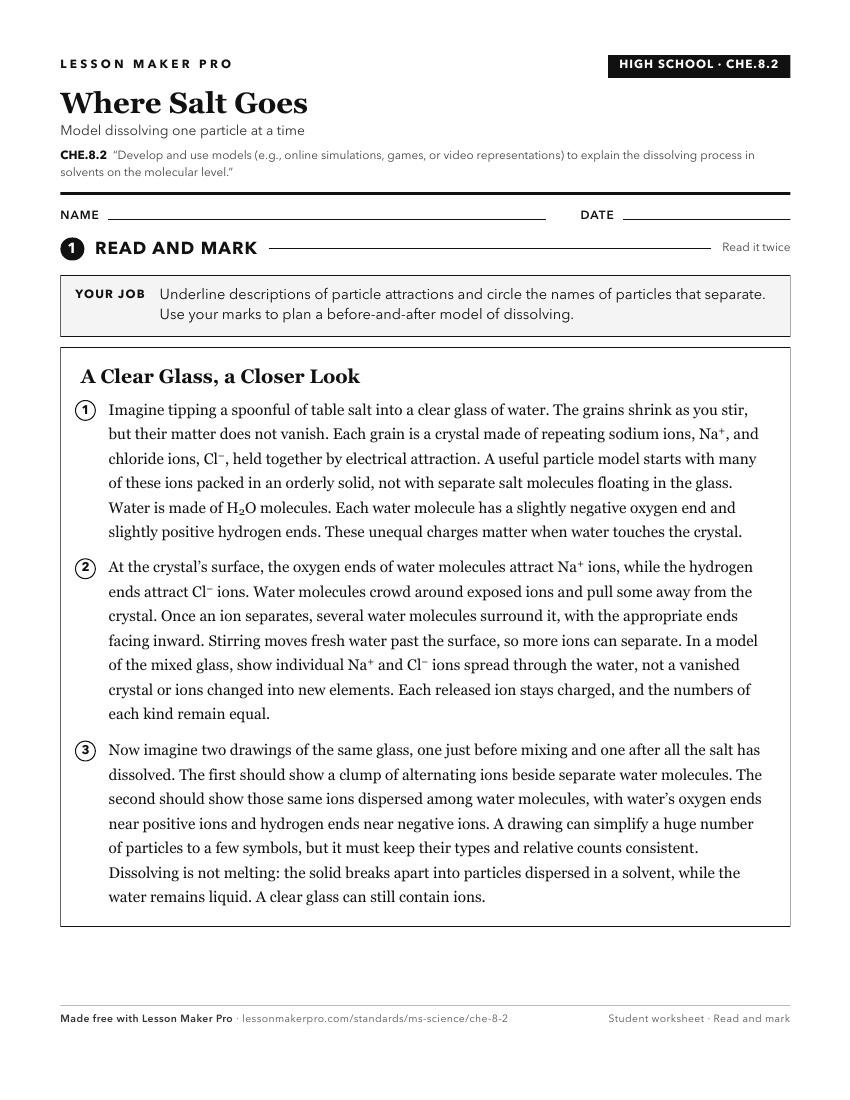
A ready-to-print activity worksheet aligned to CHE.8.2, with an answer key for the teacher on its own page. No account needed.
PDF, US Letter, prints cleanly in black and white.
Download the worksheetKeep exploring
Related Standards
- CHE.4.1
Develop and use models (e.g., Lewis dot, 3-D ball-stick, 3-D printing, or simulation programs such as PhET) to predict the type of bonding between atoms and the...
- P.5.5B.3
Investigate how different variables (e.g., temperature change, stirring, particle size, or surface area) affect the rate at which a solute will dissolve.
- E.4.9A.1
Develop and use models to explain how the sun's energy drives the water cycle. (e.g., evaporation, condensation, precipitation, transpiration, runoff, and groun...
- CHE.7.2
Enrichment: Use an engineering design process to develop models (e.g., online simulations or student interactive activities) to explain and predict the behavior...
Turn this exact standard into a lesson
Grade, subject, topic, and the complete standard are prefilled. Create one free, no account needed.
Also for this standard:Make a WorksheetMake a QuizMake a Sub Lesson