Mississippi Science CHE.8.8
The Standard
- CHE.8
- Students will demonstrate an understanding of the nature of properties of various types of chemical solutions.
Enrichment: Investigate parts per million and/or parts per billion as it applies to environmental concerns in your geographic region, and reference laws that govern these factors.
2026 Mississippi College- and Career-Readiness Standards for Science · Solutions
Teacher's field guide
What This Standard Means
What Students Need to Do
- Students read a local drinking water report and identify contaminant levels in parts per million or parts per billion. They convert units, compare a reported level with its legal limit, and identify the law behind that limit.
What Mastery Looks Like
- A student can convert 0.004 ppm to 4 ppb and compare it with the 10 ppb federal limit for arsenic in drinking water. They can name the Safe Drinking Water Act and explain that a level below the limit is not zero.
Common Misconceptions
- Students may treat 1 ppm and 1 ppb as equal, or reverse the conversion. They may confuse a measured level with the legal limit. Some assume that a level below the limit means no contaminant is present.
How to Assess It
- Exit ticket: A sample water report lists arsenic at 0.007 ppm. Convert the reading to ppb, compare it with the 10 ppb federal limit, and name the law behind that limit.
Lesson moves
Ways to Teach It
Dilute 1 mL colored water in 999 mL water three times, using each new mixture; label the original mixture's concentration in ppm and ppb.
Give pairs a local water report and ask: Does a reading below the legal limit mean the contaminant is absent?
Give teams cards labeled 0.005 ppm, 5 ppb, 0.5 ppm, and 500 ppb; have them race to match equivalent concentrations.
Find your water utility's latest report, choose one contaminant, and compare its reported concentration with the EPA limit under the Safe Drinking Water Act.
Free download
Printable CHE.8.8 Worksheet
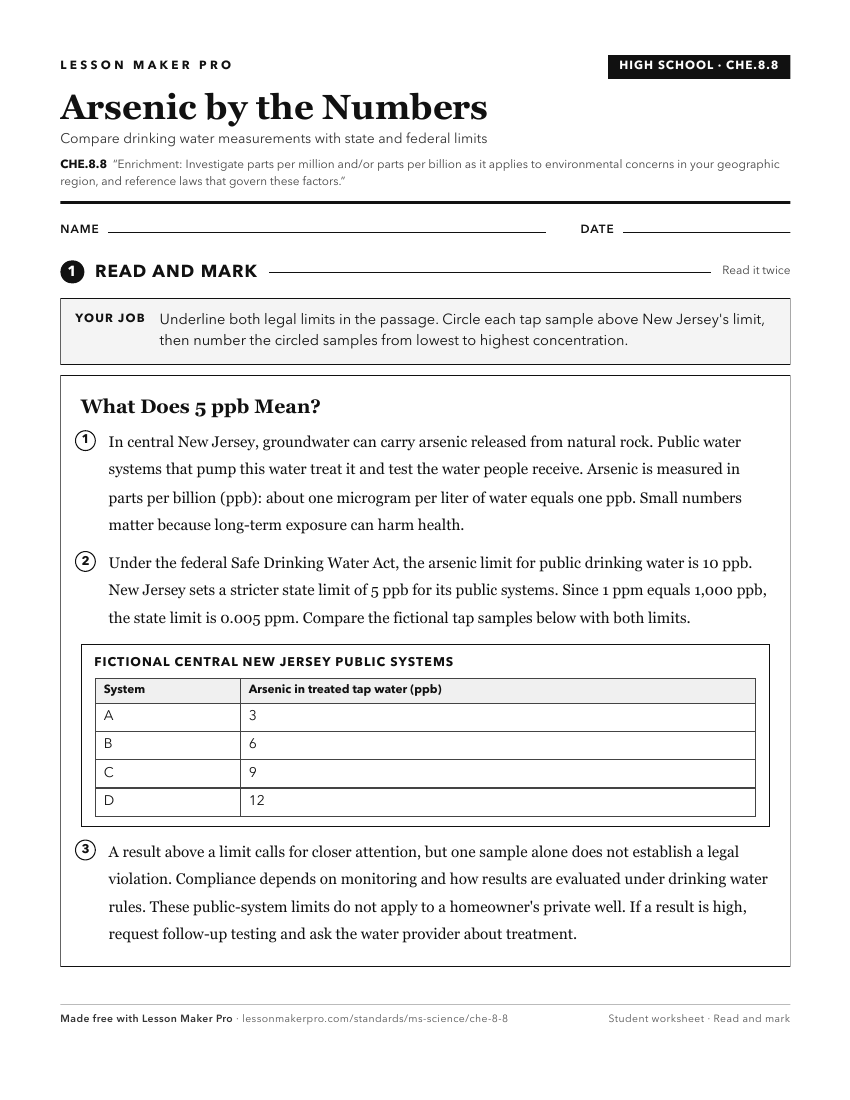
A ready-to-print activity worksheet aligned to CHE.8.8, with an answer key for the teacher on its own page. No account needed.
PDF, US Letter, prints cleanly in black and white.
Download the worksheetKeep exploring
Related Standards
- BIO.5.8
Enrichment: Use an engineering design process to create a solution that addresses changing ecological conditions (e.g., climate change, invasive species, loss o...
- ESS.4.4
Enrichment: Use an engineering design process to research, develop, and test models to aid in the responsible management of natural resources (e.g., recycling, ...
- ENV.4.4
Enrichment: Explore online resources related to air pollution to determine air quality in a geographic area and communicate the possible effects on the environm...
- ENV.4.3
Enrichment: Research and analyze case studies to determine the impact of human-related and natural environmental changes on human health and communicate possibl...
Turn this exact standard into a lesson
Grade, subject, topic, and the complete standard are prefilled. Create one free, no account needed.
Also for this standard:Make a WorksheetMake a QuizMake a Sub Lesson