Mississippi Science P.5.5B
Standard Cluster
Students will demonstrate an understanding of mixtures and solutions. Obtain and evaluate scientific information to describe what happens to the properties of substances in mixtures and solutions (solvent and solute). Analyze and interpret data to communicate that the concentration of a solution is determined by the relative amount of solute versus solvent in various mixtures. Investigate how different variables (e.g., temperature change, stirring, particle size, or surface area) affect the rate at which a solute will dissolve. Design an effective system (e.g., sifting, filtration, evaporation, magnetic attraction, or floatation) for separating various mixtures. Use an engineering design process to define the problem, design, construct, evaluate, and improve the system. *
2026 Mississippi College- and Career-Readiness Standards for Science · Organization of Matter and Chemical Interactions
Cluster contents
Standards in This Cluster
P.5.5B is a cluster heading. These are the individual standards under it.
- P.5.5B.1
Obtain and evaluate scientific information to describe what happens to the properties of substances in mixtures and solutions (solvent and solute).
- P.5.5B.2
Analyze and interpret data to communicate that the concentration of a solution is determined by the relative amount of solute versus solvent in various mixtures...
- P.5.5B.3
Investigate how different variables (e.g., temperature change, stirring, particle size, or surface area) affect the rate at which a solute will dissolve.
- P.5.5B.4
Design an effective system (e.g., sifting, filtration, evaporation, magnetic attraction, or floatation) for separating various mixtures. Use an engineering desi...
Teacher's field guide
What This Cluster Means
What Students Need to Do
- Students use a short reading and observations to explain what happens when materials mix or dissolve. They compare amounts of solute and solvent, test what changes dissolving speed, and build and improve a way to separate a mixture.
What Mastery Looks Like
- A student identifies sugar as the solute and water as the solvent, and explains that dissolved sugar is still present. They use amounts in a table to compare concentration and describe how stirring changes dissolving time. They test a separation method, check what remains mixed, and improve one step.
Common Misconceptions
- Students may think dissolved sugar has vanished or that stirring lets more sugar dissolve. They may compare concentration by solute amount alone, even when water amounts differ, or expect a coffee filter to catch dissolved salt.
How to Assess It
- Exit ticket: Cup A has 1 teaspoon of salt in 100 mL of water. Cup B has 3 teaspoons in 100 mL of water. Name the solute and solvent, identify the more concentrated cup, explain how stirring affects dissolving time, and say whether a coffee filter would remove the salt.
Lesson moves
Ways to Teach It
Put one teaspoon of sugar in each of two cups of equal-volume water; stir one cup only and time how long each dissolves.
Show drawings of cups with 100 mL of water and one or three teaspoons of sugar; ask which is more concentrated and why.
Run a separation challenge: teams use a magnet, water, and coffee filter to sort sand, foam bits, and steel paper clips, then improve their steps.
Show a photo of salt crystals left on a sidewalk after snow melts; ask where the water went and why salt remained.
Free download
Printable P.5.5B Worksheet
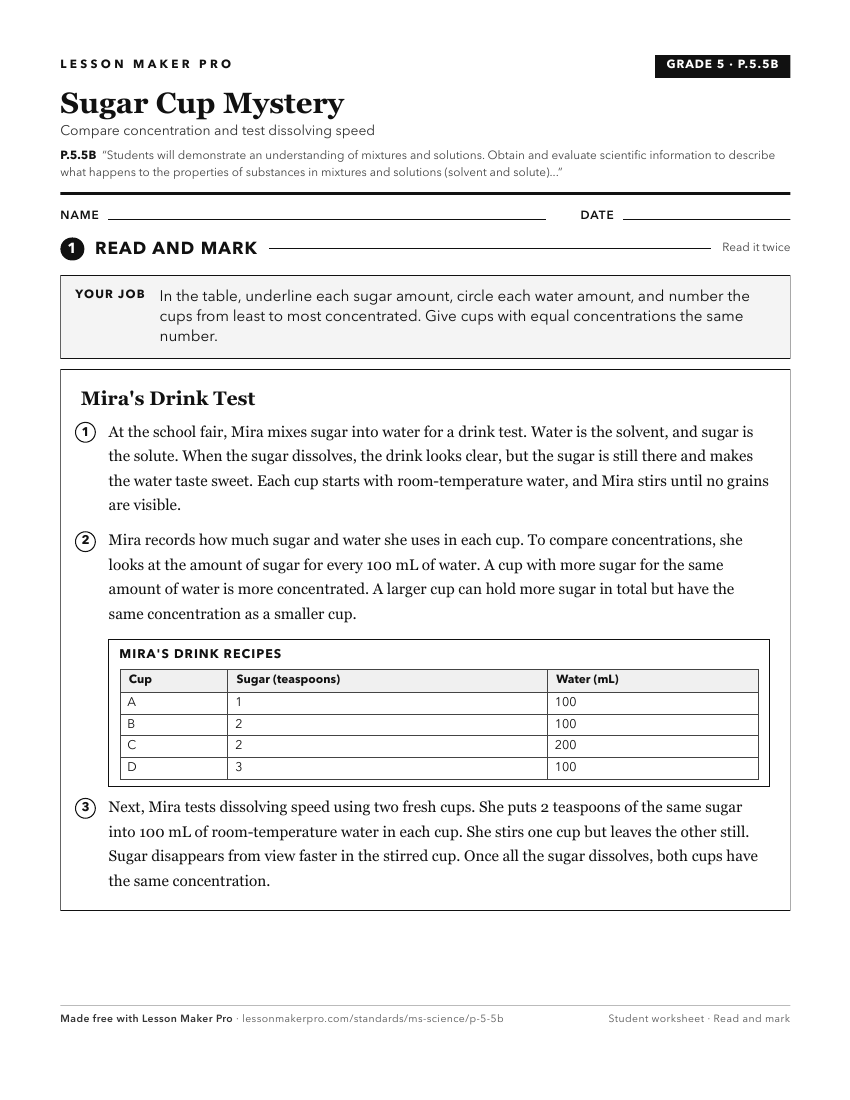
A ready-to-print activity worksheet aligned to P.5.5B, with an answer key for the teacher on its own page. No account needed.
PDF, US Letter, prints cleanly in black and white.
Download the worksheetKeep exploring
Related Standards
- PHS.1
Students will demonstrate an understanding of the nature of matter.
- P.K.5A
Students will demonstrate an understanding of the solid and liquid states of matter.
- P.2.5
Students will demonstrate an understanding of the properties of matter.
- CHE.8
Students will demonstrate an understanding of the nature of properties of various types of chemical solutions.
Turn this cluster into a lesson
Grade, subject, topic, and the complete cluster are prefilled. Create one free, no account needed.
Also for this cluster:Make a WorksheetMake a QuizMake a Sub Lesson