Mississippi Science P.7.5D.3
The Standard
- P.7.5D
- Students will demonstrate an understanding of chemical formulas and common chemical substances to predict the types of reactions and possible outcomes of the reactions.
Collect, organize, and interpret data using various tools (e.g., litmus paper, pH paper, cabbage juice) regarding neutralization of acids and bases using common substances.
2026 Mississippi College- and Career-Readiness Standards for Science · Organization of Matter and Chemical Interactions
Teacher's field guide
What This Standard Means
What Students Need to Do
- Students test an acid and a base with pH paper or cabbage juice. They add one to the other, record the results in a table, and use the readings to tell whether the mixture became less acidic or reached neutral.
What Mastery Looks Like
- A student records the starting and final pH or indicator colors in an organized table. They point to a reading near pH 7 as evidence that the mixture is near neutral.
Common Misconceptions
- Students may think fizzing proves a mixture is neutral, even when it remains acidic. They may also think adding water neutralizes acid or that equal amounts of any acid and base always make a neutral mixture.
How to Assess It
- Exit ticket: Vinegar starts at pH 3. After adding baking soda solution, readings are 5, 7, and 8. Ask which reading shows a neutral mixture and what happened after that reading.
Lesson moves
Ways to Teach It
Use droppers to add baking soda solution to diluted vinegar, testing with pH paper and recording each result in a table.
Ask, 'Does fizzing prove a vinegar and baking soda mixture is neutral?' Have students defend an answer using its final pH reading.
Give pairs cards showing before and after pH readings for vinegar and baking soda mixtures; have them sort which mixtures reached neutral.
Drop an antacid tablet into diluted vinegar, then compare pH paper readings before and after to see how antacids reduce acidity.
Free download
Printable P.7.5D.3 Worksheet
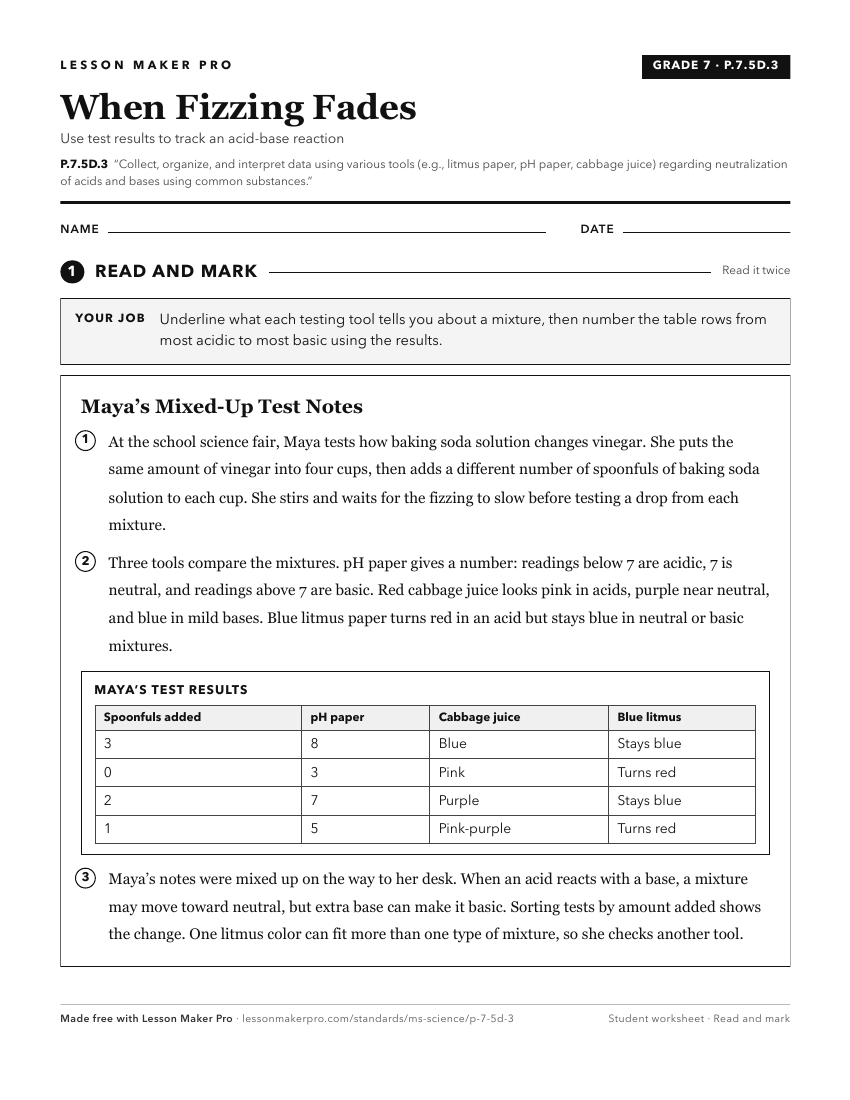
A ready-to-print activity worksheet aligned to P.7.5D.3, with an answer key for the teacher on its own page. No account needed.
PDF, US Letter, prints cleanly in black and white.
Download the worksheetKeep exploring
Related Standards
- FB.2.4
Analyze and interpret data to classify common solutions such as acids, bases, or neutral. Communicate the importance of pH in living systems.
- CHE.9.2
Enrichment: Analyze and interpret data to identify differences between strong and weak acids and bases (i.e., dissociation).
- CHE.9.1
Enrichment: Analyze and interpret data to describe the properties of acids, bases, and salts.
- CHE.9.3
Enrichment: Plan and conduct investigations using the pH scale to classify acid and base solutions.
Turn this exact standard into a lesson
Grade, subject, topic, and the complete standard are prefilled. Create one free, no account needed.
Also for this standard:Make a WorksheetMake a QuizMake a Sub Lesson