Mississippi Science FB.2.4
The Standard
- FB.2
- Students will demonstrate an understanding of the structure and interactions of matter and how the organization of matter supports living organisms.
Analyze and interpret data to classify common solutions such as acids, bases, or neutral. Communicate the importance of pH in living systems.
2026 Mississippi College- and Career-Readiness Standards for Science · The Chemistry of Life
Teacher's field guide
What This Standard Means
What Students Need to Do
- Students use pH readings or indicator colors to sort solutions as acidic, basic, or neutral. They explain why pH matters to living things, using an example such as stomach enzymes.
What Mastery Looks Like
- Given a pH table and an indicator key, students classify each sample and point to the evidence for their choice. They can explain why a stomach enzyme may work poorly if the pH rises.
Common Misconceptions
- Students may think a low pH means a solution is less acidic. They may also think every body fluid must be neutral.
How to Assess It
- Exit ticket: Lemon juice has a pH of 3, water has a pH of 7, and baking soda solution has a pH of 9. Label each solution, then explain why a stomach enzyme might work poorly at pH 9.
Lesson moves
Ways to Teach It
Test vinegar, diluted baking soda solution, and distilled water with pH strips; record the readings and sort the samples.
Ask pairs to write two sentences explaining why a stomach enzyme works in acidic fluid but may slow down if pH rises.
Give groups pH cards numbered 2, 5, 7, 9, and 12; have them race to sort the cards.
Show an aquarium log where pH drops from 7.2 to 5.5; ask students how the change might affect the fish.
Free download
Printable FB.2.4 Worksheet
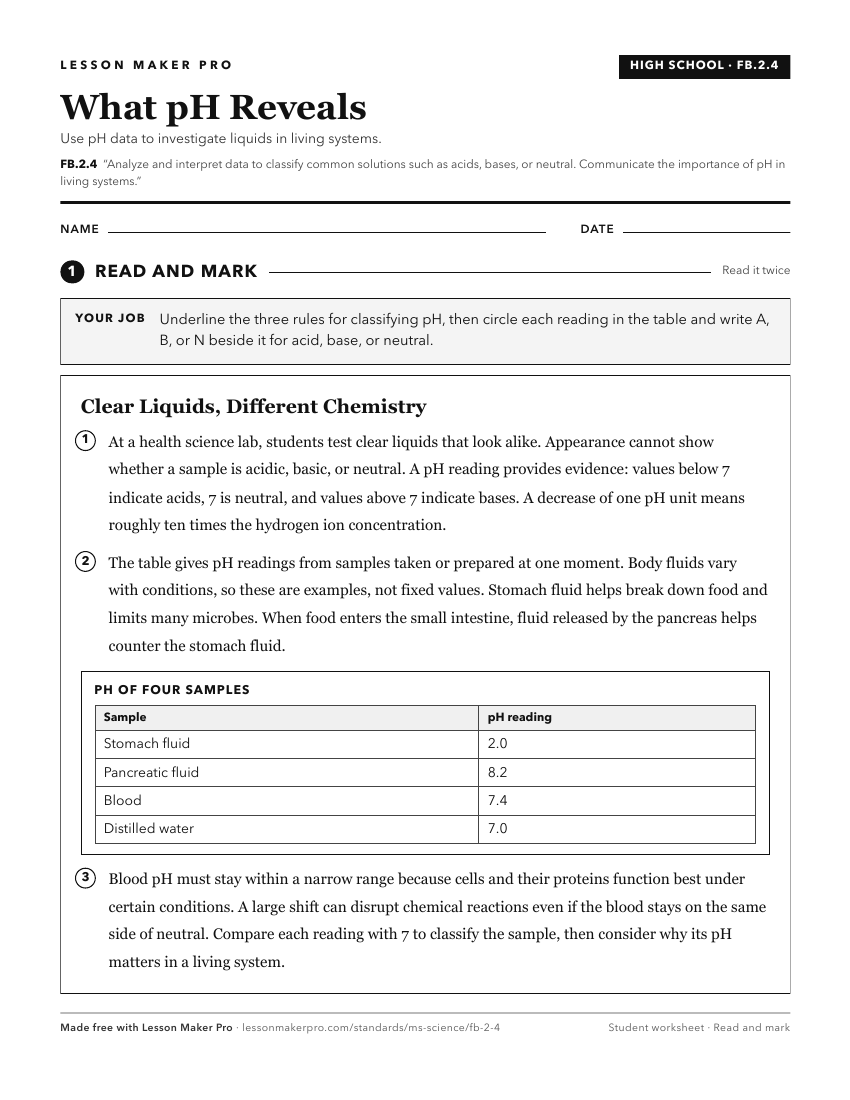
A ready-to-print activity worksheet aligned to FB.2.4, with an answer key for the teacher on its own page. No account needed.
PDF, US Letter, prints cleanly in black and white.
Download the worksheetKeep exploring
Related Standards
- CHE.9.1
Enrichment: Analyze and interpret data to describe the properties of acids, bases, and salts.
- P.7.5D.3
Collect, organize, and interpret data using various tools (e.g., litmus paper, pH paper, cabbage juice) regarding neutralization of acids and bases using common...
- CHE.9.6
Enrichment: Obtain, evaluate, and communicate information about how buffers stabilize pH in acid-base reactions.
- CHE.9.3
Enrichment: Plan and conduct investigations using the pH scale to classify acid and base solutions.
Turn this exact standard into a lesson
Grade, subject, topic, and the complete standard are prefilled. Create one free, no account needed.
Also for this standard:Make a WorksheetMake a QuizMake a Sub Lesson