Mississippi Science ESS.2A
Standard Cluster
Students will develop an understanding of the structure and composition of Earth and its materials. Analyze and interpret data to explain and communicate the differentiation of Earth’s internal chemical structure (e.g., core, mantle, and crust) using the production of internal heat from the radioactive decay of unstable isotopes and gravitational energy. Analyze and interpret data to explain and communicate the differentiation of Earth’s physical divisions (e.g., lithosphere and asthenosphere) using data from seismic waves and Earth’s magnetic field. Investigate the physical and/or chemical characteristics of mineral specimens to identify minerals and mineral deposits/groups (e.g., oxides, carbonates, halides, sulfides, sulfates, silicates, and phosphates). Include the relationship between chemical bonds, chemical formulas, mineral use, and mineral properties. Investigate the physical and/or chemical characteristics of rock specimens to identify and categorize igneous, sedimentary, and metamorphic rocks. Include the processes that generate the transformation of rocks.
2026 Mississippi College- and Career-Readiness Standards for Science · Earth Structure and History
Cluster contents
Standards in This Cluster
ESS.2A is a cluster heading. These are the individual standards under it.
- ESS.2A.1
Analyze and interpret data to explain and communicate the differentiation of Earth’s internal chemical structure (e.g., core, mantle, and crust) using the produ...
- ESS.2A.2
Analyze and interpret data to explain and communicate the differentiation of Earth’s physical divisions (e.g., lithosphere and asthenosphere) using data from se...
- ESS.2A.3
Investigate the physical and/or chemical characteristics of mineral specimens to identify minerals and mineral deposits/groups (e.g., oxides, carbonates, halide...
- ESS.2A.4
Investigate the physical and/or chemical characteristics of rock specimens to identify and categorize igneous, sedimentary, and metamorphic rocks. Include the p...
Teacher's field guide
What This Cluster Means
What Students Need to Do
- Students use seismic-wave and magnetic-field data to map Earth's chemical and physical layers. They explain how gravity separated dense materials and how radioactive decay adds heat. They identify minerals from tests and formulas, link bonding to properties and uses, and classify rocks by how they form and change.
What Mastery Looks Like
- A student uses missing S waves and Earth's magnetic field to infer a moving, liquid outer core. They distinguish the crust from the lithosphere and asthenosphere on a wave-speed graph. They identify a mineral group from its formula and test results, then name a rock and explain how it formed.
Common Misconceptions
- Students often treat the crust and lithosphere as the same layer or assume the whole mantle is liquid. Some think S waves travel through liquid. Others identify minerals by color alone or assume every rock forms by melting.
How to Assess It
- Show a wave-speed graph with a shallow low-speed zone and missing S waves at the outer core. Ask students to label the asthenosphere and outer core and cite one graph feature for each.
Lesson moves
Ways to Teach It
Test quartz, calcite, and halite with a scratch kit and vinegar; compare their formulas, bonding, properties, and uses.
Show an S-wave shadow-zone diagram and a magnetic-field map; ask, 'What evidence points to a moving, liquid outer core?'
Give pairs wave-speed graphs and layer cards; have them match crust, mantle, core, lithosphere, and asthenosphere, then defend their matches.
Compare a granite countertop, slate tile, and sandstone paver; identify each rock and sketch the process that formed it.
Free download
Printable ESS.2A Worksheet
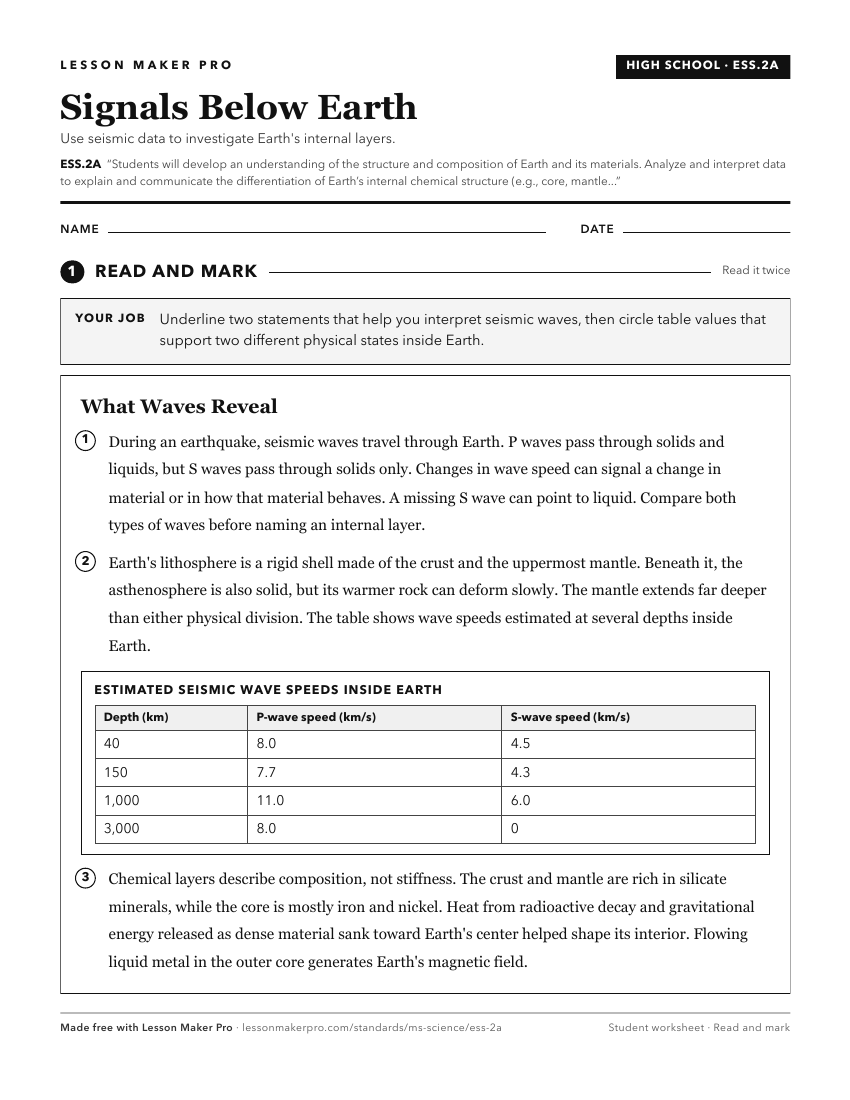
A ready-to-print activity worksheet aligned to ESS.2A, with an answer key for the teacher on its own page. No account needed.
PDF, US Letter, prints cleanly in black and white.
Download the worksheetKeep exploring
Related Standards
- ESS.2B
Students will develop an understanding of the history and evolution of the earth.
- ESS.3
Students will develop an understanding of Earth’s systems and cycles.
- E.3.7B
Students will demonstrate an understanding of the composition of Earth and the processes which change Earth's landforms.
- ESS.4
Students will develop an understanding of Earth’s resources and the impact of human activities.
Turn this cluster into a lesson
Grade, subject, topic, and the complete cluster are prefilled. Create one free, no account needed.
Also for this cluster:Make a WorksheetMake a QuizMake a Sub Lesson