Mississippi Science ESS.2A.2
The Standard
- ESS.2A
- Students will develop an understanding of the structure and composition of Earth and its materials.
Analyze and interpret data to explain and communicate the differentiation of Earth’s physical divisions (e.g., lithosphere and asthenosphere) using data from seismic waves and Earth’s magnetic field.
2026 Mississippi College- and Career-Readiness Standards for Science · Earth Structure and History
Teacher's field guide
What This Standard Means
What Students Need to Do
- Students read seismic wave graphs to find boundaries inside Earth. They use slower waves beneath the lithosphere, missing S waves in the outer core, and magnetic field evidence to explain what those regions are like.
What Mastery Looks Like
- A student labels the rigid lithosphere, the solid but slowly flowing asthenosphere, and the liquid outer core on a depth chart. They cite the wave data for each boundary and explain how moving liquid metal in the outer core produces Earth’s magnetic field.
Common Misconceptions
- Some students think the asthenosphere is liquid, so S waves cannot pass through it. Others think Earth’s magnetic field comes from a permanent magnet in the mantle.
How to Assess It
- Give students a depth chart showing slower waves from 100 to 200 km and no S waves beyond 2,900 km. Ask: “Where are the asthenosphere and liquid outer core, and what does each data set tell you about them?”
Lesson moves
Ways to Teach It
Have students cut out sections of a seismic wave-speed graph, arrange them by depth, and label the boundaries they find.
Show the low-speed zone and ask: “Why can S waves pass through the asthenosphere but not the outer core?”
Play a matching game with cards showing layer names, depths, and seismic wave patterns; require one data point to defend each match.
Use a seafloor magnetic stripe map to trace plate movement above the asthenosphere and discuss what the stripes record.
Free download
Printable ESS.2A.2 Worksheet
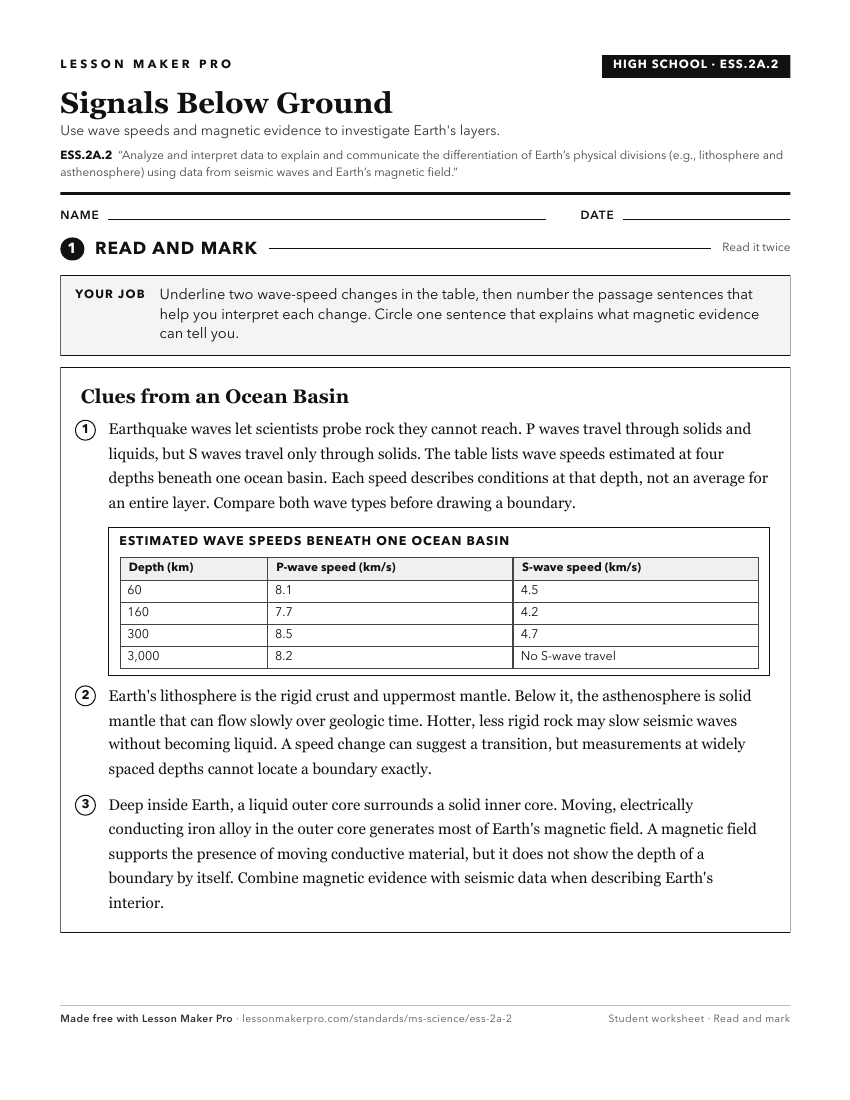
A ready-to-print activity worksheet aligned to ESS.2A.2, with an answer key for the teacher on its own page. No account needed.
PDF, US Letter, prints cleanly in black and white.
Download the worksheetKeep exploring
Related Standards
- ESS.2A.1
Analyze and interpret data to explain and communicate the differentiation of Earth’s internal chemical structure (e.g., core, mantle, and crust) using the produ...
- ESS.2B.4
Research, analyze, and explain the origin of geologic features and processes that result from plate tectonics, including sea floor spreading, earthquake activit...
- E.4.9C.1
Analyze and interpret data to describe (i.e., NASA, NOAA, USGS) and predict how natural processes (e.g., weathering, erosion, deposition, earthquakes, tsunamis,...
- E.3.7B.1
Obtain and evaluate scientific information (e.g. using technology) to describe the four major layers of Earth and the varying compositions of each layer.
Turn this exact standard into a lesson
Grade, subject, topic, and the complete standard are prefilled. Create one free, no account needed.
Also for this standard:Make a WorksheetMake a QuizMake a Sub Lesson