Mississippi Science ESS.2B.4
The Standard
- ESS.2B
- Students will develop an understanding of the history and evolution of the earth.
Research, analyze, and explain the origin of geologic features and processes that result from plate tectonics, including sea floor spreading, earthquake activity, volcanic activity, mountain building, and location of natural resources.
2026 Mississippi College- and Career-Readiness Standards for Science · Earth Structure and History
Teacher's field guide
What This Standard Means
What Students Need to Do
- Students compare seafloor ages and maps of earthquakes, volcanoes, and mineral deposits. They explain how moving plates form new crust, build mountains, trigger hazards, and concentrate some resources.
What Mastery Looks Like
- Students use young rock at a ridge and older rock farther away as evidence of sea floor spreading. They connect deep earthquakes and volcano chains to subduction, and high mountains to collisions. They can explain why copper deposits may form near a volcanic arc.
Common Misconceptions
- Students may put the oldest ocean crust at a ridge instead of far from it. They may expect volcanoes at every plate boundary or think earthquakes only happen where volcanoes erupt. Some assume all mineral deposits form from magma.
How to Assess It
- Show a map with a mid-ocean ridge, a trench, earthquake dots, and inland volcanoes. Ask students to mark where crust forms and explain where mountains and copper deposits may form, using two map clues.
Lesson moves
Ways to Teach It
Move two paper strips with matching magnetic stripes away from a drawn ridge to model sea floor spreading.
Show an earthquake and volcano map; ask, 'Why do some earthquake belts have no volcanoes?'
Give pairs boundary and feature cards to match, including ridges, trenches, earthquakes, mountains, and copper deposits; have them defend one match.
Plot recent USGS earthquakes along the Pacific coast, then compare their positions with plate boundaries and nearby cities.
Free download
Printable ESS.2B.4 Worksheet
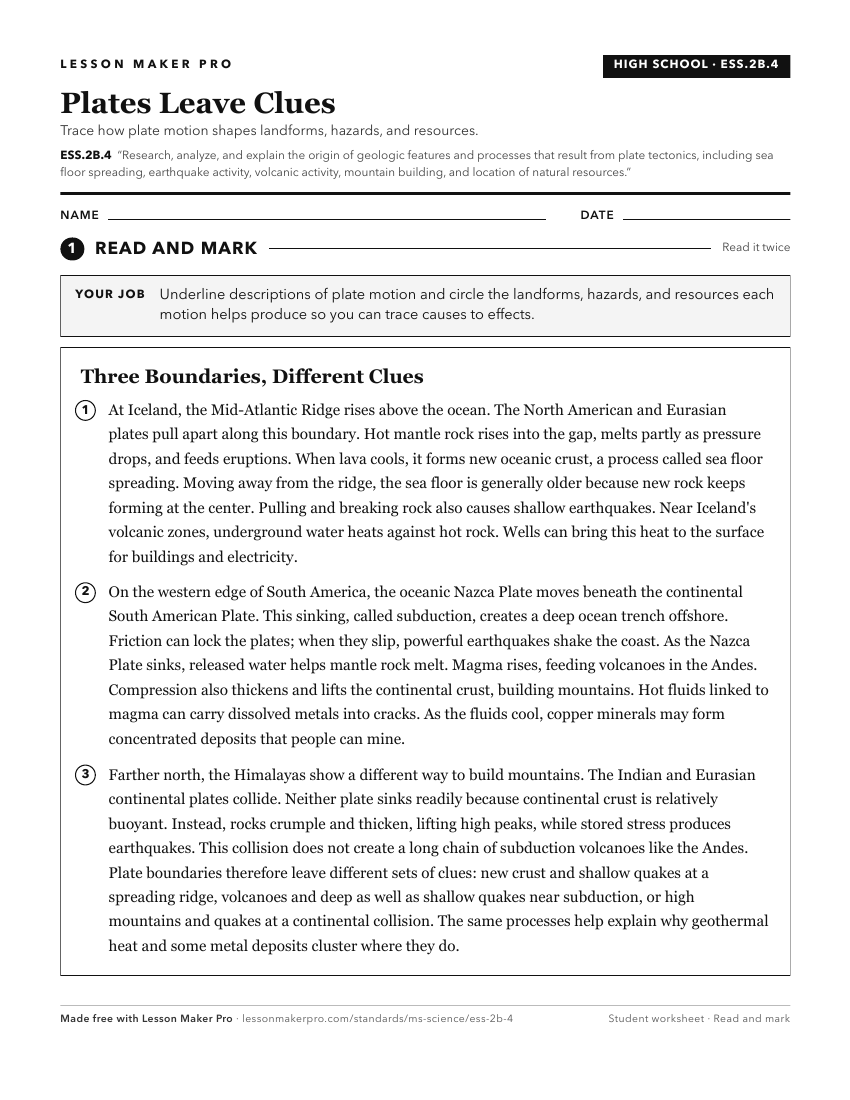
A ready-to-print activity worksheet aligned to ESS.2B.4, with an answer key for the teacher on its own page. No account needed.
PDF, US Letter, prints cleanly in black and white.
Download the worksheetKeep exploring
Related Standards
- E.8.9A.2
Explore and debate theories of plate tectonics to form conclusions about past and current movements of rocks at Earth's surface throughout history.
- MAQ.3.2
Develop an understanding of plate tectonics to predict certain geological features (e.g., sea floor spreading, paleomagnetic measurements, and orogenesis).
- MAQ.3.1
Use geospatial data to analyze, explain, and communicate differences among the major geological features of specific aquatic ecosystems (e.g., plate tectonics, ...
- E.8.9A.3
Map land and water patterns from various time periods and use rocks and fossils to report evidence of how Earth's plates have moved great distances, collided, a...
Turn this exact standard into a lesson
Grade, subject, topic, and the complete standard are prefilled. Create one free, no account needed.
Also for this standard:Make a WorksheetMake a QuizMake a Sub Lesson