Mississippi Science ESS.2A.1
The Standard
- ESS.2A
- Students will develop an understanding of the structure and composition of Earth and its materials.
Analyze and interpret data to explain and communicate the differentiation of Earth’s internal chemical structure (e.g., core, mantle, and crust) using the production of internal heat from the radioactive decay of unstable isotopes and gravitational energy.
2026 Mississippi College- and Career-Readiness Standards for Science · Earth Structure and History
Teacher's field guide
What This Standard Means
What Students Need to Do
- Students use density and composition data to map Earth’s chemical layers. They explain how radioactive decay and gravitational energy heated early Earth, letting dense iron sink beneath lighter silicates.
What Mastery Looks Like
- Given a data table, a student places an iron-rich core beneath a dense silicate mantle and a lighter crust. They cite density values and explain how both heat sources helped the layers separate.
Common Misconceptions
- Students may think the entire mantle is liquid or that all three layers have the same composition. Some think radioactive decay alone made iron sink, leaving out gravitational energy and the movement of material in early Earth.
How to Assess It
- Exit ticket: Give students iron-rich metal at 11 g/cm³, magnesium-rich silicate at 4.5 g/cm³, and lighter silicate at 2.8 g/cm³. Ask them to label the layers and explain how the two heat sources helped form them.
Lesson moves
Ways to Teach It
Measure the density of ten steel washers and a pebble using a scale and water displacement, then rank them by density.
Ask students to write three sentences explaining why the iron-rich core lies beneath silicate rock, using layer densities and both heat sources.
Give pairs shuffled cards with layer names, densities, and compositions; have them match the cards and defend their choices.
Use a printed earthquake P-wave shadow-zone diagram to locate the core boundary, then compare it with students’ density-based layer diagrams.
Free download
Printable ESS.2A.1 Worksheet
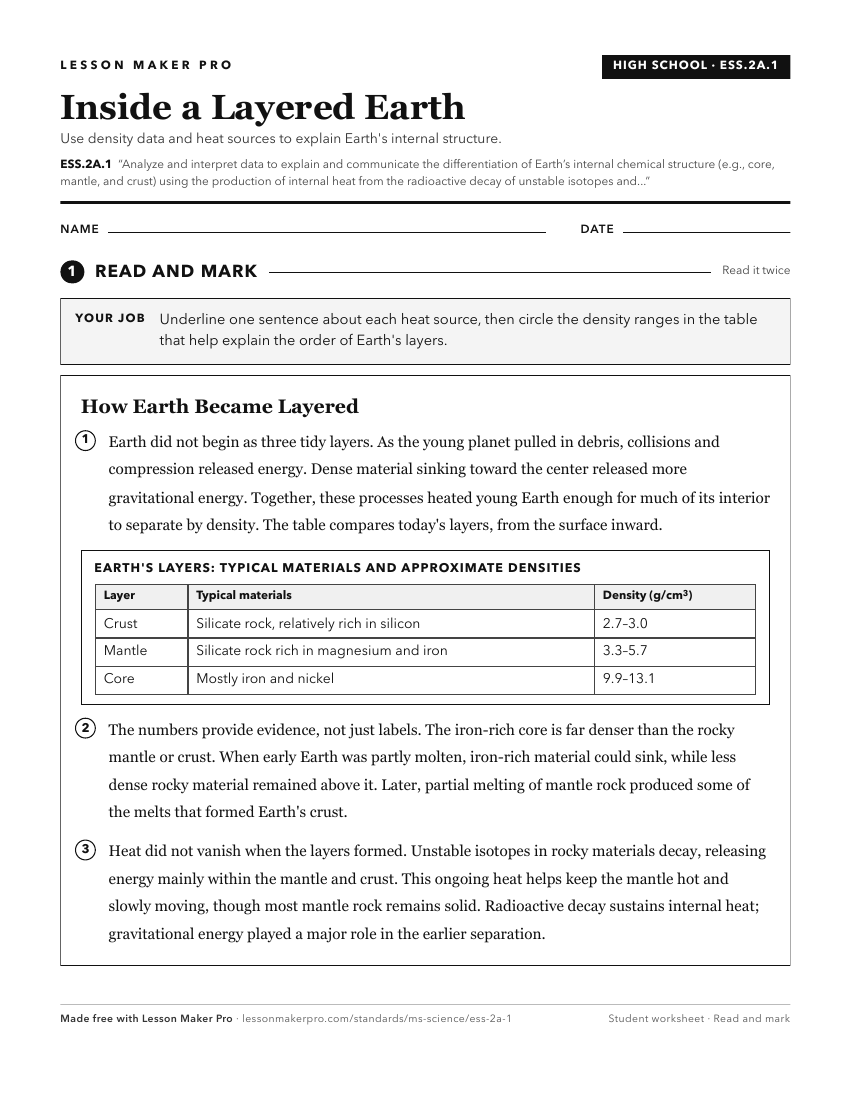
A ready-to-print activity worksheet aligned to ESS.2A.1, with an answer key for the teacher on its own page. No account needed.
PDF, US Letter, prints cleanly in black and white.
Download the worksheetKeep exploring
Related Standards
- ESS.2A.2
Analyze and interpret data to explain and communicate the differentiation of Earth’s physical divisions (e.g., lithosphere and asthenosphere) using data from se...
- E.3.7B.1
Obtain and evaluate scientific information (e.g. using technology) to describe the four major layers of Earth and the varying compositions of each layer.
- E.8.9A.1
Investigate and explain how the flow of Earth's internal energy drives the cycling of matter through convection currents between Earth's surface and the deep in...
- ESS.2B.3
Use mathematical concepts to calculate the absolute age of Earth materials using actual or simulated isotope ratios.
Turn this exact standard into a lesson
Grade, subject, topic, and the complete standard are prefilled. Create one free, no account needed.
Also for this standard:Make a WorksheetMake a QuizMake a Sub Lesson