Mississippi Science ESS.2B.3
The Standard
- ESS.2B
- Students will develop an understanding of the history and evolution of the earth.
Use mathematical concepts to calculate the absolute age of Earth materials using actual or simulated isotope ratios.
2026 Mississippi College- and Career-Readiness Standards for Science · Earth Structure and History
Teacher's field guide
What This Standard Means
What Students Need to Do
- Students use parent and daughter isotope counts to find how many half-lives have passed. They multiply that number by the isotope’s half-life to calculate a mineral’s age.
What Mastery Looks Like
- Given a closed sample with no daughter atoms at formation, they trace 80 parent atoms to 40, then 20. With a 100-million-year half-life, they calculate an age of 200 million years.
Common Misconceptions
- Students may read a 1:3 parent-to-daughter ratio as three half-lives instead of two. They may also count daughter atoms that were present when the mineral formed.
How to Assess It
- Exit ticket: A closed mineral started with no daughter atoms. It now has 20 parent atoms and 60 daughter atoms. If the half-life is 100 million years, how old is it? Show the halving steps.
Lesson moves
Ways to Teach It
Start with 16 parent-isotope counters; flip half to daughter counters each round, then label each round as 100 million years.
Ask students to sketch why a 1:3 parent-to-daughter ratio means two half-lives, not three.
Give pairs ratio cards labeled 8:0, 4:4, and 2:6; partners match each to zero, one, or two half-lives.
Show a meteorite photo and give a simulated 1:1 uranium-238 to lead-206 ratio; students estimate its age using a 4.5-billion-year half-life.
Free download
Printable ESS.2B.3 Worksheet
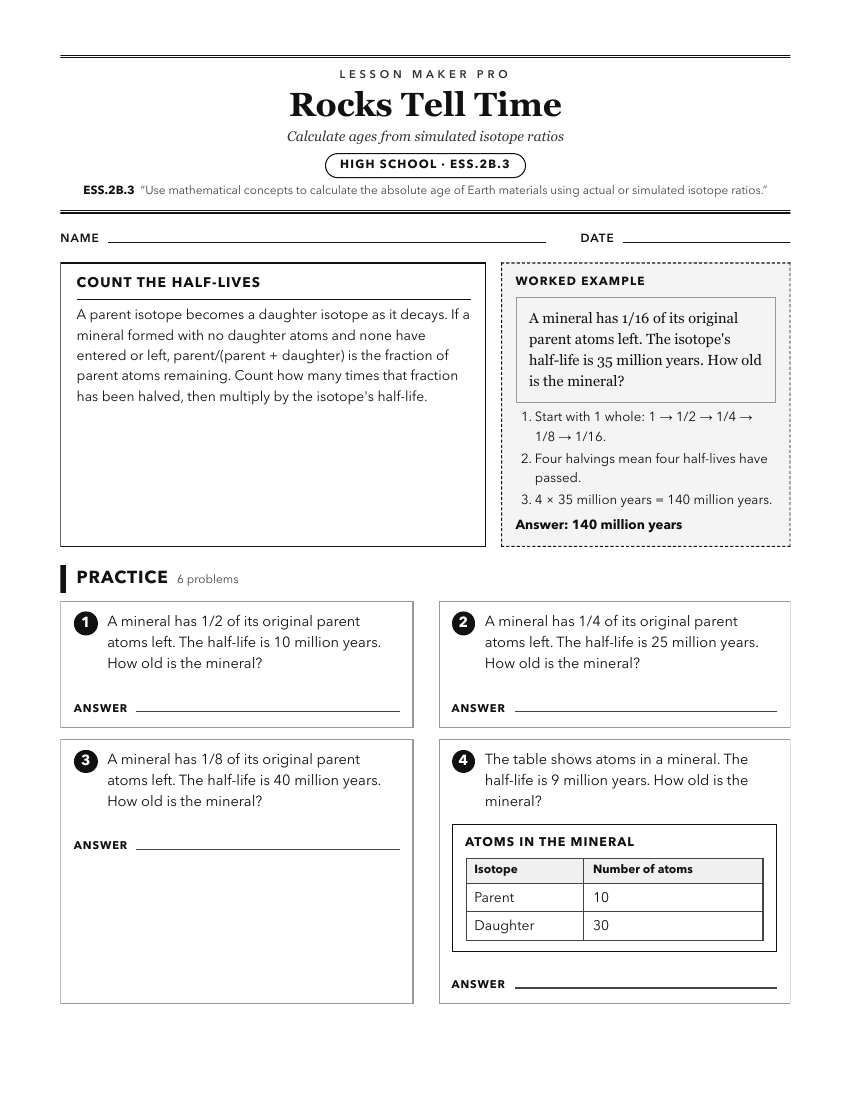
A ready-to-print activity worksheet aligned to ESS.2B.3, with an answer key for the teacher on its own page. No account needed.
PDF, US Letter, prints cleanly in black and white.
Download the worksheetKeep exploring
Related Standards
- PHY.6.4
Simulate the process of nuclear decay using online simulations and/or laboratory experiences and using mathematical computations determine the half-life of radi...
- ESS.2A.1
Analyze and interpret data to explain and communicate the differentiation of Earth’s internal chemical structure (e.g., core, mantle, and crust) using the produ...
- E.8.7.1
Use scientific evidence to create a timeline of Earth’s history that depicts relative dates from index fossil records and layers of rock (strata).
- ESS.2B.2
Apply different techniques (e.g., superposition, original horizontality, cross-cutting relationships, lateral continuity, principle of inclusions, fossil succes...
Turn this exact standard into a lesson
Grade, subject, topic, and the complete standard are prefilled. Create one free, no account needed.
Also for this standard:Make a WorksheetMake a QuizMake a Sub Lesson