Mississippi Science ESS.2B.2
The Standard
- ESS.2B
- Students will develop an understanding of the history and evolution of the earth.
Apply different techniques (e.g., superposition, original horizontality, cross-cutting relationships, lateral continuity, principle of inclusions, fossil succession, and unconformities) to analyze and interpret the relative age of actual sequences, models, or photographs.
2026 Mississippi College- and Career-Readiness Standards for Science · Earth Structure and History
Teacher's field guide
What This Standard Means
What Students Need to Do
- Students put rock layers and events in order without assigning years. They use layer position, faults, fossils, rock fragments, and gaps to explain the order. They also check whether layers were once flat or connected across a gap.
What Mastery Looks Like
- Given a rock diagram, students can order deposition, tilting, faulting, and erosion from oldest to youngest. They can point to the feature that supports each step, such as a fault cutting through older layers.
Common Misconceptions
- Students may assume the highest visible rock is always youngest, even when layers have been overturned. They may think a fault is older than the layers it cuts. They may also mistake an erosional gap for a layer deposited at that time.
How to Assess It
- Exit ticket: Draw three layers labeled A, B, and C from bottom to top, with a fault cutting A and B but not C. Ask students to order A, B, the fault, and C from oldest to youngest and give two clues.
Lesson moves
Ways to Teach It
Stack three clay layers, cut through them with a craft stick, then add a fourth layer; have students label the events in order.
Draw tilted layers cut flat beneath horizontal layers; ask, "Which happened first, tilting or the top layers, and where is time missing?"
Give pairs two paper rock columns with matching fossil symbols; have them align the layers and number them from oldest to youngest.
Show a roadcut photo with a fault crossing rock layers; ask students whether the fault or layers formed first and why.
Free download
Printable ESS.2B.2 Worksheet
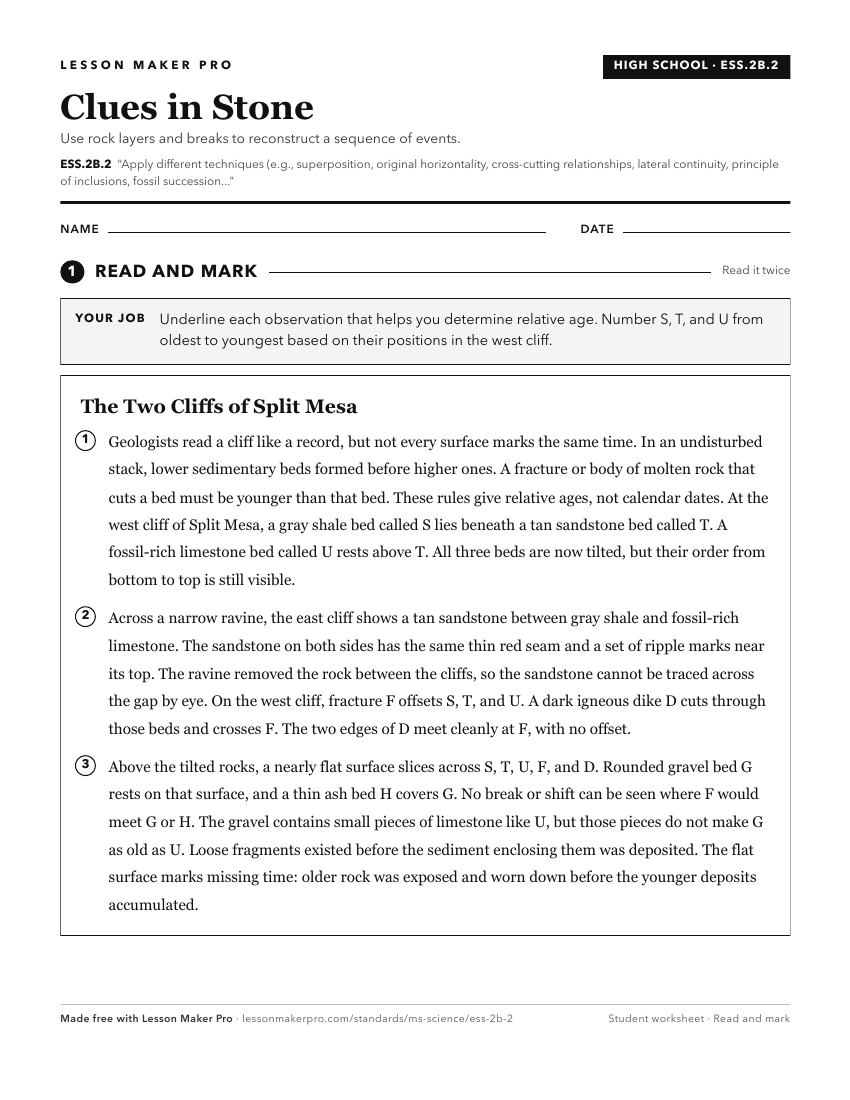
A ready-to-print activity worksheet aligned to ESS.2B.2, with an answer key for the teacher on its own page. No account needed.
PDF, US Letter, prints cleanly in black and white.
Download the worksheetKeep exploring
Related Standards
- FB.5.2
Analyze and interpret data to support claims that different types of fossils provide evidence of the diversity of life that has existed on Earth and of the rela...
- E.3.7A.2
Develop and use models to demonstrate the processes involved in the development of various rock formations, including superposition, and how those formations ca...
- E.8.7.1
Use scientific evidence to create a timeline of Earth’s history that depicts relative dates from index fossil records and layers of rock (strata).
- ESS.2B.3
Use mathematical concepts to calculate the absolute age of Earth materials using actual or simulated isotope ratios.
Turn this exact standard into a lesson
Grade, subject, topic, and the complete standard are prefilled. Create one free, no account needed.
Also for this standard:Make a WorksheetMake a QuizMake a Sub Lesson