Mississippi Science E.3.7B.1
The Standard
- E.3.7B
- Students will demonstrate an understanding of the composition of Earth and the processes which change Earth's landforms.
Obtain and evaluate scientific information (e.g., using technology) to describe the four major layers of Earth and the varying compositions of each layer.
2026 Mississippi College- and Career-Readiness Standards for Science · Earth’s Structure and History
Teacher's field guide
What This Standard Means
What Students Need to Do
- Students use science sources to identify Earth's four layers. They describe what each layer is made of and check whether a source's claims are accurate.
What Mastery Looks Like
- Students label the layers in order: a solid rock crust, a mostly solid rock mantle, a liquid iron and nickel outer core, and a solid iron and nickel inner core. They use a science source to correct a false claim about a layer.
Common Misconceptions
- Students may think the whole mantle is liquid lava. They may mix up the liquid outer core and solid inner core, or trust a colorful diagram without checking its claims.
How to Assess It
- Exit ticket: Label a blank Earth diagram and write each layer's main material and whether it is solid or liquid. Use a science source from the lesson to explain why the claim 'The whole mantle is liquid' is wrong.
Lesson moves
Ways to Teach It
Build a cutaway Earth from four colors of modeling clay, then add material and solid-or-liquid labels to each layer.
Compare a NASA Earth layers page with an unsigned cartoon; write which source you trust for the mantle's material and why.
Deal cards naming layers, materials, and solid or liquid states; have pairs race to build four correct sets.
Show a photo of a volcanic eruption and ask why seeing lava does not mean the whole mantle is liquid.
Free download
Printable E.3.7B.1 Worksheet
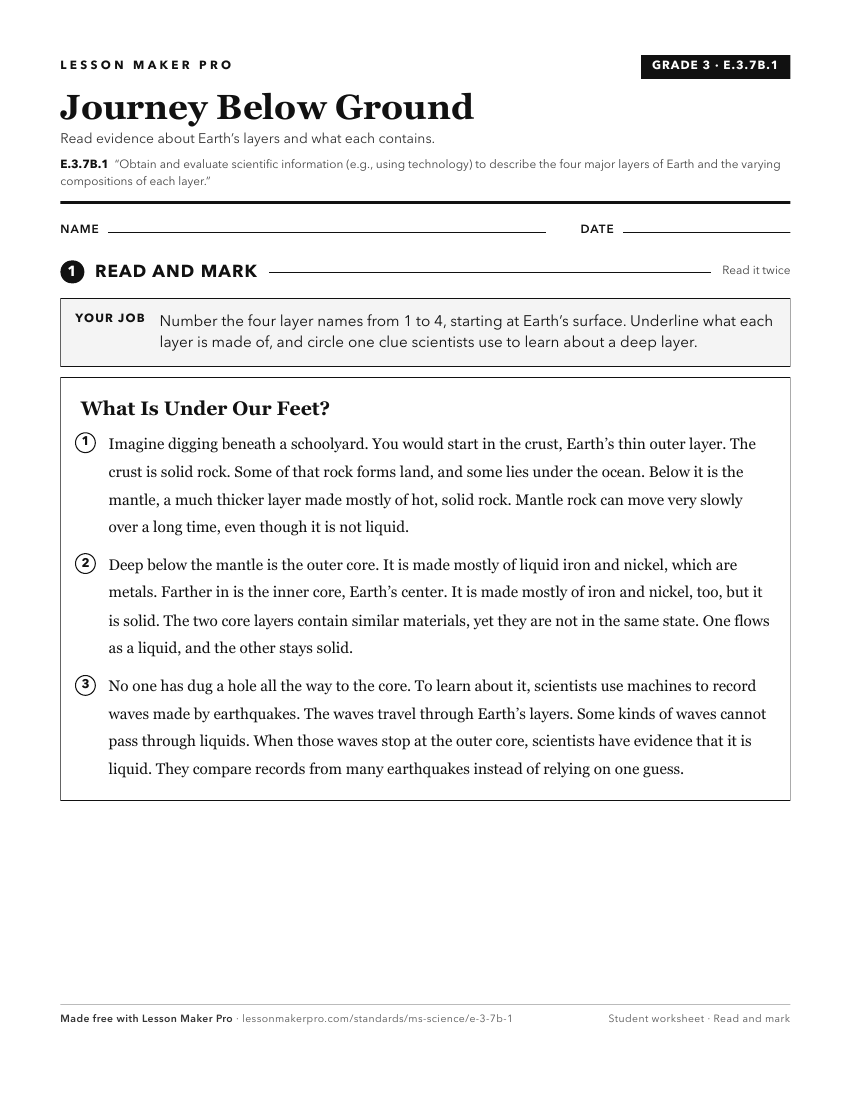
A ready-to-print activity worksheet aligned to E.3.7B.1, with an answer key for the teacher on its own page. No account needed.
PDF, US Letter, prints cleanly in black and white.
Download the worksheetKeep exploring
Related Standards
- E.3.7A.1
Plan and conduct controlled scientific investigations to identify the processes involved in forming the three major types of rock, and investigate common techni...
- ESS.2A.2
Analyze and interpret data to explain and communicate the differentiation of Earth’s physical divisions (e.g., lithosphere and asthenosphere) using data from se...
- ESS.2A.1
Analyze and interpret data to explain and communicate the differentiation of Earth’s internal chemical structure (e.g., core, mantle, and crust) using the produ...
- E.2.10.1
Use informational text, other media, and first-hand observations to investigate, analyze, and compare the properties of Earth materials (including rocks, soils,...
Turn this exact standard into a lesson
Grade, subject, topic, and the complete standard are prefilled. Create one free, no account needed.
Also for this standard:Make a WorksheetMake a QuizMake a Sub Lesson