Mississippi Science E.3.7A.1
The Standard
- E.3.7A
- Students will demonstrate an understanding of the various processes involved in the rock cycle, superposition of rock layers, and fossil formation.
Plan and conduct controlled scientific investigations to identify the processes involved in forming the three major types of rock, and investigate common techniques used to identify them.
2026 Mississippi College- and Career-Readiness Standards for Science · Earth’s Structure and History
Teacher's field guide
What This Standard Means
What Students Need to Do
- Students plan a fair test that changes one factor at a time. They investigate models of rock formation and examine real rocks for clues such as grains, crystals, and bands.
What Mastery Looks Like
- A student links cooling to igneous rock, compacted and cemented grains to sedimentary rock, and heat and pressure to metamorphic rock. They use visible clues to identify a rock and explain what stayed the same in their test.
Common Misconceptions
- Students may call every rock with layers sedimentary, even though metamorphic rocks can have bands. They may think metamorphic rocks melt or that a sand-and-glue model becomes real rock overnight.
How to Assess It
- Show photos of granite, sandstone, and gneiss beside two equal sand cups, one prepared with water and one with glue. Ask students to identify each rock using a visible clue and name the factor changed between cups.
Lesson moves
Ways to Teach It
Give pairs equal sand cups prepared with equal volumes of water or glue; have them compare grain bonding after drying.
Show gneiss bands and sandstone layers; ask students to write which formed under heat and pressure and what clues support their answer.
Give teams granite, sandstone, and gneiss samples with hand lenses; have them match each texture to cooling, cementation, or heat and pressure.
Show a granite countertop and slate roof tile; ask how granite's hardness and slate's flat splitting surfaces suit each job.
Free download
Printable E.3.7A.1 Worksheet
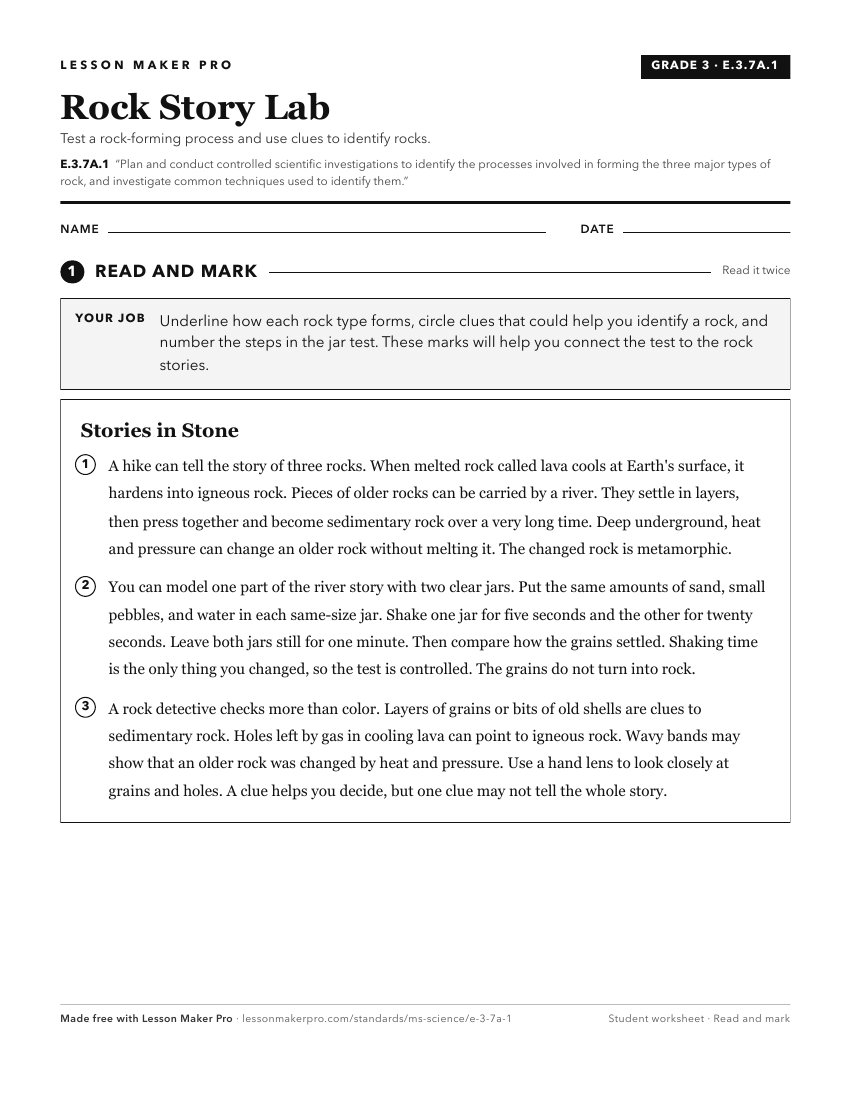
A ready-to-print activity worksheet aligned to E.3.7A.1, with an answer key for the teacher on its own page. No account needed.
PDF, US Letter, prints cleanly in black and white.
Download the worksheetKeep exploring
Related Standards
- ESS.2B.6
Plan and conduct a scientific investigation to determine how factors (e.g., wind velocity, water velocity, ice, and temperature) may affect the rate of weatheri...
- E.3.7A.2
Develop and use models to demonstrate the processes involved in the development of various rock formations, including superposition, and how those formations ca...
- E.8.9A.6
Design and conduct investigations to evaluate the chemical and physical processes involved in the formation of soils.
- ESS.2A.4
Investigate the physical and/or chemical characteristics of rock specimens to identify and categorize igneous, sedimentary, and metamorphic rocks. Include the p...
Turn this exact standard into a lesson
Grade, subject, topic, and the complete standard are prefilled. Create one free, no account needed.
Also for this standard:Make a WorksheetMake a QuizMake a Sub Lesson