Mississippi Science ESS.2A.4
The Standard
- ESS.2A
- Students will develop an understanding of the structure and composition of Earth and its materials.
Investigate the physical and/or chemical characteristics of rock specimens to identify and categorize igneous, sedimentary, and metamorphic rocks. Include the processes that generate the transformation of rocks.
2026 Mississippi College- and Career-Readiness Standards for Science · Earth Structure and History
Teacher's field guide
What This Standard Means
What Students Need to Do
- Students inspect rock samples for crystals, grains, and layers. They use those clues to identify rock types and explain how each formed. They describe how a rock can change into another type.
What Mastery Looks Like
- Students distinguish granite, sandstone, and slate by their textures. They cite a visible clue for each label and explain how cooling, cementation, or heat and pressure produced the rock.
Common Misconceptions
- Students may call every layered rock sedimentary, even though slate's layers formed under pressure. They may think rock must melt to become metamorphic.
How to Assess It
- Set out granite, sandstone, and slate samples. Ask students to choose one, identify its rock type, cite one visible clue, and name the process that formed it.
Lesson moves
Ways to Teach It
Give pairs granite, sandstone, and slate samples, hand lenses, and a sorting mat; have them record texture clues before labeling each rock.
Ask, 'If slate has layers, why isn't it sedimentary?' Have students write two sentences comparing how slate and sandstone formed.
Play rock cycle relay: teams arrange weathering, deposition, cementation, and heat cards between granite, sandstone, and quartzite, then defend their sequence.
Show photos of a granite countertop, sandstone building, and slate roof; ask students which rock properties suit each use.
Free download
Printable ESS.2A.4 Worksheet
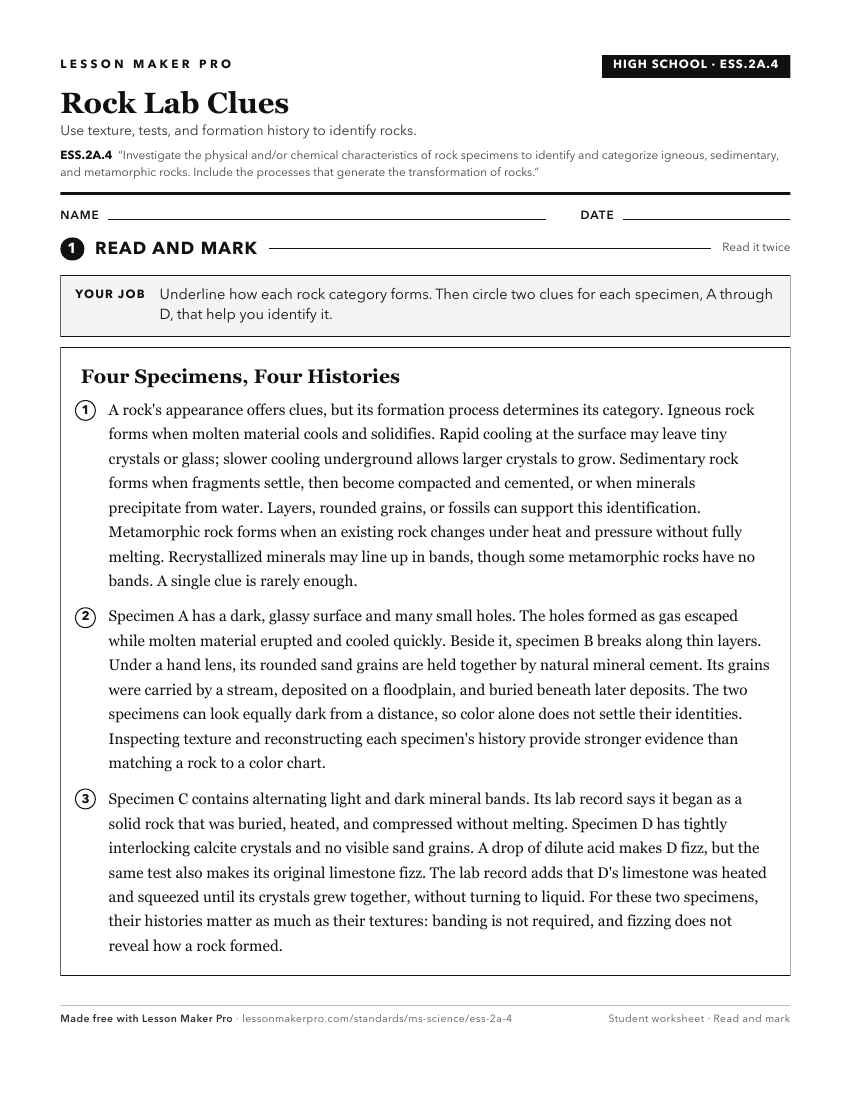
A ready-to-print activity worksheet aligned to ESS.2A.4, with an answer key for the teacher on its own page. No account needed.
PDF, US Letter, prints cleanly in black and white.
Download the worksheetKeep exploring
Related Standards
- E.3.7A.1
Plan and conduct controlled scientific investigations to identify the processes involved in forming the three major types of rock, and investigate common techni...
- P.2.5.1
Conduct a structured investigation to collect, represent, and analyze categorical data to classify matter as solid, liquid, or gas. Report findings and describe...
- P.5.5A.3
Analyze matter through observations and measurements to classify materials (e.g., powders, metals, minerals, or liquids) based on their properties (e.g., color,...
- ESS.2A.3
Investigate the physical and/or chemical characteristics of mineral specimens to identify minerals and mineral deposits/groups (e.g., oxides, carbonates, halide...
Turn this exact standard into a lesson
Grade, subject, topic, and the complete standard are prefilled. Create one free, no account needed.
Also for this standard:Make a WorksheetMake a QuizMake a Sub Lesson