Mississippi Science ESS.2A.3
The Standard
- ESS.2A
- Students will develop an understanding of the structure and composition of Earth and its materials.
Investigate the physical and/or chemical characteristics of mineral specimens to identify minerals and mineral deposits/groups (e.g., oxides, carbonates, halides, sulfides, sulfates, silicates, and phosphates). Include the relationship between chemical bonds, chemical formulas, mineral use, and mineral properties.
2026 Mississippi College- and Career-Readiness Standards for Science · Earth Structure and History
Teacher's field guide
What This Standard Means
What Students Need to Do
- Students test mineral samples for hardness, streak, cleavage, and reaction with vinegar. They use test results and formulas to identify minerals and groups in deposit samples. They explain how bonding relates to a mineral's properties and uses.
What Mastery Looks Like
- Given an unknown sample and its formula, a student identifies calcite by its vinegar reaction and CaCO3, then places it among carbonates. They connect halite's ionic structure to its water solubility and use as road salt.
Common Misconceptions
- Students may call every mineral that contains oxygen an oxide, even when its formula shows a carbonate or sulfate. They may identify pyrite as gold from its color or confuse a streak test with a hardness test.
How to Assess It
- Exit ticket: CaCO3 fizzes with vinegar; NaCl dissolves in water. Name both minerals and groups, then connect NaCl's bonding to its use on icy roads.
Lesson moves
Ways to Teach It
At mineral stations, test quartz, calcite, and halite with a steel nail, vinegar, and water; match each sample to a formula.
Ask: Why does quartz scratch glass but halite dissolve in water? Use SiO2 and NaCl to explain their bonding and properties.
Sort cards with mineral names and formulas for hematite, calcite, halite, pyrite, anhydrite, quartz, and fluorapatite into seven labeled groups.
Show a road salt bag and halite; ask students how NaCl's ionic structure lets it dissolve and lower water's freezing point.
Free download
Printable ESS.2A.3 Worksheet
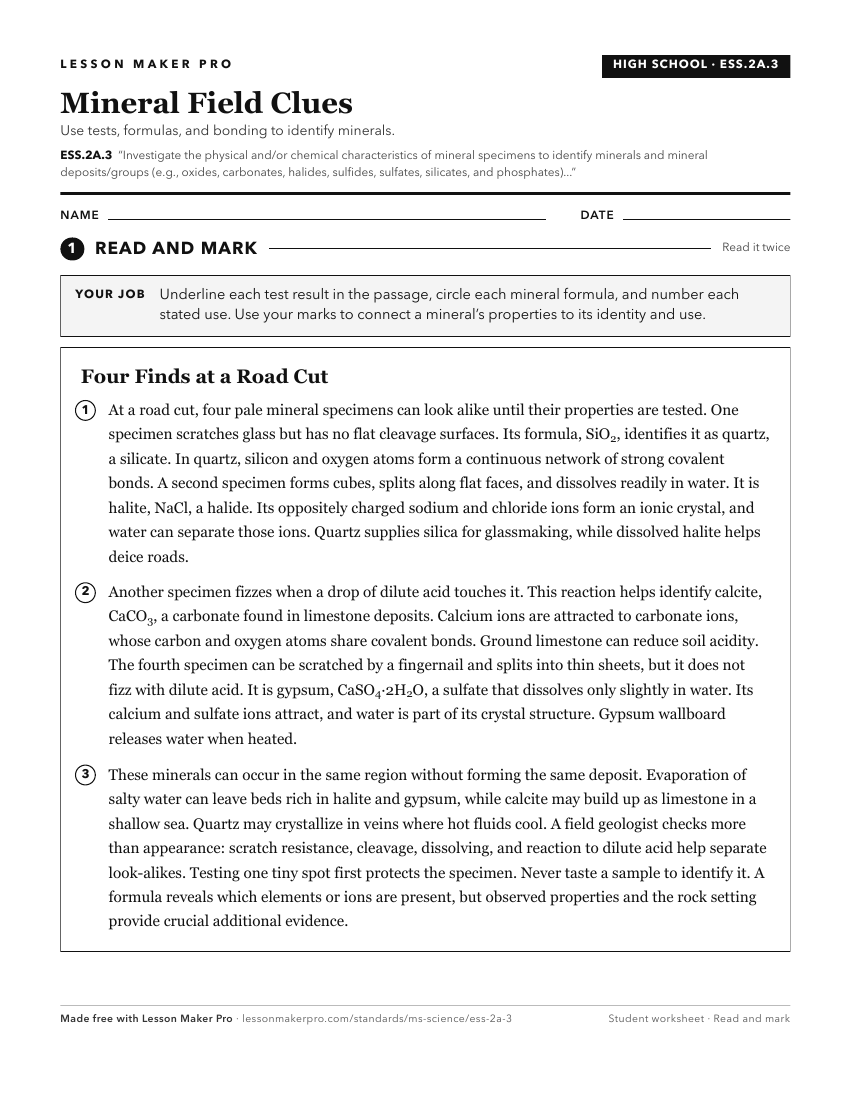
A ready-to-print activity worksheet aligned to ESS.2A.3, with an answer key for the teacher on its own page. No account needed.
PDF, US Letter, prints cleanly in black and white.
Download the worksheetKeep exploring
Related Standards
- P.7.5C.3
Collect, organize, and interpret data from investigations to identify and analyze the relationships between the physical and chemical properties of elements, at...
- P.2.5.1
Conduct a structured investigation to collect, represent, and analyze categorical data to classify matter as solid, liquid, or gas. Report findings and describe...
- P.5.5A.3
Analyze matter through observations and measurements to classify materials (e.g., powders, metals, minerals, or liquids) based on their properties (e.g., color,...
- ESS.2A.4
Investigate the physical and/or chemical characteristics of rock specimens to identify and categorize igneous, sedimentary, and metamorphic rocks. Include the p...
Turn this exact standard into a lesson
Grade, subject, topic, and the complete standard are prefilled. Create one free, no account needed.
Also for this standard:Make a WorksheetMake a QuizMake a Sub Lesson