Mississippi Science ESS.1A.2
The Standard
- ESS.1A
- Students will develop an understanding of the universe, its development, immense size, and composition.
Interpret information from the Hertzsprung -Russell diagram to differentiate types of stars, including our sun, according to size, magnitude, and classification.
2026 Mississippi College- and Career-Readiness Standards for Science · Earth in the Universe
Teacher's field guide
What This Standard Means
What Students Need to Do
- Students read temperature, spectral class, and absolute magnitude on an H-R diagram. They use a star's position to compare its size and identify main-sequence stars, giants, supergiants, and white dwarfs, including the Sun.
What Mastery Looks Like
- A student locates the Sun as a G-type main-sequence star. They explain why a cool, bright giant is larger than a hot, dim white dwarf, using both axes as evidence.
Common Misconceptions
- Students may think red stars are hotter than blue stars. They may also read a lower absolute magnitude number as dimmer, or assume every hot star is large.
How to Assess It
- On a labeled H-R diagram, circle the Sun, a red giant, and a white dwarf. Ask students to name each type and rank them by size, using temperature and absolute magnitude to explain their ranking.
Lesson moves
Ways to Teach It
Give pairs star cards with temperature and absolute magnitude; have them place sticky notes on a printed H-R diagram and label each star group.
Ask students to write two sentences explaining how a cool red giant can be brighter than a hot white dwarf.
Post four star-group signs; point to stars on an H-R diagram and have students move to the matching sign.
Show a sky chart of Sirius and Betelgeuse; compare how bright they look from Earth with their absolute magnitudes on an H-R diagram.
Free download
Printable ESS.1A.2 Worksheet
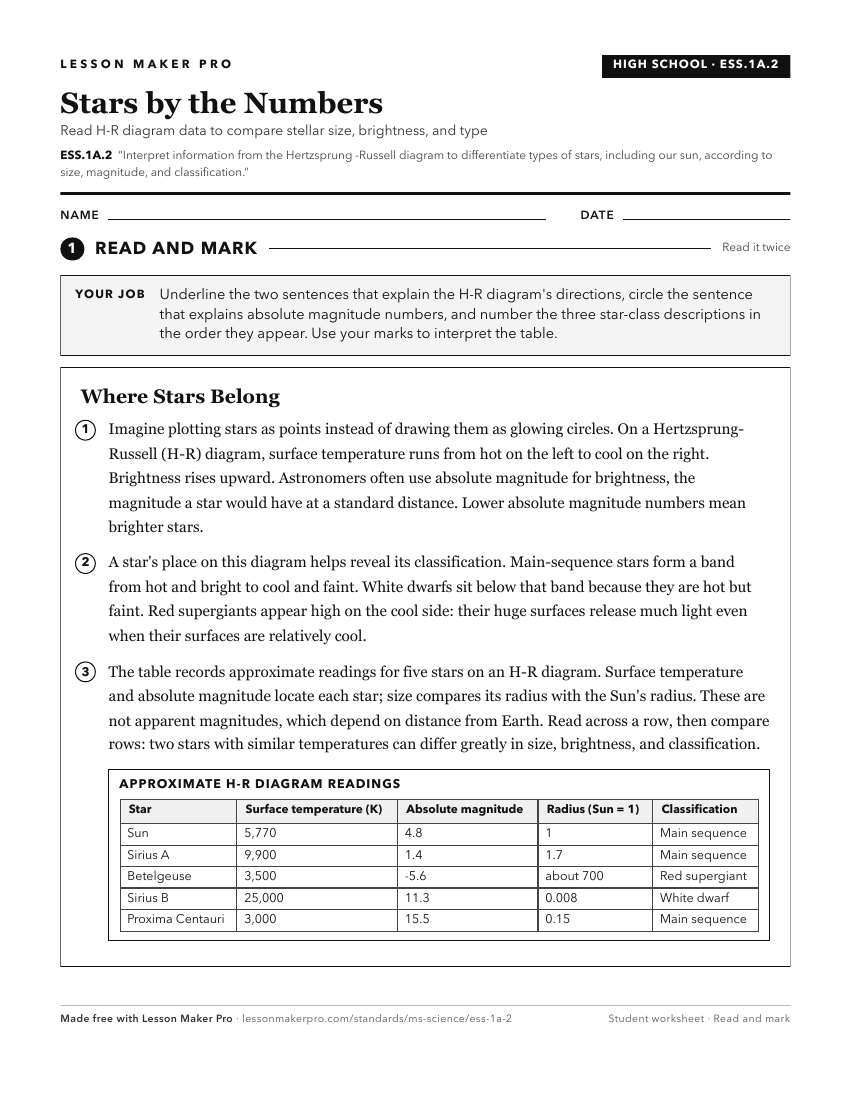
A ready-to-print activity worksheet aligned to ESS.1A.2, with an answer key for the teacher on its own page. No account needed.
PDF, US Letter, prints cleanly in black and white.
Download the worksheetKeep exploring
Related Standards
- E.5.8B.4
Obtain information and analyze how our understanding of the solar system has evolved over time (e.g., Earth-centered model of Aristotle and Ptolemy compared to ...
- ESS.1A.3
Organize and interpret data sets for patterns and trends to compare and contrast stellar evolution in order to explain and communicate how a star changes during...
- E.6.8.7
Analyze and interpret data from the surface features of the Sun (e.g., photosphere, corona, sunspots, prominences, and solar flares) to predict how these featur...
- E.2.8.1
Recognize that there are many stars that can be observed in the night sky and the Sun is the Earth’s closest star.
Turn this exact standard into a lesson
Grade, subject, topic, and the complete standard are prefilled. Create one free, no account needed.
Also for this standard:Make a WorksheetMake a QuizMake a Sub Lesson