Mississippi Science E.6.8.7
The Standard
- E.6.8
- Students will demonstrate an understanding of Earth’s place in the universe and the interactions of the solar system (sun, planets, their moons, comets, and asteroids) using evidence from multiple scientific resources to explain how these objects are held in orbit around the Sun because of its gravitational pull.
Analyze and interpret data from the surface features of the Sun (e.g., photosphere, corona, sunspots, prominences, and solar flares) to predict how these features may affect Earth.
2026 Mississippi College- and Career-Readiness Standards for Science · Earth and the Universe
Teacher's field guide
What This Standard Means
What Students Need to Do
- Students read solar images and simple records of sunspots and flares. They use the data to predict possible effects on Earth's radio signals and satellites. They explain that solar material reaching Earth can also cause auroras.
What Mastery Looks Like
- A student can identify the photosphere, corona, sunspots, prominences, and flares in images. They can use a rise in sunspot counts or a reported flare to explain a possible effect on Earth without claiming it will happen.
Common Misconceptions
- Students may think sunspots are holes rather than cooler, darker areas. They may confuse a prominence with a flare or assume every flare causes an outage on Earth.
How to Assess It
- Give students this exit ticket: Sunspot counts rose from 8 to 24 over three days, and a flare was recorded. What might happen to radio communication on Earth, and why is it not certain?
Lesson moves
Ways to Teach It
Have pairs mark sunspots on three dated solar photos with sticky dots, then plot each day's count on grid paper.
Ask: If sunspot counts rise, can you promise a radio blackout? Use the graph to defend your answer.
Play a card match with photos of the photosphere, corona, sunspots, prominences, and flares; students pair each with a visual clue.
Hand out a printed NOAA space weather alert; students write a one-sentence note to a satellite operator about the reported risk.
Free download
Printable E.6.8.7 Worksheet
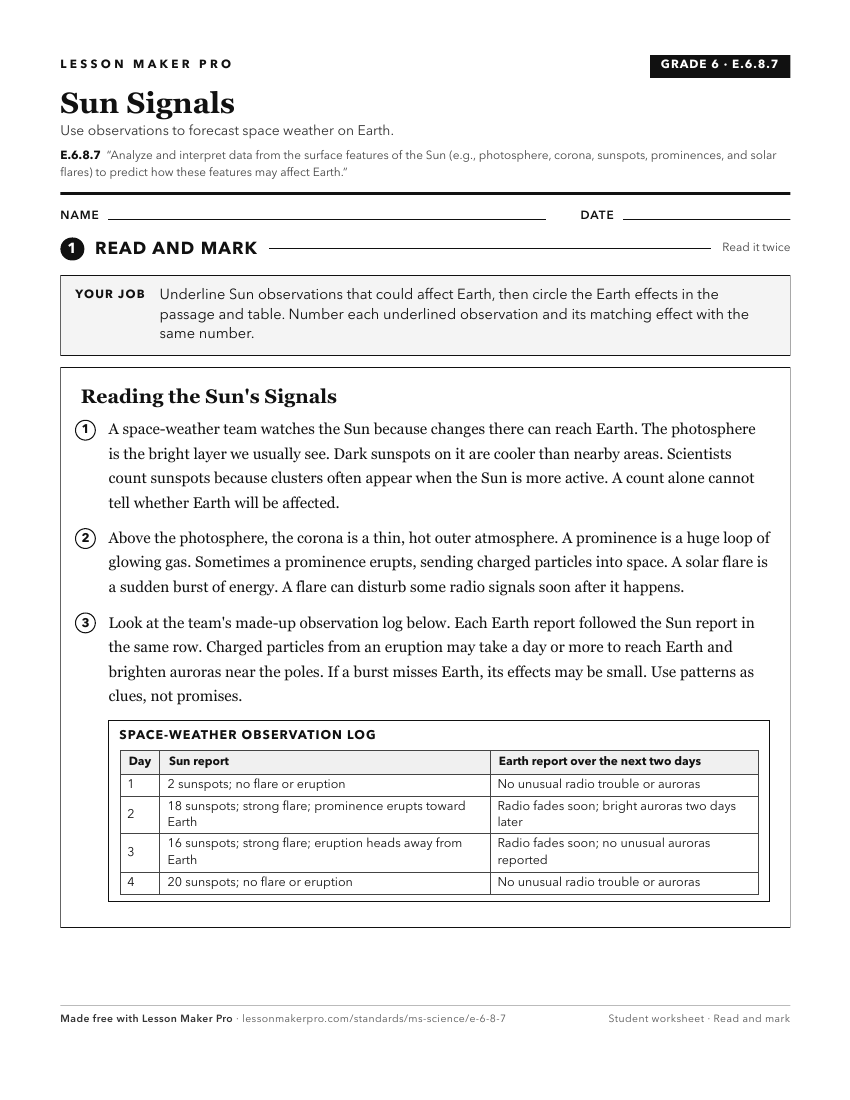
A ready-to-print activity worksheet aligned to E.6.8.7, with an answer key for the teacher on its own page. No account needed.
PDF, US Letter, prints cleanly in black and white.
Download the worksheetKeep exploring
Related Standards
- ESS.2A.2
Analyze and interpret data to explain and communicate the differentiation of Earth’s physical divisions (e.g., lithosphere and asthenosphere) using data from se...
- E.4.9B.1
Analyze and interpret data (e.g., temperature, precipitation, wind speed/direction, relative humidity, or cloud types) to predict changes in weather over time.
- E.7.9A.5
Analyze models to explain the cause and effect relationship between solar energy and convection and the resulting weather patterns and climate conditions.
- E.4.9C.1
Analyze and interpret data to describe (i.e., NASA, NOAA, USGS) and predict how natural processes (e.g., weathering, erosion, deposition, earthquakes, tsunamis,...
Turn this exact standard into a lesson
Grade, subject, topic, and the complete standard are prefilled. Create one free, no account needed.
Also for this standard:Make a WorksheetMake a QuizMake a Sub Lesson