Mississippi Science PHS.5.8
The Standard
- PHS.5
- Students will analyze the scientific principles of motion, force, and work.
Research the efficiency of everyday machines and debate ways to improve their economic impact on society (e.g., electrical appliances, transportation vehicles).
2026 Mississippi College- and Career-Readiness Standards for Science · Newton’s Laws of Motion
Teacher's field guide
What This Standard Means
What Students Need to Do
- Students compare the useful output of everyday machines with the energy they use. They research purchase and running costs, then debate which changes would save money for households or schools.
What Mastery Looks Like
- Given two bulbs with similar brightness, a student uses watts, hours, and an electricity rate to calculate running costs. They use those figures and purchase prices to explain who pays more up front and who saves over time.
Common Misconceptions
- Students may assume a lower-watt bulb must be dimmer instead of checking lumens. They may compare purchase prices alone or assume energy savings always cover a higher purchase price.
How to Assess It
- Exit ticket: Two 800-lumen bulbs use 60 W and 9 W for 1,000 hours at $0.20 per kWh. Calculate each electricity cost, then recommend one for a school if the 9 W bulb costs $3 more.
Lesson moves
Ways to Teach It
Have pairs test an LED and an incandescent bulb in the same lamp with a plug-in watt meter, then check each bulb's lumen label.
Debate whether the school should replace working bulbs now or wait until they burn out, using bulb prices and measured watts.
Give pairs four bulb price cards and an electricity-rate card; have them rank total costs for 1,000 hours at equal brightness.
Use a sample electricity bill and an LED box to estimate a family's yearly cost for a lamp used three hours daily.
Free download
Printable PHS.5.8 Worksheet
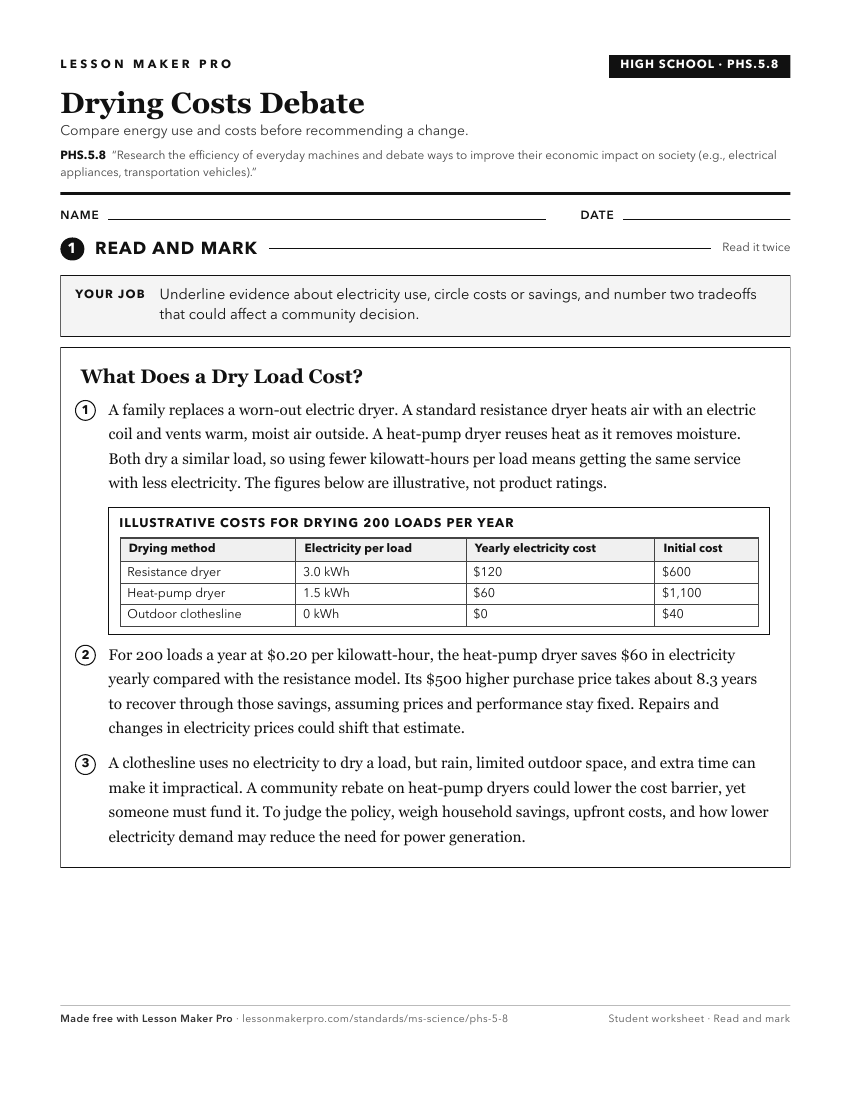
A ready-to-print activity worksheet aligned to PHS.5.8, with an answer key for the teacher on its own page. No account needed.
PDF, US Letter, prints cleanly in black and white.
Download the worksheetKeep exploring
Related Standards
- P.6.6.3
Investigate and communicate ways to manipulate applied/frictional forces to improve movement of objects on various surfaces (e.g., athletic shoes, wheels on car...
- ENV.2.2
Investigate and research the pros and cons of using traditional sources of energy (e.g., fossil fuels) and alternative sources of energy (e.g., water, wind, geo...
- PHY.3.10
Enrichment: Research the efficiency of everyday machines (e.g., automobiles, hair dryers, refrigerators, and washing machines).
- E.8.10.3
Using scientific data, debate the societal advantages and disadvantages of technological advancements in renewable energy sources.
Turn this exact standard into a lesson
Grade, subject, topic, and the complete standard are prefilled. Create one free, no account needed.
Also for this standard:Make a WorksheetMake a QuizMake a Sub Lesson