Mississippi Science PHS.5.3
The Standard
- PHS.5
- Students will analyze the scientific principles of motion, force, and work.
Collect, organize, and interpret graphical data using correct metric units to determine the average speed of an object.
2026 Mississippi College- and Career-Readiness Standards for Science · Newton’s Laws of Motion
Teacher's field guide
What This Standard Means
What Students Need to Do
- Students time an object as it travels measured distances and record the results in a table. They graph distance against time with metric units, then divide total distance by total time to find average speed.
What Mastery Looks Like
- A student puts time on the horizontal axis and distance on the vertical axis, with units on both. They calculate average speed for the whole trip in m/s and recognize that a steeper graph segment shows faster movement.
Common Misconceptions
- Students may divide time by distance or put the units on the wrong axes. They may average the speeds of two parts of a trip without accounting for how long each part lasted.
How to Assess It
- Give students these data: 0 m at 0 s, 4 m at 2 s, and 10 m at 6 s. Ask them to graph the points with labeled axes and calculate the trip’s average speed in m/s.
Lesson moves
Ways to Teach It
Roll a toy car past tape marks at 0, 1, and 2 m; record arrival times with a stopwatch and graph the results.
Draw two distance-time graphs on the board, one steeper than the other, and ask students to explain which object moves faster.
Give pairs distance-time table cards and graph cards; have them match each pair and calculate its average speed in m/s.
Give students a runner’s 400 m track lap time of 100 s; ask for the runner’s average speed and whether it was constant.
Free download
Printable PHS.5.3 Worksheet
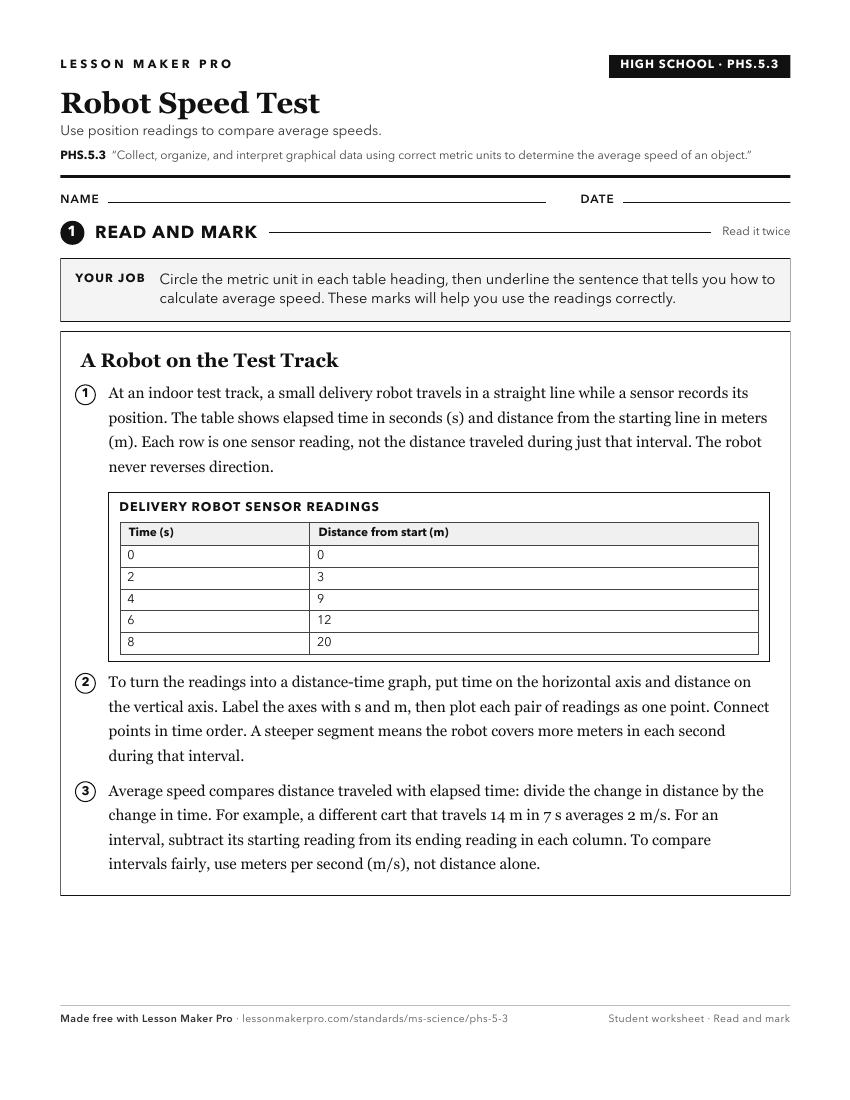
A ready-to-print activity worksheet aligned to PHS.5.3, with an answer key for the teacher on its own page. No account needed.
PDF, US Letter, prints cleanly in black and white.
Download the worksheetKeep exploring
Related Standards
- P.6.6.5
Conduct investigations to predict and explain the motion of an object according to its position, direction, speed, and acceleration.
- P.5.5A.2
Collect, analyze, and interpret data from measurements of the physical properties of solids, liquids, and gases (e.g., volume, shape, movement, and spacing of p...
- P.2.5.2
Compare and measure the length of solid objects using technology and mathematical representations. Analyze and communicate findings.
- PHY.1.6
Design and mathematically/graphically analyze quantitative data to explore displacement, velocity, and acceleration of various objects. Use probe systems, video...
Turn this exact standard into a lesson
Grade, subject, topic, and the complete standard are prefilled. Create one free, no account needed.
Also for this standard:Make a WorksheetMake a QuizMake a Sub Lesson