Mississippi Science FB.2.6
The Standard
- FB.2
- Students will demonstrate an understanding of the structure and interactions of matter and how the organization of matter supports living organisms.
Explain the role of the major biomolecules (carbohydrates, proteins -including enzymes, lipids, and nucleic acids) to the survival of living organisms.
2026 Mississippi College- and Career-Readiness Standards for Science · The Chemistry of Life
Teacher's field guide
What This Standard Means
What Students Need to Do
- Students explain how carbohydrates supply energy, lipids build membranes and store energy, proteins build cell parts and act as enzymes, and nucleic acids hold instructions. They connect each job to a cell's survival.
What Mastery Looks Like
- Given four cell needs, students match sugar to quick energy, a lipid to a membrane, DNA to protein instructions, and an enzyme to a reaction. They explain that an enzyme can help with another reaction because it is not used up.
Common Misconceptions
- Students may think enzymes are used up in reactions or that every protein is an enzyme. Some think DNA supplies energy, or that fats have no useful role in cells.
How to Assess It
- On an exit ticket, list four cell needs: quick energy, a faster reaction, a membrane, and instructions for making proteins. Ask students to name the biomolecule for each and explain one match.
Lesson moves
Ways to Teach It
Give pairs paper cutouts of a sugar chain, enzyme, membrane lipid, and DNA strand; have them build a chart showing each cell job.
Ask, 'Why might a cell with plenty of food still struggle if its enzymes stopped working?' Have students write two sentences.
Label four corners with biomolecule names; read job cards such as 'speeds digestion' and 'stores genetic instructions' for students to sort.
Compare a sports drink label with a peanut butter label; have students identify carbohydrates and fats, then explain each nutrient's energy role.
Free download
Printable FB.2.6 Worksheet
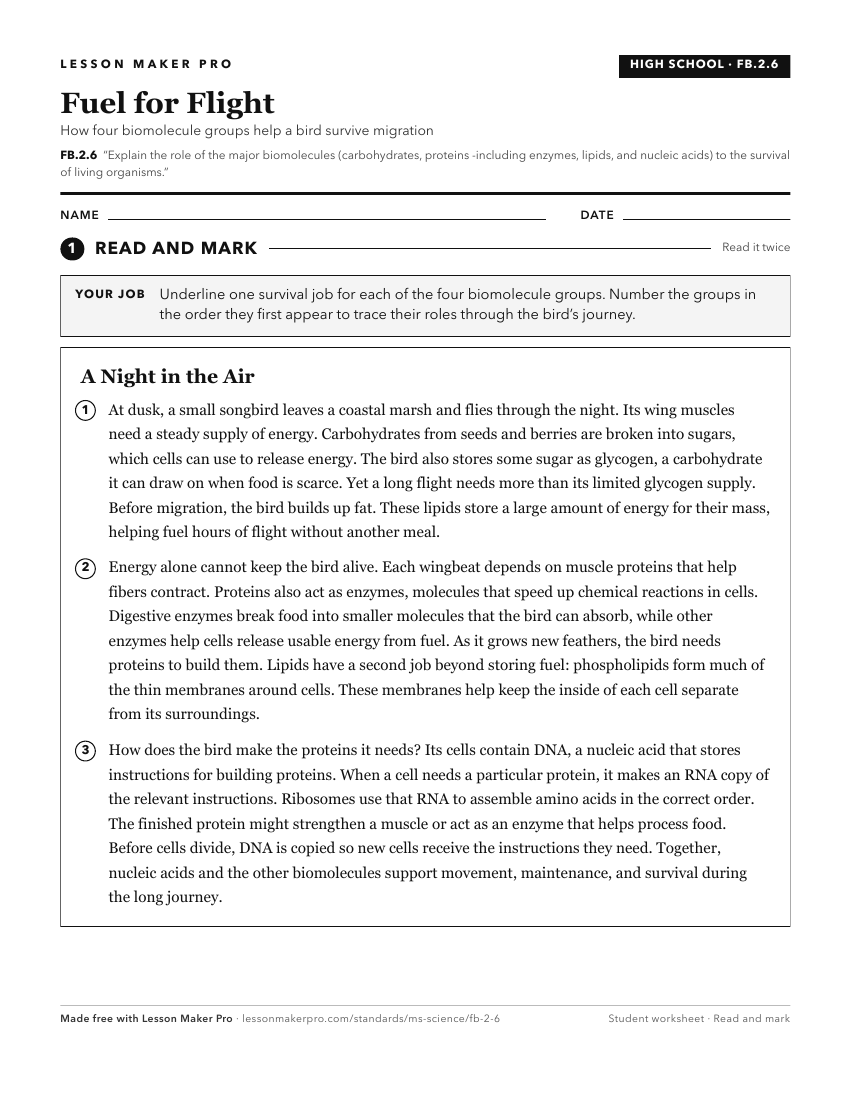
A ready-to-print activity worksheet aligned to FB.2.6, with an answer key for the teacher on its own page. No account needed.
PDF, US Letter, prints cleanly in black and white.
Download the worksheetKeep exploring
Related Standards
- BIO.1B.1
Develop and use models to compare and contrast the structure and function of carbohydrates, lipids, proteins, and nucleic acids (DNA and RNA) in organisms.
- L.6.3.1
Use scientific reasoning to explain differences between biotic and abiotic factors that demonstrate what living organisms need to survive.
- MAQ.1.2
Describe the role of water within biological systems (e.g., provides the medium necessary to allow for life processes such as protein synthesis, enzymatic react...
- FB.2.7
Enrichment: Explore the structure of biomolecules using molecular models. Relate the structure of biomolecules to their function in living things (discuss types...
Turn this exact standard into a lesson
Grade, subject, topic, and the complete standard are prefilled. Create one free, no account needed.
Also for this standard:Make a WorksheetMake a QuizMake a Sub Lesson