Mississippi Science BIO.1A.3
The Standard
- BIO.1A
- Students will demonstrate an understanding of the characteristics of life and biological organization.
Using specific examples, explain how cells can be organized into complex tissues, organs, and organ systems in multicellular organisms.
2026 Mississippi College- and Career-Readiness Standards for Science · Cells as a System
Teacher's field guide
What This Standard Means
What Students Need to Do
- Students trace a specialized cell through a tissue, organ, and organ system. They explain how the parts work together to do a job.
What Mastery Looks Like
- A student can link a cardiac muscle cell to heart muscle tissue, the heart, and the circulatory system. They can explain how the muscle tissue helps the heart pump blood.
Common Misconceptions
- Students may think a tissue and an organ are the same thing, or that an organ contains only one type of tissue. Some think a single cell can do the whole job of an organ.
How to Assess It
- Exit ticket: Starting with a cardiac muscle cell, name its tissue, organ, and organ system. Tell how each level helps move blood.
Lesson moves
Ways to Teach It
Give pairs cards labeled cardiac muscle cell, heart muscle tissue, heart, and circulatory system; have them arrange the cards and explain each link.
Ask students to write why a single cardiac muscle cell cannot pump blood through the body, but a heart can.
Have teams race to order cards showing an intestinal lining cell, epithelial tissue, small intestine, and digestive system, then explain their order.
Show a scraped-knee photo and ask how damaged epidermal cells affect epithelial tissue, the skin, and the integumentary system.
Free download
Printable BIO.1A.3 Worksheet
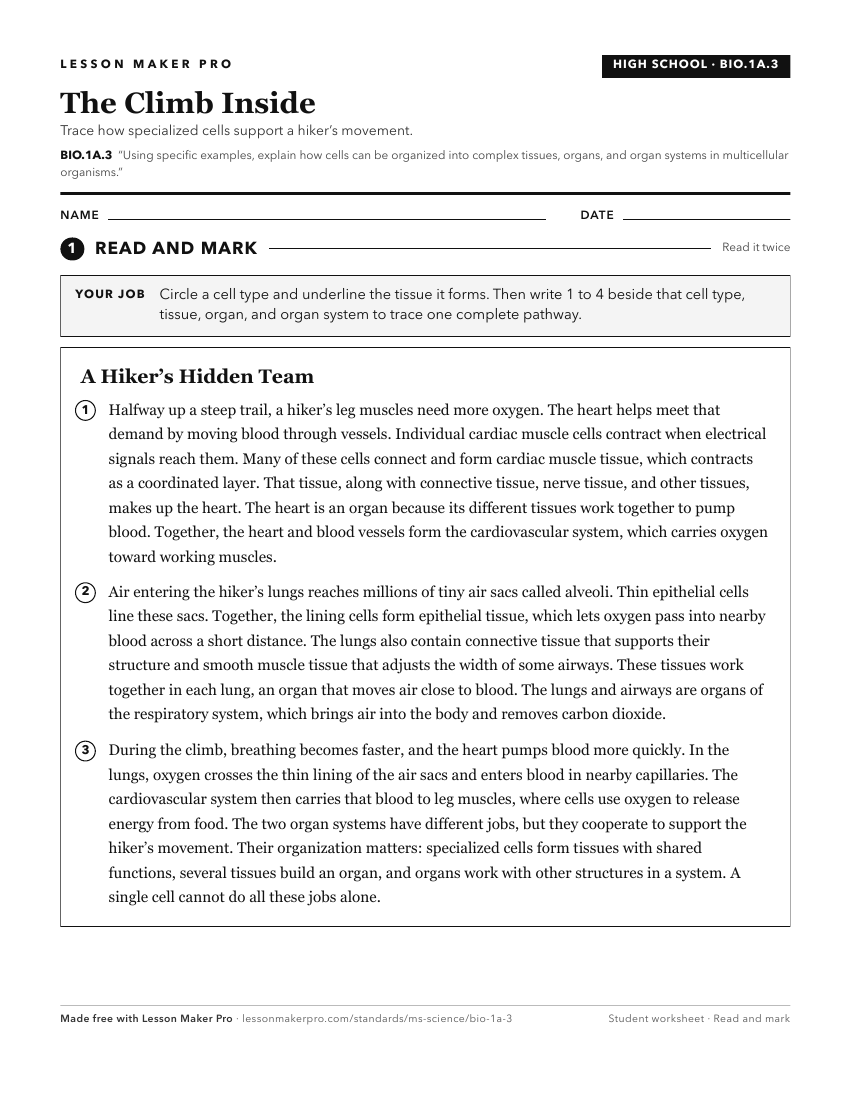
A ready-to-print activity worksheet aligned to BIO.1A.3, with an answer key for the teacher on its own page. No account needed.
PDF, US Letter, prints cleanly in black and white.
Download the worksheetKeep exploring
Related Standards
- HAP.2.2
Construct a model to demonstrate how the structural organization of cells in a tissue relates to the specialized function of that tissue.
- L.6.1.6
Develop and use models to show relationships among the increasing complexity of multicellular organisms (cells, tissues, organs, organ systems, organisms) and h...
- HAP.2
Students will demonstrate an understanding of the relationship of cells and tissues that form complex structures of the body.
- BIO.1E.1
Construct models to explain how the processes of cell division and cell differentiation produce and maintain complex multicellular organisms.
Turn this exact standard into a lesson
Grade, subject, topic, and the complete standard are prefilled. Create one free, no account needed.
Also for this standard:Make a WorksheetMake a QuizMake a Sub Lesson