Mississippi Science HAP.2
Standard Cluster
Students will demonstrate an understanding of the relationship of cells and tissues that form complex structures of the body. Analyze the characteristics of the four main tissue types: epithelial, connective, muscle, and nervous. Examine tissues using microscopes and other various technologies. Construct a model to demonstrate how the structural organization of cells in a tissue relates to the specialized function of that tissue. Enrichment: Use an engineering design process to research and develop medications (i.e., targeted cancer therapy drugs) that target uncontrolled cancer cell reproduction. *
2026 Mississippi College- and Career-Readiness Standards for Science · Cells and Tissues
Cluster contents
Standards in This Cluster
HAP.2 is a cluster heading. These are the individual standards under it.
- HAP.2.1
Analyze the characteristics of the four main tissue types: epithelial, connective, muscle, and nervous. Examine tissues using microscopes and other various tech...
- HAP.2.2
Construct a model to demonstrate how the structural organization of cells in a tissue relates to the specialized function of that tissue.
- HAP.2.3
Enrichment: Use an engineering design process to research and develop medications (i.e., targeted cancer therapy drugs) that target uncontrolled cancer cell rep...
Teacher's field guide
What This Cluster Means
What Students Need to Do
- Students identify epithelial, connective, muscle, and nervous tissue in slides or images. They compare how cells are arranged and build a model showing how one arrangement helps a tissue do its job.
What Mastery Looks Like
- A student can identify the four tissue types from clear microscope images and point to features that support each choice. Their model shows a feature, such as layers of epithelial cells, and explains how it helps form a barrier.
Common Misconceptions
- Students may call tendon muscle because both show parallel fibers. They may mistake the material around connective tissue cells for empty space. Some think one cell counts as a tissue.
How to Assess It
- Show four unlabeled images of intestinal lining, tendon, skeletal muscle, and spinal cord. Ask students to name each tissue type and explain how one visible feature helps that tissue work.
Lesson moves
Ways to Teach It
View prepared slides of skin, tendon, skeletal muscle, and spinal cord, then arrange clay cells to model one tissue's job.
Show images of tendon and skeletal muscle; ask, "How does each arrangement help it resist pulling or create movement?"
Give pairs four unlabeled tissue images and clue cards; have them match each image to a tissue type and defend one match.
Show a photo of a healing cut; ask which tissue covers the wound and which tissue supports it underneath.
Free download
Printable HAP.2 Worksheet
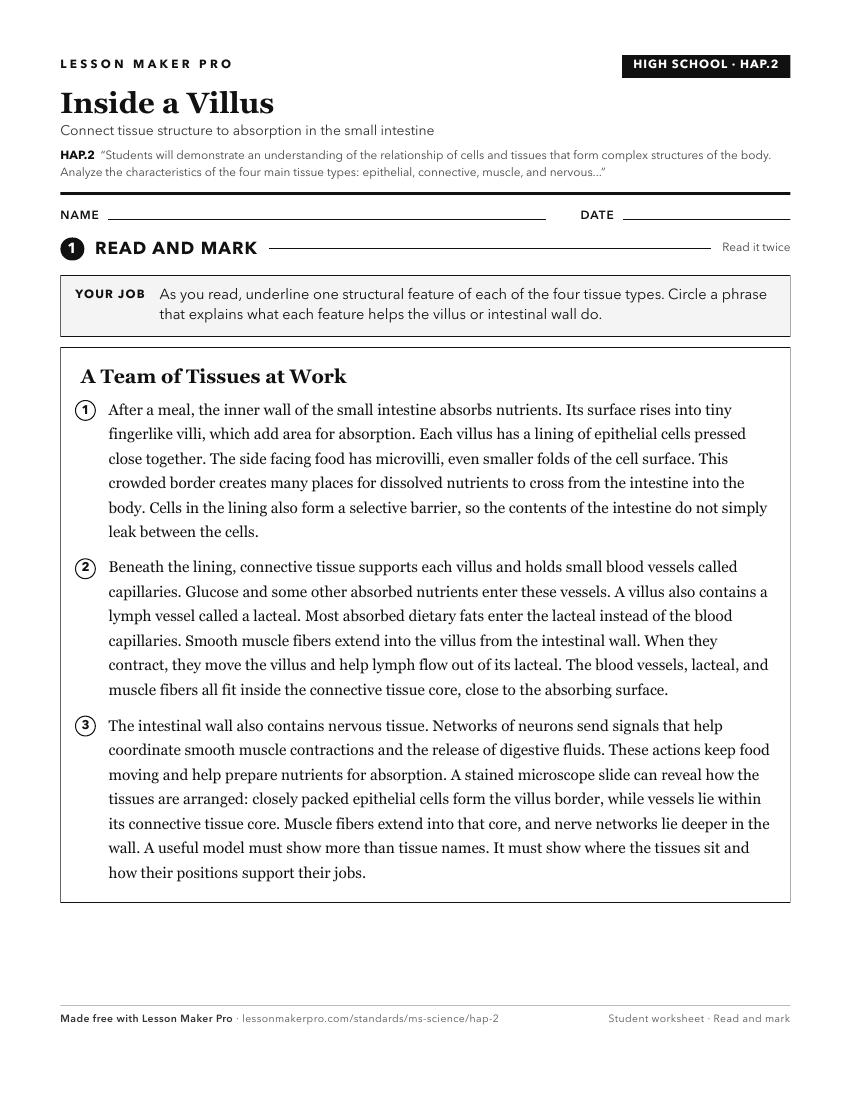
A ready-to-print activity worksheet aligned to HAP.2, with an answer key for the teacher on its own page. No account needed.
PDF, US Letter, prints cleanly in black and white.
Download the worksheetKeep exploring
Related Standards
- FB.3
Students will demonstrate an understanding of how the structure of living organisms supports the essential functions of life.
- L.4.1
Students will demonstrate an understanding of the organization, functions, and interconnections of the major human body systems.
- BIO.1A
Students will demonstrate an understanding of the characteristics of life and biological organization.
- FB.2
Students will demonstrate an understanding of the structure and interactions of matter and how the organization of matter supports living organisms.
Turn this cluster into a lesson
Grade, subject, topic, and the complete cluster are prefilled. Create one free, no account needed.
Also for this cluster:Make a WorksheetMake a QuizMake a Sub Lesson