Mississippi Science L.8.4B.3
The Standard
- L.8.4B
- Students will demonstrate an understanding of how similarities and differences among living and extinct species provide evidence that changes have occurred in organisms over time and that similarity of characteristics provides evidence of common ancestry.
Obtain and evaluate scientific information to explain that separated populations, which remain separated, can evolve through mutations to become a new species (speciation).
2026 Mississippi College- and Career-Readiness Standards for Science · Adaptation and Diversity
Teacher's field guide
What This Standard Means
What Students Need to Do
- Students read reports about populations kept apart. They trace how inherited mutations add traits that can spread over generations. They check whether the evidence supports a claim that the groups became separate species.
What Mastery Looks Like
- A student can explain how separation and inherited changes can lead to new species over many generations. They can use breeding records to support the claim, rather than relying on differences in appearance alone.
Common Misconceptions
- Students may think an animal mutates because it needs to survive, or that one mutation creates a new species overnight. They may assume groups are separate species just because they live on different islands or look different.
How to Assess It
- Exit ticket: An unsigned post says two island lizard groups are different species because they look different. A field study reports long separation, inherited differences, and no fertile offspring from crossbreeding. Which source gives stronger evidence, and what two facts support your answer?
Lesson moves
Ways to Teach It
Model two isolated populations with colored beads; add a new color by mutation card and apply different survival rules for five generations.
Give pairs an unsigned claim and a field report on isolated lizards; ask which better supports speciation and what evidence is missing.
Give groups six population history cards; have them sort cases with isolation, inherited differences, and failed breeding from cases showing only different appearances.
Show a printed Galápagos finch range map and beak measurements; ask whether those alone prove separate species and what breeding evidence students need.
Free download
Printable L.8.4B.3 Worksheet
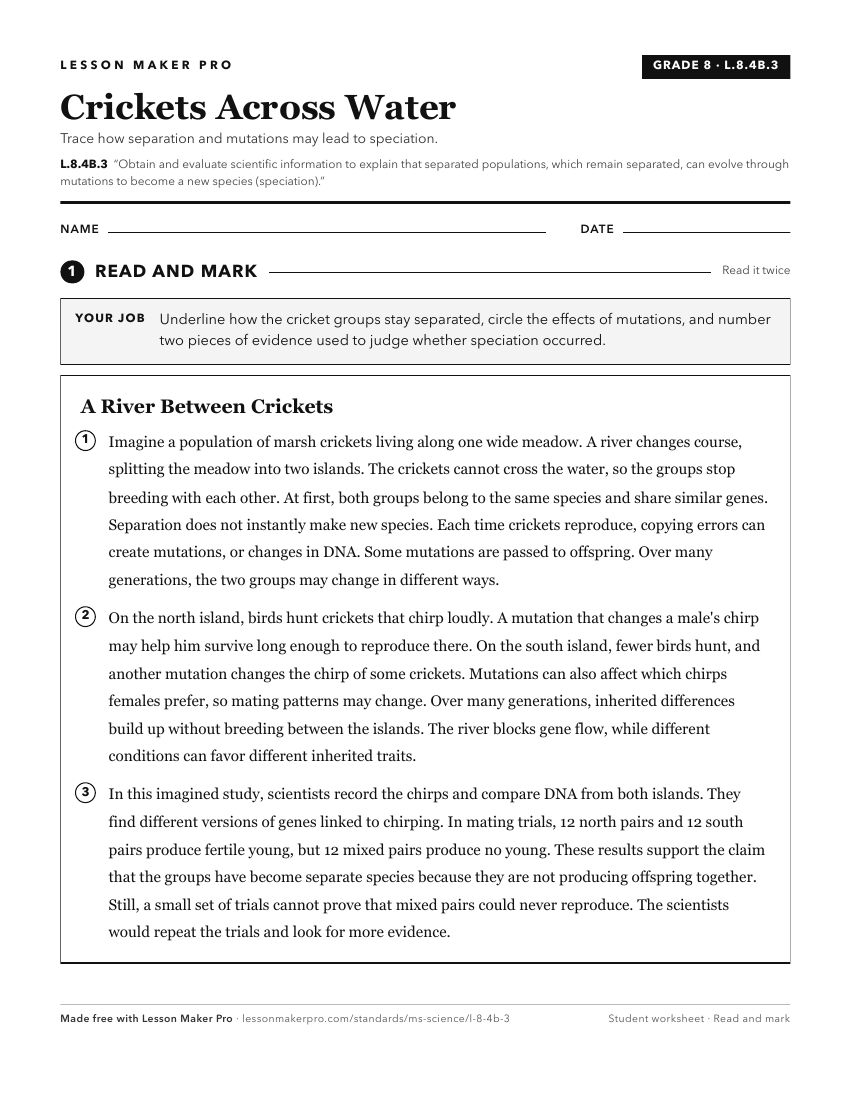
A ready-to-print activity worksheet aligned to L.8.4B.3, with an answer key for the teacher on its own page. No account needed.
PDF, US Letter, prints cleanly in black and white.
Download the worksheetKeep exploring
Related Standards
- FB.5.4
Investigate how biological adaptations and genetic variations of traits in a population enhance the probability of survival in an environment (natural selection...
- BIO.4.6
Construct explanations for the mechanisms of speciation (e.g., geographic, and reproductive isolation).
- ESS.3.8
Analyze and interpret the record of shared ancestry, evolution, and extinction as related to natural selection using fossils.
- FB.5.3
Obtain and communicate information to explain how DNA evidence and fossil records support Darwin’s theory of evolution.
Turn this exact standard into a lesson
Grade, subject, topic, and the complete standard are prefilled. Create one free, no account needed.
Also for this standard:Make a WorksheetMake a QuizMake a Sub Lesson