Mississippi Science BIO.3A
Standard Cluster
Students will develop and use models to explain the role of meiosis in the production of haploid gametes required for sexual reproduction. Model sex cell formation (meiosis) and combination (fertilization) to demonstrate the maintenance of chromosome number through each generation in sexually reproducing populations. Explain why the DNA of the daughter cells is different from the DNA of the parent cell. Compare and contrast mitosis and meiosis in terms of reproduction. Investigate chromosomal abnormalities (e.g., Down syndrome, Turner’s syndrome, and Klinefelter syndrome) that might arise from errors in meiosis (nondisjunction) and how these abnormalities are identified (karyotypes).
2026 Mississippi College- and Career-Readiness Standards for Science · Reproduction and Heredity
Cluster contents
Standards in This Cluster
BIO.3A is a cluster heading. These are the individual standards under it.
- BIO.3A.1
Model sex cell formation (meiosis) and combination (fertilization) to demonstrate the maintenance of chromosome number through each generation in sexually repro...
- BIO.3A.2
Compare and contrast mitosis and meiosis in terms of reproduction.
- BIO.3A.3
Investigate chromosomal abnormalities (e.g., Down syndrome, Turner’s syndrome, and Klinefelter syndrome) that might arise from errors in meiosis (nondisjunction...
Teacher's field guide
What This Cluster Means
What Students Need to Do
- Students model how meiosis makes gametes with half the chromosomes and how fertilization restores the full number. They explain why gametes have different DNA, including crossing over and chromosome sorting. They compare meiosis with mitosis and use karyotypes to find extra or missing chromosomes.
What Mastery Looks Like
- Given a cell with four chromosomes, a student draws four gametes with two chromosomes each. They combine two gametes to show a four-chromosome cell and explain why the gametes differ. They distinguish meiosis from mitosis and identify an extra chromosome on a karyotype.
Common Misconceptions
- Students may think human gametes carry 46 chromosomes or that the chromosome number grows with each generation. They may expect meiosis to make identical cells, like mitosis. They may blame an extra chromosome on crossing over rather than on chromosomes failing to separate.
How to Assess It
- Exit ticket: A cell with four chromosomes undergoes meiosis. Draw the four resulting cells, label each chromosome count, show fertilization of two cells, and explain one reason the resulting cells have different DNA.
Lesson moves
Ways to Teach It
Use red and blue paper chromosome strips to model crossing over, two meiotic divisions, and fertilization with another group's gamete.
Ask: Why does a four-chromosome cell produce two-chromosome gametes, while mitosis produces four-chromosome body cells? Write a three-sentence answer.
Give pairs a printed karyotype with three copies of chromosome 21; have them count, circle the extra copy, and name nondisjunction.
Write 47,XXY on a mock lab report and ask how an egg or sperm could carry an extra sex chromosome.
Free download
Printable BIO.3A Worksheet
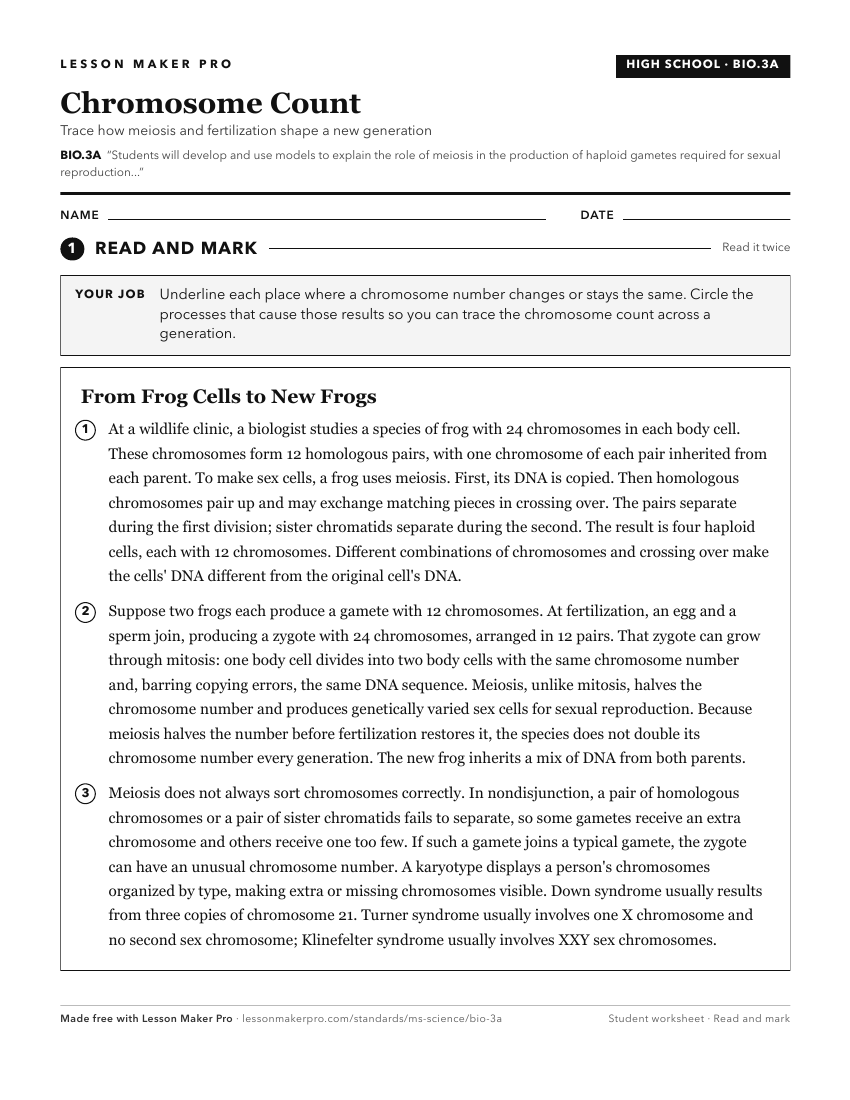
A ready-to-print activity worksheet aligned to BIO.3A, with an answer key for the teacher on its own page. No account needed.
PDF, US Letter, prints cleanly in black and white.
Download the worksheetKeep exploring
Related Standards
- L.8.2A
Students will demonstrate an understanding of how sexual reproduction results in offspring with genetic variation while asexual reproduction results in offsprin...
- L.8.2A.4
Construct a model of meiosis to explain its role in sexual reproduction, which results in offspring that have a new combination of genetic information different...
- BIO.1E
Students will develop and use models to explain the role of the cell cycle during growth, development, and maintenance in multicellular organisms.
- GEN.5.1
Model the inheritance of chromosomes through meiotic cell division and demonstrate how meiosis and sexual reproduction lead to genetic variation in populations.
Turn this cluster into a lesson
Grade, subject, topic, and the complete cluster are prefilled. Create one free, no account needed.
Also for this cluster:Make a WorksheetMake a QuizMake a Sub Lesson