Mississippi Science BIO.3A.2
The Standard
- BIO.3A
- Students will develop and use models to explain the role of meiosis in the production of haploid gametes required for sexual reproduction.
Compare and contrast mitosis and meiosis in terms of reproduction.
2026 Mississippi College- and Career-Readiness Standards for Science · Reproduction and Heredity
Teacher's field guide
What This Standard Means
What Students Need to Do
- Students compare mitosis and meiosis by what each produces and how each supports reproduction. They explain why asexual offspring tend to resemble one parent, while sexual offspring can differ from both parents.
What Mastery Looks Like
- Given a cell with four chromosomes, a student can show mitosis producing two cells with four chromosomes each and meiosis producing four cells with two each. They can explain that fertilization joins two sex cells and restores the chromosome number.
Common Misconceptions
- Students may think mitosis makes sperm and eggs, or that meiosis makes two identical cells. They may also think an offspring gets a full set of chromosomes from each parent, doubling its chromosome number.
How to Assess It
- Exit ticket: A hydra with 12 chromosomes reproduces by budding or by making sperm and eggs. Name the division behind each route, give the chromosome count in a sex cell, and say which route produces more variation.
Lesson moves
Ways to Teach It
Use two colored pairs of duplicated paper chromosomes to model mitosis and meiosis; count cells and chromosomes after each process.
Ask partners: Why can siblings differ without having different chromosome counts? Have them explain using meiosis and fertilization.
Give groups cards marked 'two identical cells,' 'four varied cells,' 'growth,' and 'egg or sperm'; have them sort and justify each match.
Show a photo of a tomato cutting and a seed packet; ask which resulting plants will vary more and why.
Free download
Printable BIO.3A.2 Worksheet
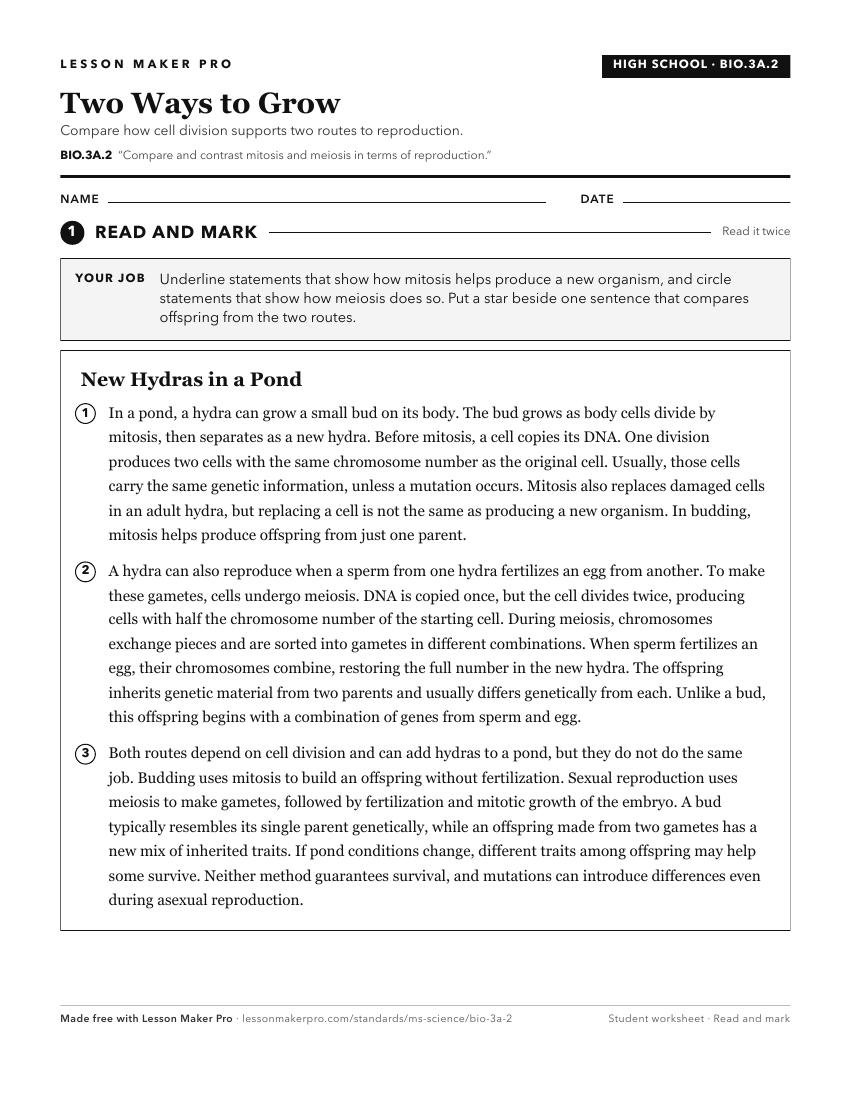
A ready-to-print activity worksheet aligned to BIO.3A.2, with an answer key for the teacher on its own page. No account needed.
PDF, US Letter, prints cleanly in black and white.
Download the worksheetKeep exploring
Related Standards
- FB.3.6
Compare and contrast the processes and results of mitosis and meiosis.
- L.8.2A.2
Create a diagram of mitosis and explain its role in asexual reproduction, which results in offspring with identical genetic information.
- L.8.2A.5
Compare and contrast advantages and disadvantages of asexual and sexual reproduction.
- BOT.3.3
Compare and contrast the consequences of the following reproductive methods: asexual reproduction, vegetative propagation, and sexual reproduction.
Turn this exact standard into a lesson
Grade, subject, topic, and the complete standard are prefilled. Create one free, no account needed.
Also for this standard:Make a WorksheetMake a QuizMake a Sub Lesson