Mississippi Science BOT.3.3
The Standard
- BOT.3
- Students will characterize the reproductive strategies of plants.
Compare and contrast the consequences of the following reproductive methods: asexual reproduction, vegetative propagation, and sexual reproduction.
2026 Mississippi College- and Career-Readiness Standards for Science · Plant Reproduction
Teacher's field guide
What This Standard Means
What Students Need to Do
- Students identify how a plant makes new plants through pollinated flowers, cuttings, runners, or other plant parts. They compare the methods by genetic similarity, speed, and disease risk.
What Mastery Looks Like
- A student can explain that vegetative propagation is a type of asexual reproduction. Given a farm scenario, they can predict which plants are likely to vary genetically and explain why that matters if disease strikes.
Common Misconceptions
- Students may treat vegetative propagation and asexual reproduction as unrelated methods. They may think cuttings need pollination or that seeds from pollinated flowers produce copies of the parent.
How to Assess It
- Ask on an exit ticket: “A grower plants potatoes from tubers and tomatoes from pollinated flowers. Which group is likely to vary more genetically, and why?” Have students name the method used for the potatoes.
Lesson moves
Ways to Teach It
Put mint cuttings in water, label the parent plant, and have students predict which traits the new plants will share.
Ask students to write which strawberry field might face more risk from a new fungus: one grown from runners or one grown from seeds.
Give pairs cards showing cuttings, runners, and pollinated flowers; have them sort the cards and predict whether offspring will resemble the parent.
Compare apple scions grafted onto rootstocks with seed-grown apple trees, then ask why orchards use grafts for predictable fruit.
Free download
Printable BOT.3.3 Worksheet
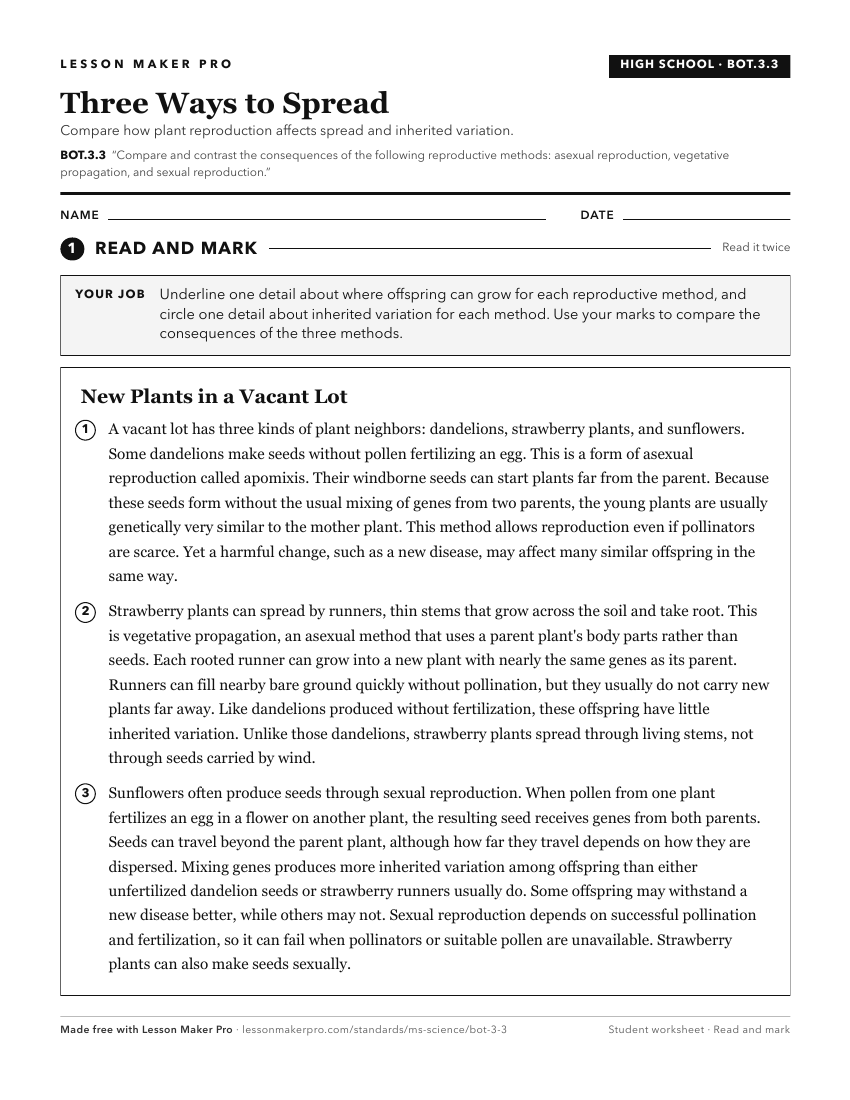
A ready-to-print activity worksheet aligned to BOT.3.3, with an answer key for the teacher on its own page. No account needed.
PDF, US Letter, prints cleanly in black and white.
Download the worksheetKeep exploring
Related Standards
- BOT.3.1
Describe the various processes of asexual reproduction and vegetative propagation used by plants. Communicate the importance of these reproductive methods in re...
- BIO.3A.2
Compare and contrast mitosis and meiosis in terms of reproduction.
- BIO.1E.3
Relate the processes of cellular reproduction to asexual reproduction in simple organisms (i.e., budding, vegetative propagation, regeneration, binary fission)....
- L.8.2A.5
Compare and contrast advantages and disadvantages of asexual and sexual reproduction.
Turn this exact standard into a lesson
Grade, subject, topic, and the complete standard are prefilled. Create one free, no account needed.
Also for this standard:Make a WorksheetMake a QuizMake a Sub Lesson