Mississippi Science BIO.1E.3
The Standard
- BIO.1E
- Students will develop and use models to explain the role of the cell cycle during growth, development, and maintenance in multicellular organisms.
Relate the processes of cellular reproduction to asexual reproduction in simple organisms (i.e., budding, vegetative propagation, regeneration, binary fission). Explain why the DNA of the daughter cells is the same as the parent cell.
2026 Mississippi College- and Career-Readiness Standards for Science · Cells as a System
Teacher's field guide
What This Standard Means
What Students Need to Do
- Students trace how budding, plant propagation, regrowth from a body fragment, and bacterial division can produce new organisms. They explain that DNA is copied before cells divide, so new cells receive the same DNA as the parent cell.
What Mastery Looks Like
- Given diagrams of a yeast bud and a dividing bacterium, students can show where the copied DNA goes. They can explain why a new worm growing from a planarian fragment is reproduction, while a lizard regrowing its tail is repair.
Common Misconceptions
- Students may think a bud or potato shoot gets only half the parent’s DNA. They may call any regrowth reproduction or assume bacteria divide by mitosis.
How to Assess It
- Exit ticket: Draw a yeast cell making a bud. Label when DNA is copied, then explain why the bud has the parent cell’s DNA.
Lesson moves
Ways to Teach It
Use clay for a yeast cell and two matching paper DNA strips; move one strip into a bud before pinching it off.
Ask: “A planarian fragment grows into a new worm, but a lizard regrows a tail. Which is reproduction, and why?”
Give pairs picture cards of yeast, potato eyes, planarian fragments, and dividing bacteria; have them match each picture to its process.
Show a photo of a sprouting potato; ask students to point to a new shoot and compare its DNA with the potato’s.
Free download
Printable BIO.1E.3 Worksheet
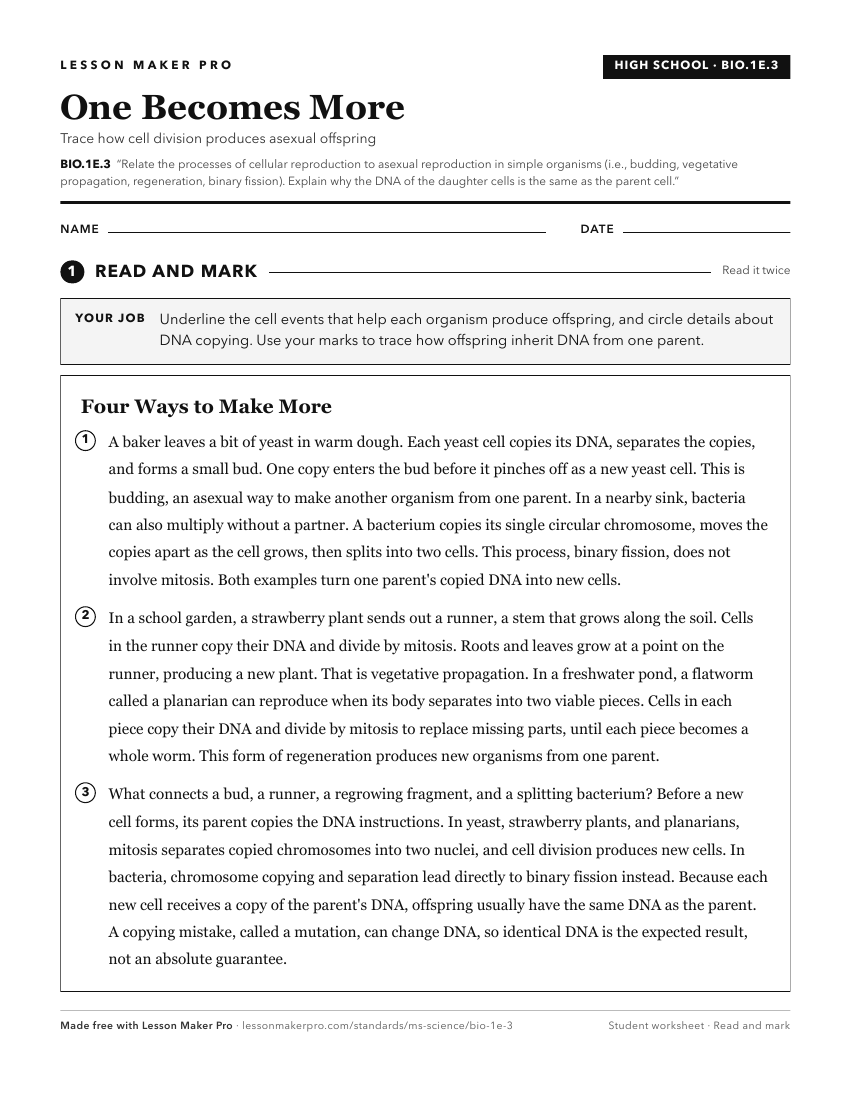
A ready-to-print activity worksheet aligned to BIO.1E.3, with an answer key for the teacher on its own page. No account needed.
PDF, US Letter, prints cleanly in black and white.
Download the worksheetKeep exploring
Related Standards
- L.8.2A
Students will demonstrate an understanding of how sexual reproduction results in offspring with genetic variation while asexual reproduction results in offsprin...
- BIO.3A.1
Model sex cell formation (meiosis) and combination (fertilization) to demonstrate the maintenance of chromosome number through each generation in sexually repro...
- L.8.2A.2
Create a diagram of mitosis and explain its role in asexual reproduction, which results in offspring with identical genetic information.
- BOT.3.1
Describe the various processes of asexual reproduction and vegetative propagation used by plants. Communicate the importance of these reproductive methods in re...
Turn this exact standard into a lesson
Grade, subject, topic, and the complete standard are prefilled. Create one free, no account needed.
Also for this standard:Make a WorksheetMake a QuizMake a Sub Lesson