Mississippi Science BOT.3.1
The Standard
- BOT.3
- Students will characterize the reproductive strategies of plants.
Describe the various processes of asexual reproduction and vegetative propagation used by plants. Communicate the importance of these reproductive methods in regard to human food production.
2026 Mississippi College- and Career-Readiness Standards for Science · Plant Reproduction
Teacher's field guide
What This Standard Means
What Students Need to Do
- Students identify how runners, tubers, bulbs, and stem cuttings grow into new plants without seeds. They explain why farmers use these methods to grow food crops with predictable traits.
What Mastery Looks Like
- A student can point to the eye on a potato or the bud on a strawberry runner and explain how it starts a new plant. They can explain how planting copies of a crop can give farmers consistent harvests but also leave many plants open to the same disease.
Common Misconceptions
- Students may call a potato tuber a seed or think any potato piece will grow, even one without an eye. They may think a cutting needs pollination before it can make a new plant.
How to Assess It
- Exit ticket: A farmer plants potato pieces with eyes instead of seeds. Explain how a new plant grows, then name one benefit and one risk for the farmer.
Lesson moves
Ways to Teach It
Plant potato pieces with eyes and garlic cloves in labeled cups, then mark where each new shoot should grow.
Ask students to write why a farmer might plant potato pieces instead of seeds and what could go wrong with that choice.
Give pairs crop and method cards to match: strawberries and runners, potatoes and tubers, garlic and bulbs, cassava and cuttings.
Show a banana farm photo and ask why growers plant suckers instead of seeds, then predict what a shared disease might do.
Free download
Printable BOT.3.1 Worksheet
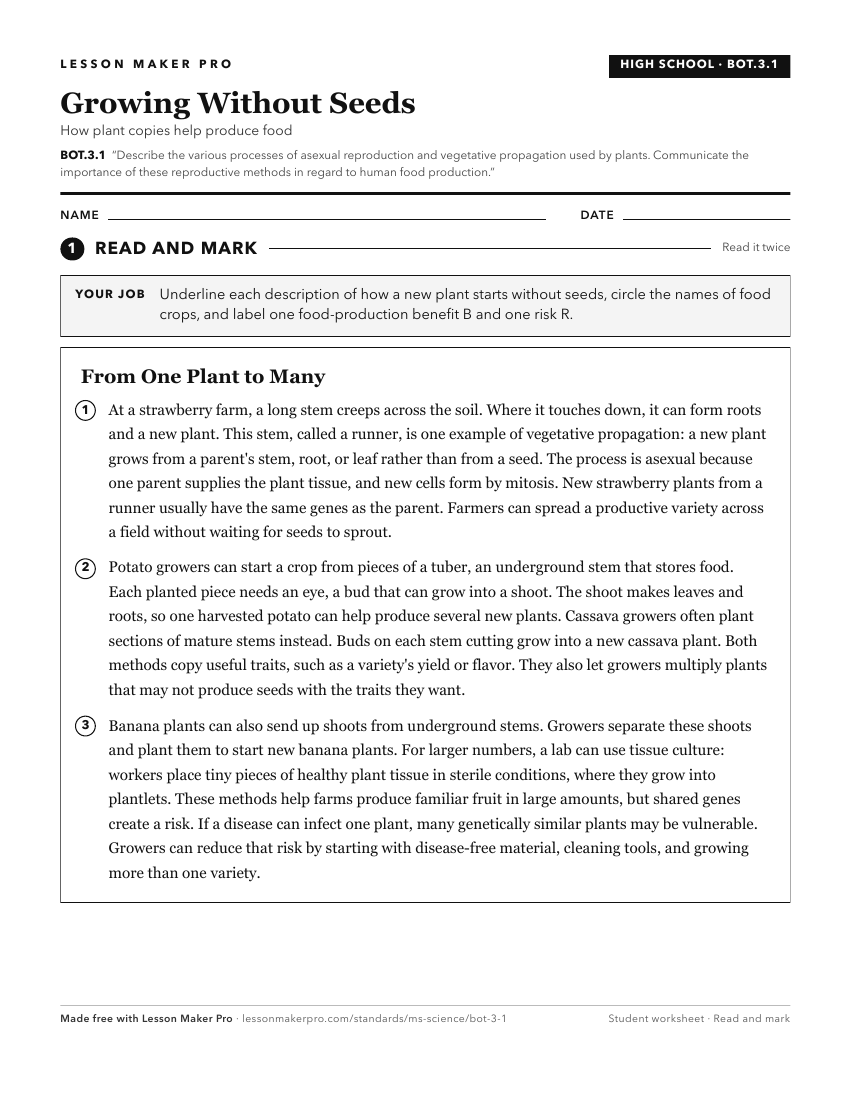
A ready-to-print activity worksheet aligned to BOT.3.1, with an answer key for the teacher on its own page. No account needed.
PDF, US Letter, prints cleanly in black and white.
Download the worksheetKeep exploring
Related Standards
- BIO.1E.3
Relate the processes of cellular reproduction to asexual reproduction in simple organisms (i.e., budding, vegetative propagation, regeneration, binary fission)....
- L.8.2A.5
Compare and contrast advantages and disadvantages of asexual and sexual reproduction.
- BOT.3
Students will characterize the reproductive strategies of plants.
- BOT.3.3
Compare and contrast the consequences of the following reproductive methods: asexual reproduction, vegetative propagation, and sexual reproduction.
Turn this exact standard into a lesson
Grade, subject, topic, and the complete standard are prefilled. Create one free, no account needed.
Also for this standard:Make a WorksheetMake a QuizMake a Sub Lesson