Mississippi Science BOT.3
Standard Cluster
Students will characterize the reproductive strategies of plants. Describe the various processes of asexual reproduction and vegetative propagation used by plants. Communicate the importance of these reproductive methods in regard to human food production. Enrichment: Research and present an agronomically important crop (e.g., potato, sweet potato, pineapple, or strawberry) that is produced via vegetative propagation (non-GMOs) for human consumption. Include evidence-based arguments that identify the potential benefits and negative effects of this method of crop production. Compare and contrast the consequences of the following reproductive methods: asexual reproduction, vegetative propagation, and sexual reproduction. Plan and conduct comparative flower dissection to identify reproductive structures within the flower. Compare the similarities between corresponding plant reproductive structures from a variety of species. Record via drawings of observed dissection specimens and explain the similarities and differences observed. Identify differences in flower structure and shape. Provide a rationale that explains the value of these differences in flower structure to reproductive success (e.g., pollinators, flower shape, smell, color, size, orientation). Plan, conduct, and communicate the results of a comparative laboratory investigation of differing fruit types. Using laboratory data, correctly categorize fruits, vegetables, nuts, modified stems, or other plant parts. Compare the scientific definitions of these terms to those used by the general public/society and the USDA to categorize food.
2026 Mississippi College- and Career-Readiness Standards for Science · Plant Reproduction
Cluster contents
Standards in This Cluster
BOT.3 is a cluster heading. These are the individual standards under it.
- BOT.3.1
Describe the various processes of asexual reproduction and vegetative propagation used by plants. Communicate the importance of these reproductive methods in re...
- BOT.3.2
Enrichment: Research and present an agronomically important crop (e.g., potato, sweet potato, pineapple, or strawberry) that is produced via vegetative propagat...
- BOT.3.3
Compare and contrast the consequences of the following reproductive methods: asexual reproduction, vegetative propagation, and sexual reproduction.
- BOT.3.4
Plan and conduct comparative flower dissection to identify reproductive structures within the flower.
- BOT.3.5
Compare the similarities between corresponding plant reproductive structures from a variety of species. Record via drawings of observed dissection specimens and...
- BOT.3.6
Identify differences in flower structure and shape. Provide a rationale that explains the value of these differences in flower structure to reproductive success...
- BOT.3.7
Plan, conduct, and communicate the results of a comparative laboratory investigation of differing fruit types.
- BOT.3.8
Using laboratory data, correctly categorize fruits, vegetables, nuts, modified stems, or other plant parts. Compare the scientific definitions of these terms to...
Teacher's field guide
What This Cluster Means
What Students Need to Do
- Students compare how seeds form after pollination and fertilization with how runners, tubers, and cuttings make new plants. They dissect flowers from two species, sketch reproductive parts, and sort foods by the plant part they come from. They explain why growers clone crops and what can go wrong.
What Mastery Looks Like
- A student can label stamens and pistils on two flower sketches and explain how differences in flower shape may help attract pollinators. They can identify a tomato as a botanical fruit and a potato as a modified stem, even though both count as vegetables in food groups. They can explain why cloned crops keep desired traits but share disease risks, while seeds can bring more variation.
Common Misconceptions
- Students may call every edible plant part a fruit or assume a potato is a root. They may think runners and tubers need seeds, or that cloning a crop has no downside.
How to Assess It
- On an exit ticket, show an unlabeled flower diagram, a strawberry runner, and a potato tuber. Ask students to mark the ovary, circle the two ways to make plants without seeds, and name one benefit and one risk of cloning a food crop.
Lesson moves
Ways to Teach It
Dissect a lily and a carnation with hand lenses, sketch their reproductive parts, and compare petal shape and pollen placement.
Ask students: Would you plant potatoes from tubers or seeds if a disease is spreading? Defend your choice using variation and yield.
Give pairs cards showing tomatoes, peanuts, carrots, and potatoes; have them sort by botanical plant part, then compare with grocery labels.
Use a USDA MyPlate chart and grocery labels to classify tomatoes, potatoes, and peanuts, then compare those groups with each food's botanical part.
Free download
Printable BOT.3 Worksheet
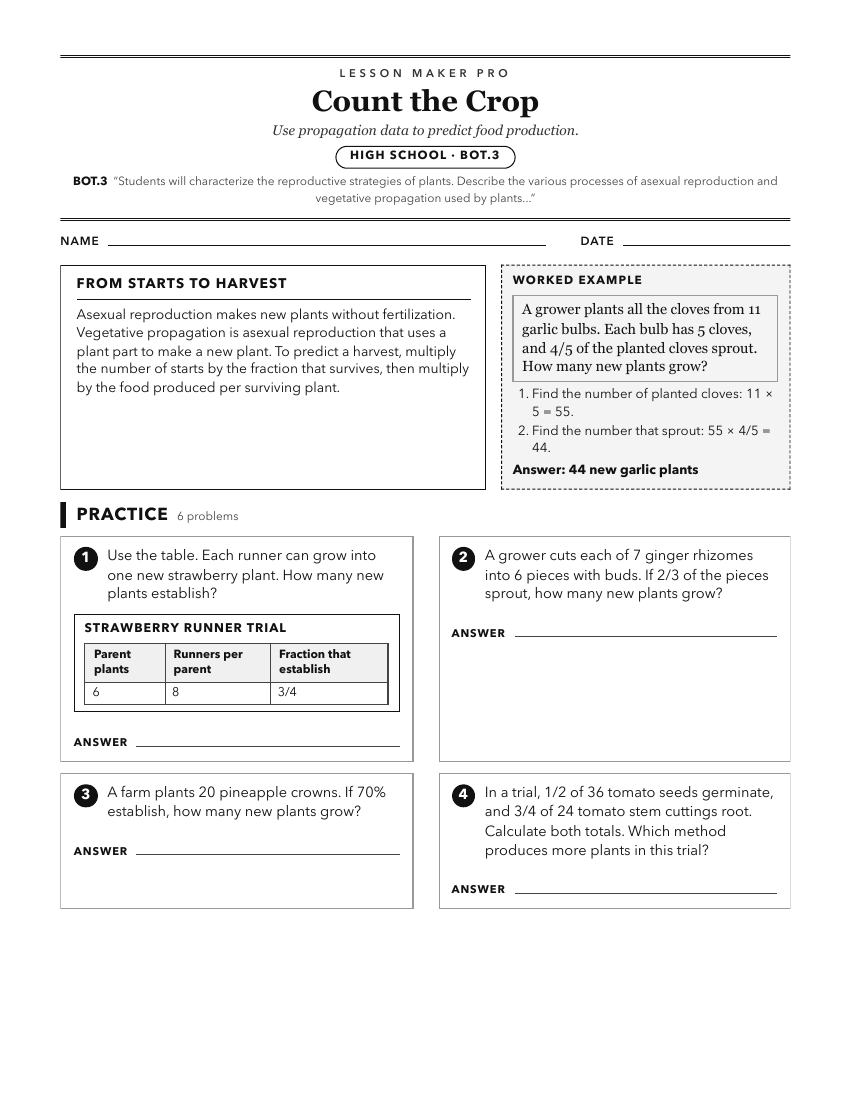
A ready-to-print activity worksheet aligned to BOT.3, with an answer key for the teacher on its own page. No account needed.
PDF, US Letter, prints cleanly in black and white.
Download the worksheetKeep exploring
Related Standards
- BOT.1
Students will investigate the morphology, anatomy, and physiology of plants.
- L.1.3B
Students will demonstrate an understanding of the interdependence of flowering plants and pollinating insects.
- L.1.4
Students will demonstrate an understanding of the ways plants adapt to their environment in order to survive.
- BOT.5
Students will explore adaptations that allow plants to survive in various habitats.
Turn this cluster into a lesson
Grade, subject, topic, and the complete cluster are prefilled. Create one free, no account needed.
Also for this cluster:Make a WorksheetMake a QuizMake a Sub Lesson