Mississippi Science BOT.1
Standard Cluster
Students will investigate the morphology, anatomy, and physiology of plants. Analyze models (3-D, paper, and/or computer-based) to distinguish the basic morphology of the plant kingdom, with attention to structures and their related functions. Use cladograms or phylogenetic trees to identify evolutionary features that distinguish the plant kingdom from other kingdoms. Using microscopes, observe, identify, record, and analyze (e.g., see and draw) cells and cell structures unique to plants. Use data measurements obtained from microscopy to compare the plant cells and organelle sizes between various examples (e.g., elodea, onion, or algae). Describe the relationship between the structure and purpose of plant organs (e.g., roots, stems, and leaves). Evaluate and explain how bacteria and fungi work symbiotically to enhance plant root function. Calculate surface area of leaves/roots and compare surface areas of various plant specimens to explain adaptations of the various plant types. Demonstrate through model development and manipulation an understanding of plant biochemistry. Conduct investigations, collect and analyze data, and communicate results that explain the processes of photosynthesis and cellular respiration (e.g., light intensity, light color, light distance, temperature, altering pH, oxygen availability, and carbon dioxide concentration). Enrichment: Use an engineering design process to manipulate a variable of choice to refine a protocol to optimize output of photosynthesis or cellular respiration. * Communicate the importance of carbon, hydrogen, oxygen, phosphorus, and nitrogen cycles to plant physiology through graphics such as poster or computer presentations. Identify and compare various live plant examples to explore plant morphological diversity, including leaf number, structure, and arrangement; root modifications; and flower structure and arrangement. Produce a visual product (e.g., an electronic presentation) to identify and communicate patterns of similarity and differences between the lab specimens. Compare and contrast functions of the various characteristics found in plant divisions and utilize dichotomous keys to identify plant species.
2026 Mississippi College- and Career-Readiness Standards for Science · Plant Morphology, Cell Structure, and Function
Cluster contents
Standards in This Cluster
BOT.1 is a cluster heading. These are the individual standards under it.
- BOT.1.1
Analyze models (3-D, paper, and/or computer-based) to distinguish the basic morphology of the plant kingdom, with attention to structures and their related func...
- BOT.1.2
Using microscopes, observe, identify, record, and analyze (e.g., see and draw) cells and cell structures unique to plants. Use data measurements obtained from m...
- BOT.1.3
Describe the relationship between the structure and purpose of plant organs (e.g., roots, stems, and leaves).
- BOT.1.4
Evaluate and explain how bacteria and fungi work symbiotically to enhance plant root function.
- BOT.1.5
Calculate surface area of leaves/roots and compare surface areas of various plant specimens to explain adaptations of the various plant types.
- BOT.1.6
Demonstrate through model development and manipulation an understanding of plant biochemistry.
- BOT.1.7
Conduct investigations, collect and analyze data, and communicate results that explain the processes of photosynthesis and cellular respiration (e.g., light int...
- BOT.1.8
Enrichment: Use an engineering design process to manipulate a variable of choice to refine a protocol to optimize output of photosynthesis or cellular respirati...
- BOT.1.9
Communicate the importance of carbon, hydrogen, oxygen, phosphorus, and nitrogen cycles to plant physiology through graphics such as poster or computer presenta...
- BOT.1.10
Identify and compare various live plant examples to explore plant morphological diversity, including leaf number, structure, and arrangement; root modifications...
- BOT.1.11
Compare and contrast functions of the various characteristics found in plant divisions and utilize dichotomous keys to identify plant species.
Teacher's field guide
What This Cluster Means
What Students Need to Do
- Students examine plant organs and cells, measure cell size and leaf area, and use keys and cladograms to compare plant traits. They test how light affects photosynthesis. They use models to track matter through photosynthesis, respiration, and nutrient cycles.
What Mastery Looks Like
- A student can identify a plant with a key, locate a trait on a cladogram, and compare cell sizes using scale bars. They can calculate leaf area and explain how root and leaf structures help a plant. They can use light-test data to explain photosynthesis and describe how helpful fungi or bacteria aid roots.
Common Misconceptions
- Students may think all plant cells have chloroplasts, including onion bulb cells. They may say plants get most of their mass from soil, or that photosynthesis replaces respiration. Some assume all fungi harm roots or that a cladogram ranks living plants from least to most evolved.
How to Assess It
- Give students scale-bar images of onion and Elodea cells and a root-hair sketch. Ask them to measure both cells, mark any chloroplasts, and explain how root hairs help the plant absorb water.
Lesson moves
Ways to Teach It
Give students onion and Elodea slides; have them draw five cells of each, measure widths with a calibrated eyepiece scale, and circle chloroplasts.
Ask students to write how root hairs and mycorrhizal fungi help a bean plant get phosphorus, and where its carbon comes from.
Give pairs four local leaves and a teacher-made dichotomous key; have them identify each plant and name the traits they used.
Move one lamp between two distances from Elodea, count bubbles for two minutes at each distance, and recommend a greenhouse light placement.
Free download
Printable BOT.1 Worksheet
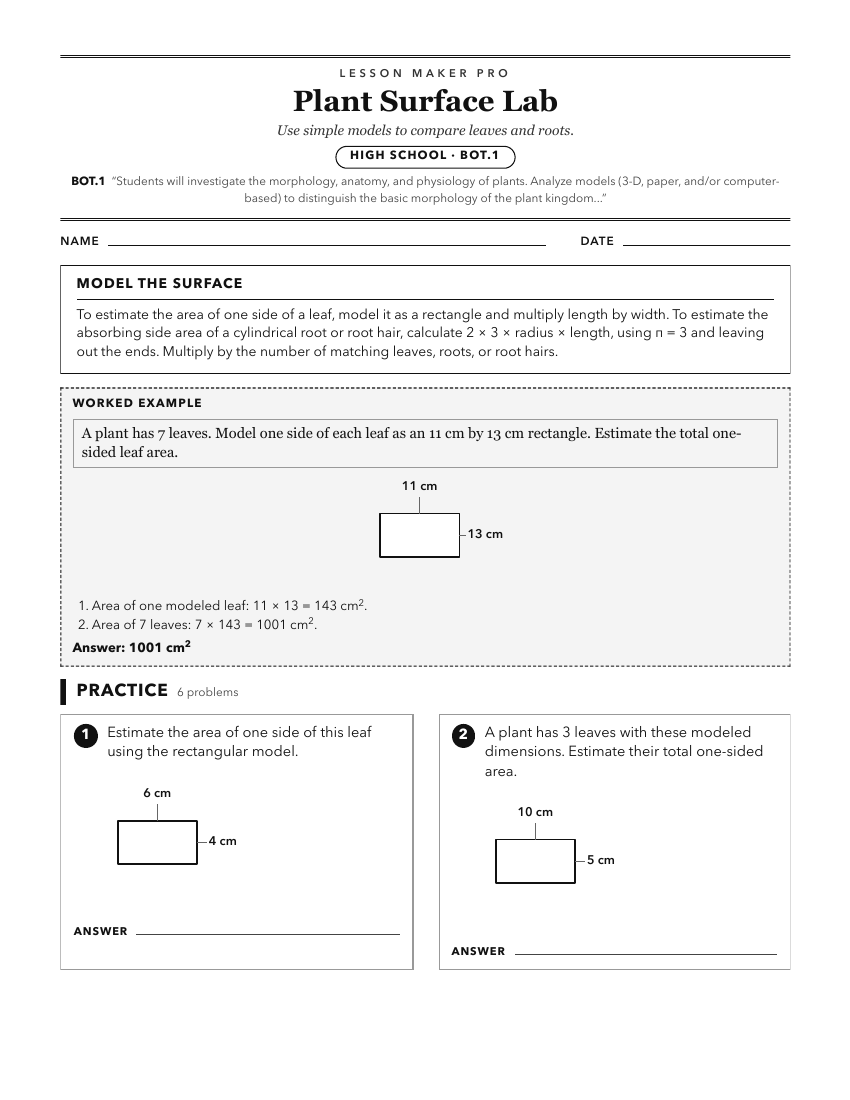
A ready-to-print activity worksheet aligned to BOT.1, with an answer key for the teacher on its own page. No account needed.
PDF, US Letter, prints cleanly in black and white.
Download the worksheetKeep exploring
Related Standards
- L.1.1
Students will demonstrate an understanding of the basic needs and structures of plants.
- BOT.6
Students will ask questions, plan, and conduct field investigations on local plant communities.
- L.1.3A
Students will demonstrate an understanding of what plants need from the environment for growth and repair.
- L.3.1
Students will demonstrate an understanding of internal and external structures in plants and animals and how they relate to their growth, survival, behavior, an...
Turn this cluster into a lesson
Grade, subject, topic, and the complete cluster are prefilled. Create one free, no account needed.
Also for this cluster:Make a WorksheetMake a QuizMake a Sub Lesson