Mississippi Science BOT.1.4
The Standard
- BOT.1
- Students will investigate the morphology, anatomy, and physiology of plants.
Evaluate and explain how bacteria and fungi work symbiotically to enhance plant root function.
2026 Mississippi College- and Career-Readiness Standards for Science · Plant Morphology, Cell Structure, and Function
Teacher's field guide
What This Standard Means
What Students Need to Do
- Students explain how bacteria in root nodules turn nitrogen gas into a form plants can use. They explain how fungi help roots take up phosphorus and water, while the plant gives both partners sugars. They use plant data to judge whether the partnerships help.
What Mastery Looks Like
- A student can trace nitrogen from the air through bacteria to a plant, and phosphorus from soil through fungal threads to roots. They can use a comparison of plants to support their explanation and name what each partner gets.
Common Misconceptions
- Students may think fungi fix nitrogen, when the bacteria do that job. Some think bacteria give plants nitrogen gas directly, rather than converting it first. Others mistake fungal threads for root hairs or forget that the plant supplies sugars.
How to Assess It
- Exit ticket: In identical conditions, bean plants grow 8 cm without partners, 12 cm with bacteria, 11 cm with fungi, and 16 cm with both. Explain the pattern using nitrogen, phosphorus, and plant sugars.
Lesson moves
Ways to Teach It
Build a root model with yarn for fungal threads and clay for nodules, then add arrows for nitrogen, phosphorus, water, and sugars.
Ask students to write: Why might a bean plant grow poorly without its root bacteria even if it has plenty of sunlight?
Give pairs cards labeled nodules, fungal threads, nitrogen gas, usable nitrogen, phosphorus, and sugar; have them arrange and explain the exchanges.
Show a photo of soybean seeds coated with root bacteria; ask why a farmer might plant them in nitrogen-poor soil.
Free download
Printable BOT.1.4 Worksheet
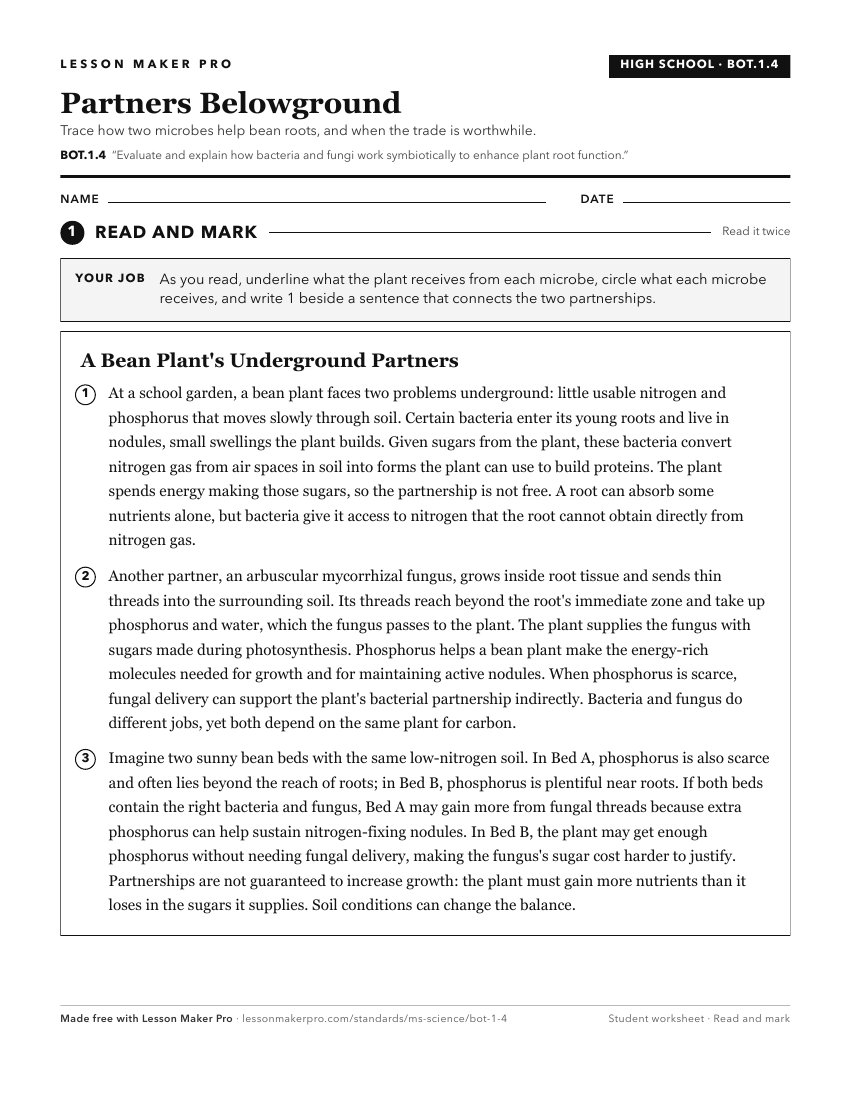
A ready-to-print activity worksheet aligned to BOT.1.4, with an answer key for the teacher on its own page. No account needed.
PDF, US Letter, prints cleanly in black and white.
Download the worksheetKeep exploring
Related Standards
- L.6.4.3
Analyze and interpret data from observations to describe how fungi obtain energy and respond to stimuli (e.g., bread mold, rotting plant material).
- L.6.3.4
Investigate organism interactions in a competitive or mutually beneficial relationship (predation, competition, cooperation, or symbiotic relationships).
- L.6.1.3
Develop and use models to explain how specific cellular components (cell wall, cell membrane, nucleus, chloroplast, vacuole, and mitochondria) function together...
- L.7.3.2
Analyze and interpret data to explain how the processes of photosynthesis, and cellular respiration (aerobic and anaerobic) work together to meet the needs of p...
Turn this exact standard into a lesson
Grade, subject, topic, and the complete standard are prefilled. Create one free, no account needed.
Also for this standard:Make a WorksheetMake a QuizMake a Sub Lesson