Mississippi Science L.7.3.2
The Standard
- L.7.3
- Students will demonstrate an understanding of the importance that matter cycles between living and non-living parts of the ecosystem to sustain life on Earth.
Analyze and interpret data to explain how the processes of photosynthesis, and cellular respiration (aerobic and anaerobic) work together to meet the needs of plants and animals.
2026 Mississippi College- and Career-Readiness Standards for Science · Ecology and Interdependence
Teacher's field guide
What This Standard Means
What Students Need to Do
- Students use data on light, oxygen, carbon dioxide, and sugar to identify photosynthesis and two ways cells release energy from sugar. They explain how plants and animals depend on these processes.
What Mastery Looks Like
- Given a data table, a student points to changes in gases or sugar to support each claim. They explain that plants make sugar and oxygen, and that both plants and animals use sugar to release energy. They know cells release less energy from sugar without oxygen.
Common Misconceptions
- Students may think plants photosynthesize but do not respire. Some think oxygen is a source of energy, or that cells release the same amount of energy from sugar with and without oxygen.
How to Assess It
- Exit ticket: A lit plant's CO2 falls from 10 to 6 units, while yeast uses sugar in a jar with no oxygen. Ask students to name each process and explain how the plant's products could help an animal release energy.
Lesson moves
Ways to Teach It
Sink spinach leaf disks in baking soda water with a syringe, then compare floating counts under a lamp and in darkness.
Ask students to write why a plant in sunlight can release oxygen while its cells still use oxygen.
Give teams three data cards: CO2 falls in light, O2 falls in darkness, and sugar falls without oxygen; have them match processes.
Show rising bread dough and a yeast CO2 graph; ask why yeast makes gas when oxygen in the dough runs low.
Free download
Printable L.7.3.2 Worksheet
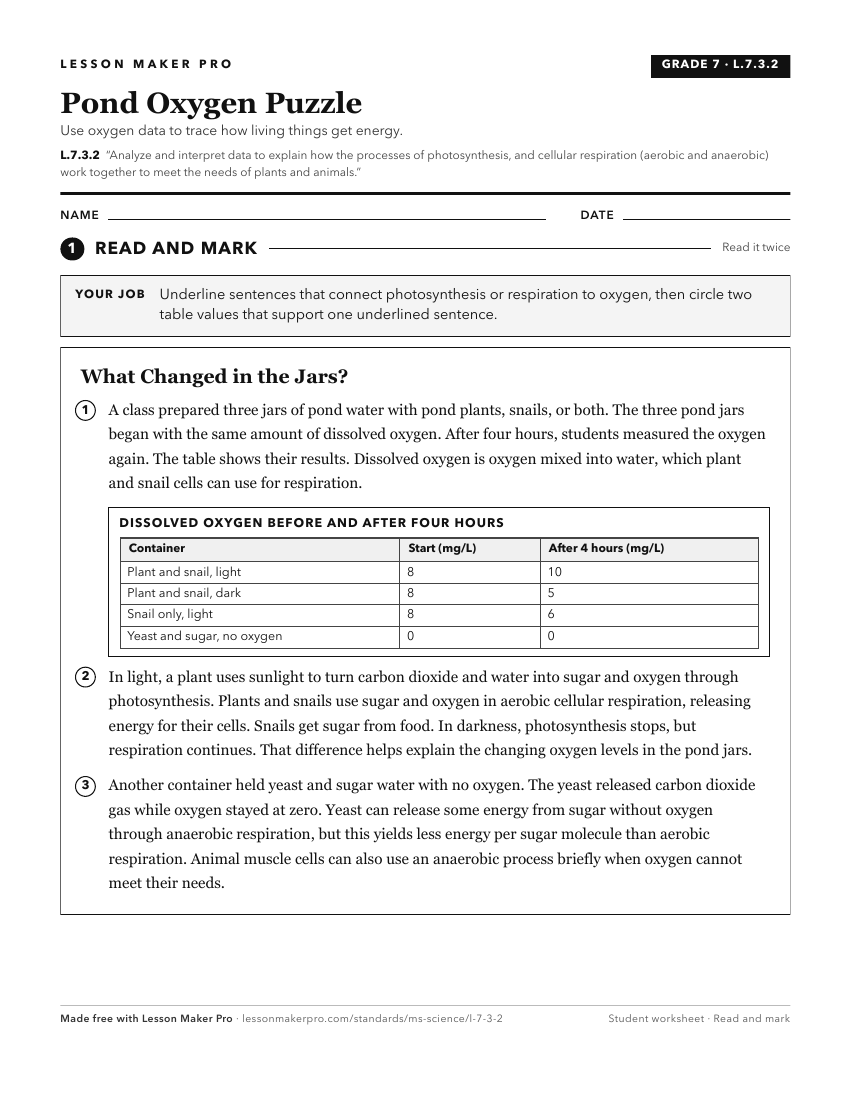
A ready-to-print activity worksheet aligned to L.7.3.2, with an answer key for the teacher on its own page. No account needed.
PDF, US Letter, prints cleanly in black and white.
Download the worksheetKeep exploring
Related Standards
- BOT.1.7
Conduct investigations, collect and analyze data, and communicate results that explain the processes of photosynthesis and cellular respiration (e.g., light int...
- FB.3.4
Analyze the relationship between photosynthesis and cellular respiration and explain that relationship in terms of the need for all living things to acquire ene...
- BIO.2.4
Conduct scientific investigations or computer simulations to compare aerobic and anaerobic cellular respiration in plants and animals, using real world examples...
- L.5.3A.1
Research and communicate the basic process of photosynthesis that is used by plants to convert light energy into chemical energy that can be stored and released...
Turn this exact standard into a lesson
Grade, subject, topic, and the complete standard are prefilled. Create one free, no account needed.
Also for this standard:Make a WorksheetMake a QuizMake a Sub Lesson