Mississippi Science FB.3.4
The Standard
- FB.3
- Students will demonstrate an understanding of how the structure of living organisms supports the essential functions of life.
Analyze the relationship between photosynthesis and cellular respiration and explain that relationship in terms of the need for all living things to acquire energy from their environment.
2026 Mississippi College- and Career-Readiness Standards for Science · Organization and Energy in Living Systems
Teacher's field guide
What This Standard Means
What Students Need to Do
- Students track glucose, oxygen, carbon dioxide, and water between photosynthesis and cellular respiration. They explain how plants store light energy in food and how cells use that food to make ATP.
What Mastery Looks Like
- A student can draw the inputs and outputs of both processes and connect them with arrows. They can explain that plants also carry out cellular respiration. They distinguish matter that cycles from energy that enters as light and eventually leaves as heat.
Common Misconceptions
- Students may think plants photosynthesize instead of respiring, or that only animals carry out cellular respiration. They may think energy cycles along with matter or confuse breathing with the cell process that makes ATP.
How to Assess It
- Give students a blank diagram with boxes for photosynthesis and cellular respiration. Ask them to add sunlight, glucose, oxygen, carbon dioxide, water, and ATP, then draw arrows showing where each goes.
Lesson moves
Ways to Teach It
Use paper cutouts labeled sunlight, glucose, oxygen, carbon dioxide, water, and ATP to build linked photosynthesis and respiration diagrams.
Ask, 'Does a plant in the dark still make ATP?' Have students explain using glucose, oxygen, and cellular respiration.
Play a card sort matching each process with its inputs and outputs, then ask why sunlight and ATP do not cycle like matter.
Trace the energy in a slice of toast from sunlight to wheat to human cells, naming each process along the way.
Free download
Printable FB.3.4 Worksheet
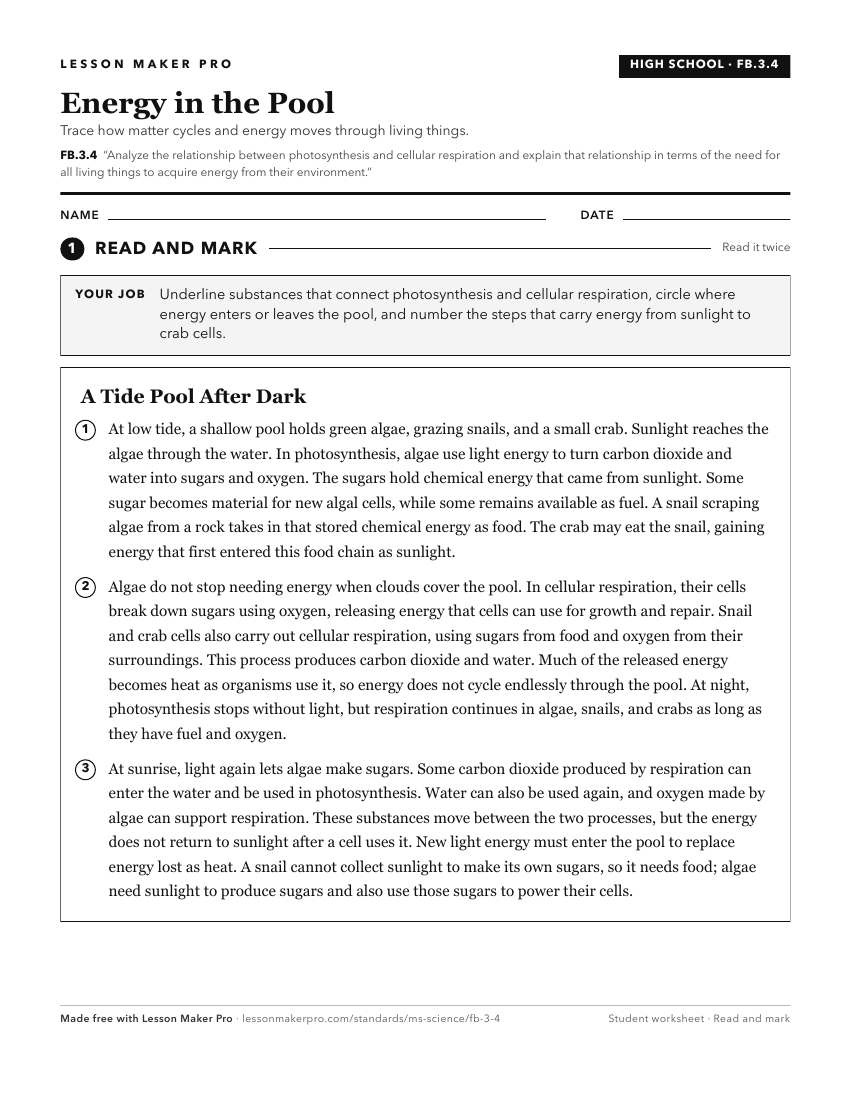
A ready-to-print activity worksheet aligned to FB.3.4, with an answer key for the teacher on its own page. No account needed.
PDF, US Letter, prints cleanly in black and white.
Download the worksheetKeep exploring
Related Standards
- BIO.2
Students will explain that cells transform energy through the processes of photosynthesis and cellular respiration to drive cellular functions.
- L.6.3.1
Use scientific reasoning to explain differences between biotic and abiotic factors that demonstrate what living organisms need to survive.
- L.5.3A.1
Research and communicate the basic process of photosynthesis that is used by plants to convert light energy into chemical energy that can be stored and released...
- L.7.3.2
Analyze and interpret data to explain how the processes of photosynthesis, and cellular respiration (aerobic and anaerobic) work together to meet the needs of p...
Turn this exact standard into a lesson
Grade, subject, topic, and the complete standard are prefilled. Create one free, no account needed.
Also for this standard:Make a WorksheetMake a QuizMake a Sub Lesson