Mississippi Science BIO.2
Standard Cluster
Students will explain that cells transform energy through the processes of photosynthesis and cellular respiration to drive cellular functions. Use models to demonstrate that ATP and ADP are cycled within a cell as a means to transfer energy. Develop models of the major reactants and products of photosynthesis to demonstrate the transformation of light energy into stored chemical energy in cells. Emphasize the chemical processes in which bonds are broken, and energy is released, and new bonds are formed, and energy is stored. Develop models of the major reactants and products of cellular respiration (aerobic and anaerobic) to demonstrate the transformation of the chemical energy stored in food to the available energy of ATP. Emphasize the chemical processes in which bonds are broken, and energy is released, and new bonds are formed, and energy is stored. Conduct scientific investigations or computer simulations to compare aerobic and anaerobic cellular respiration in plants and animals, using real world examples. Enrichment: Investigate variables (e.g., nutrient availability, temperature) that affect anaerobic respiration and current real-world applications of fermentation.
2026 Mississippi College- and Career-Readiness Standards for Science · Energy Transfer
Cluster contents
Standards in This Cluster
BIO.2 is a cluster heading. These are the individual standards under it.
- BIO.2.1
Use models to demonstrate that ATP and ADP are cycled within a cell as a means to transfer energy.
- BIO.2.2
Develop models of the major reactants and products of photosynthesis to demonstrate the transformation of light energy into stored chemical energy in cells. Emp...
- BIO.2.3
Develop models of the major reactants and products of cellular respiration (aerobic and anaerobic) to demonstrate the transformation of the chemical energy stor...
- BIO.2.4
Conduct scientific investigations or computer simulations to compare aerobic and anaerobic cellular respiration in plants and animals, using real world examples...
- BIO.2.5
Enrichment: Investigate variables (e.g., nutrient availability, temperature) that affect anaerobic respiration and current real-world applications of fermentati...
Teacher's field guide
What This Cluster Means
What Students Need to Do
- Students trace how plants use light to make sugar from carbon dioxide and water. They show how cells use sugar to make ATP, with or without oxygen. They model ATP becoming ADP when a cell uses energy.
What Mastery Looks Like
- A student can label the inputs and outputs of photosynthesis and respiration and show where energy goes. They can compare ATP production with and without oxygen in plant and animal cells. They can explain that breaking bonds takes energy, while forming bonds releases it.
Common Misconceptions
- Students may think plants photosynthesize but do not respire, or that cells make no ATP without oxygen. Some think breaking a bond releases energy by itself. Others draw ATP as a fuel that disappears instead of becoming ADP.
How to Assess It
- Exit ticket: Draw the inputs and outputs of photosynthesis and aerobic respiration, and mark where ATP is made. Add an arrow showing ATP becoming ADP during cell work, then state what changes when oxygen runs out.
Lesson moves
Ways to Teach It
Use a needleless syringe to sink spinach leaf disks in baking soda solution, then count floating disks in light and dark after 15 minutes.
Ask: If a seedling stays in darkness, can its cells still make ATP? Explain using its stored sugar.
Give pairs cards labeled light, CO2, water, sugar, O2, ATP, ADP, and phosphate; have them build both pathways and the ATP cycle.
Compare yeast raising bread without oxygen and muscle cells producing lactate during a sprint; ask why both yield less ATP than using oxygen.
Free download
Printable BIO.2 Worksheet
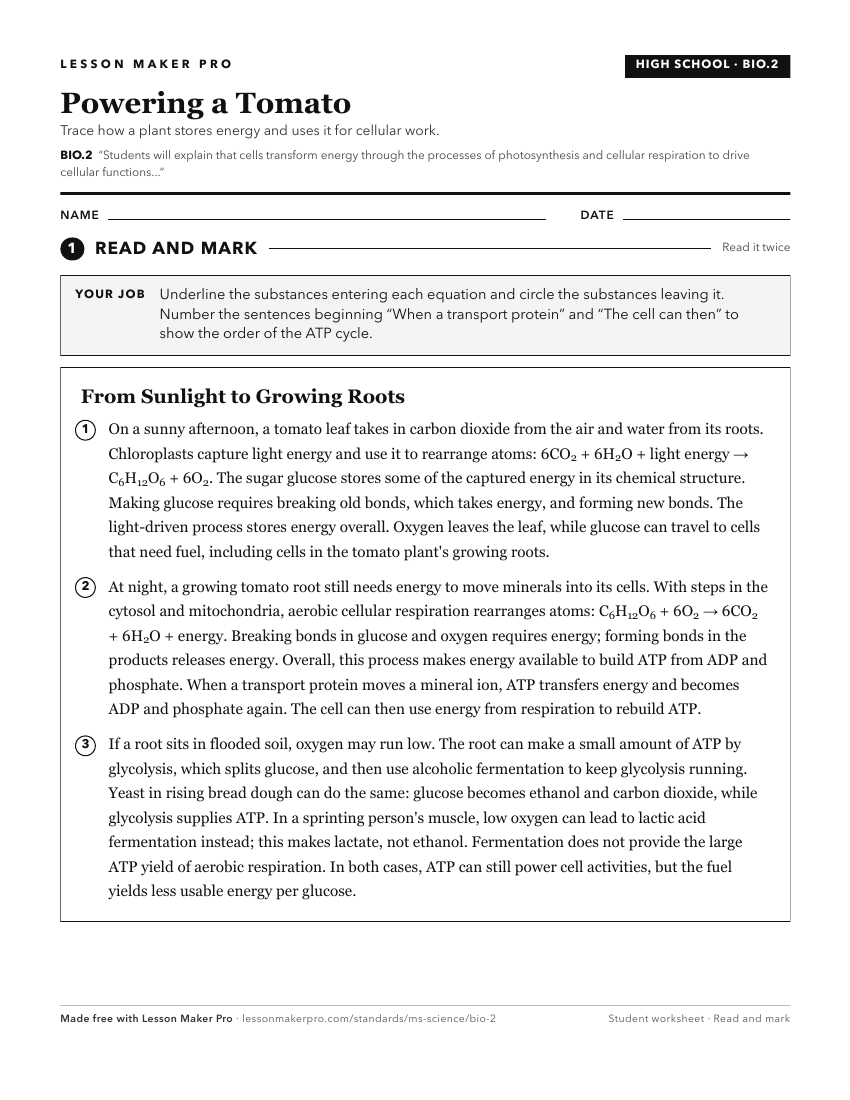
A ready-to-print activity worksheet aligned to BIO.2, with an answer key for the teacher on its own page. No account needed.
PDF, US Letter, prints cleanly in black and white.
Download the worksheetKeep exploring
Related Standards
- FB.3
Students will demonstrate an understanding of how the structure of living organisms supports the essential functions of life.
- L.5.3A
Students will demonstrate an understanding of photosynthesis and the transfer of energy from the sun into chemical energy necessary for plant growth and surviva...
- PHS.7
Students will examine different forms of energy and energy transformations.
Turn this cluster into a lesson
Grade, subject, topic, and the complete cluster are prefilled. Create one free, no account needed.
Also for this cluster:Make a WorksheetMake a QuizMake a Sub Lesson