Mississippi Science BIO.2.1
The Standard
- BIO.2
- Students will explain that cells transform energy through the processes of photosynthesis and cellular respiration to drive cellular functions.
Use models to demonstrate that ATP and ADP are cycled within a cell as a means to transfer energy.
2026 Mississippi College- and Career-Readiness Standards for Science · Energy Transfer
Teacher's field guide
What This Standard Means
What Students Need to Do
- Students draw or build a model showing ATP changing to ADP and back again inside a cell. They show how energy from food helps turn ADP back into ATP, and how ATP supplies energy for cell work.
What Mastery Looks Like
- A student can draw a repeating cycle and show where phosphate is removed and added. They can explain where the energy to add phosphate comes from and name a job ATP helps power.
Common Misconceptions
- Students may think ATP is used once and discarded. They may treat phosphate as energy itself or show ADP turning into ATP without an energy source.
How to Assess It
- Exit ticket: Draw the cycle between ATP and ADP. Label where phosphate is added and removed, where energy from food is used, and where a cell gets energy for work.
Lesson moves
Ways to Teach It
Give pairs ATP and ADP cards, a phosphate bead, and energy arrows; have them model ATP use and ADP recharge.
Ask students to write three sentences explaining why a muscle cell must keep turning ADP back into ATP during exercise.
Give groups food energy, ADP, phosphate, ATP, and cell work cards to arrange into a repeating cycle.
Show a photo of a sprinter; have students mark where food energy enters the ATP cycle and where muscle work draws on it.
Free download
Printable BIO.2.1 Worksheet
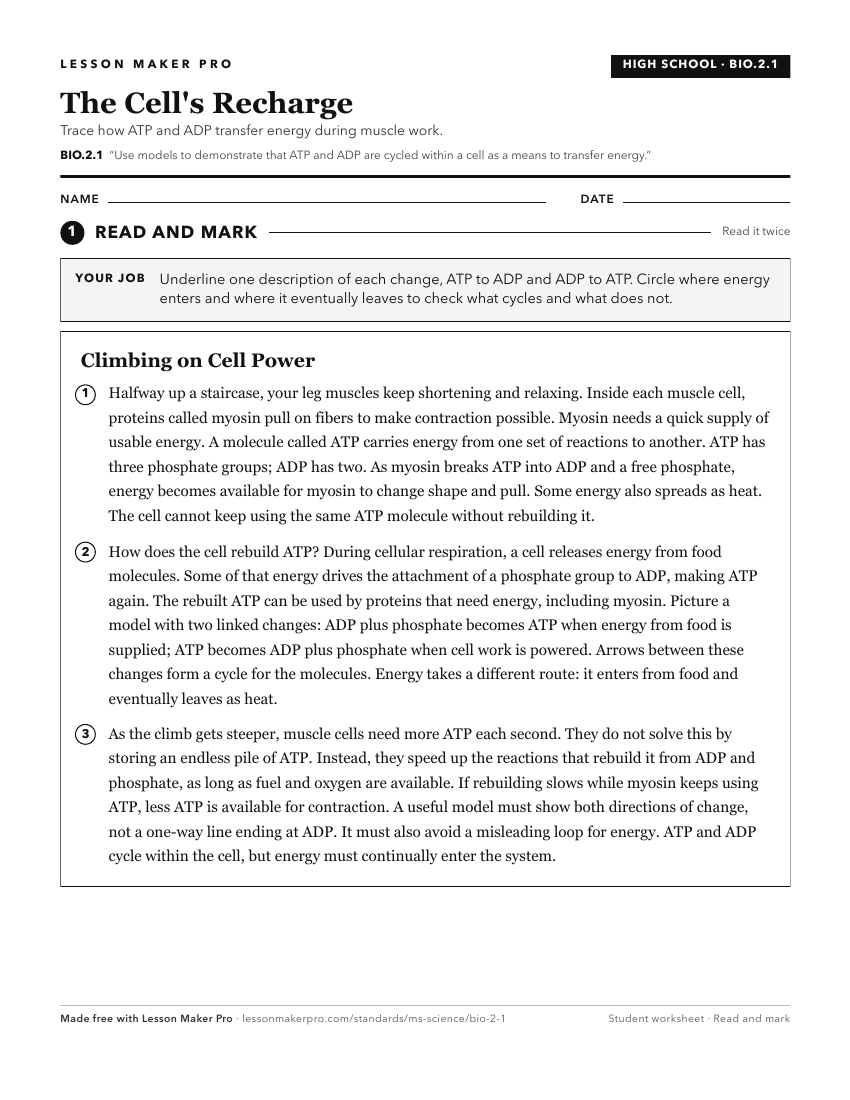
A ready-to-print activity worksheet aligned to BIO.2.1, with an answer key for the teacher on its own page. No account needed.
PDF, US Letter, prints cleanly in black and white.
Download the worksheetKeep exploring
Related Standards
- FB.3.5
Use models to explain how ADP and ATP cycle to store and release chemical energy using inorganic phosphate.
- BIO.1D.2
Develop and use models to explain how the cell deals with imbalances of solute concentration across the cell membrane (i.e., hypertonic, hypotonic, and isotonic...
- BIO.2.2
Develop models of the major reactants and products of photosynthesis to demonstrate the transformation of light energy into stored chemical energy in cells. Emp...
- BIO.2.3
Develop models of the major reactants and products of cellular respiration (aerobic and anaerobic) to demonstrate the transformation of the chemical energy stor...
Turn this exact standard into a lesson
Grade, subject, topic, and the complete standard are prefilled. Create one free, no account needed.
Also for this standard:Make a WorksheetMake a QuizMake a Sub Lesson