Mississippi Science BIO.1D.2
The Standard
- BIO.1D
- Students will describe the structure of the cell membrane and analyze how the structure is related to its primary function of regulating transport in and out of cells to maintain homeostasis.
Develop and use models to explain how the cell deals with imbalances of solute concentration across the cell membrane (i.e., hypertonic, hypotonic, and isotonic conditions, sodium/potassium pump).
2026 Mississippi College- and Career-Readiness Standards for Science · Cells as a System
Teacher's field guide
What This Standard Means
What Students Need to Do
- Students draw a cell with different solute levels inside and outside it. They use arrows to show water movement and predict changes in cell size. They model how the sodium-potassium pump moves ions using ATP.
What Mastery Looks Like
- Students show water moving toward the higher solute level and predict whether a cell swells or shrinks. They show water moving both ways in an isotonic fluid, with no overall change in cell size. They show ATP powering a pump that moves three sodium ions out and two potassium ions in.
Common Misconceptions
- Students may draw water moving toward the lower solute level. Some think water stops moving in an isotonic fluid. Others think the sodium-potassium pump moves water or works without ATP.
How to Assess It
- Exit ticket: Give students three cell diagrams labeled hypertonic, hypotonic, and isotonic. Ask them to draw water arrows, predict size changes, and label ATP, three sodium ions out, and two potassium ions in on one pump.
Lesson moves
Ways to Teach It
Weigh potato strips, soak them in salt water or plain water for 20 minutes, then blot, reweigh, and draw water arrows.
Show cells in salty and fresh water, then ask students to write which cell swells and explain why using water arrows.
Have pairs match tonicity cards to cell sketches, then use three sodium tokens, two potassium tokens, and an ATP token to model the pump.
Show a bag labeled 0.9% saline and ask why hospitals use it instead of pure water for red blood cells.
Free download
Printable BIO.1D.2 Worksheet
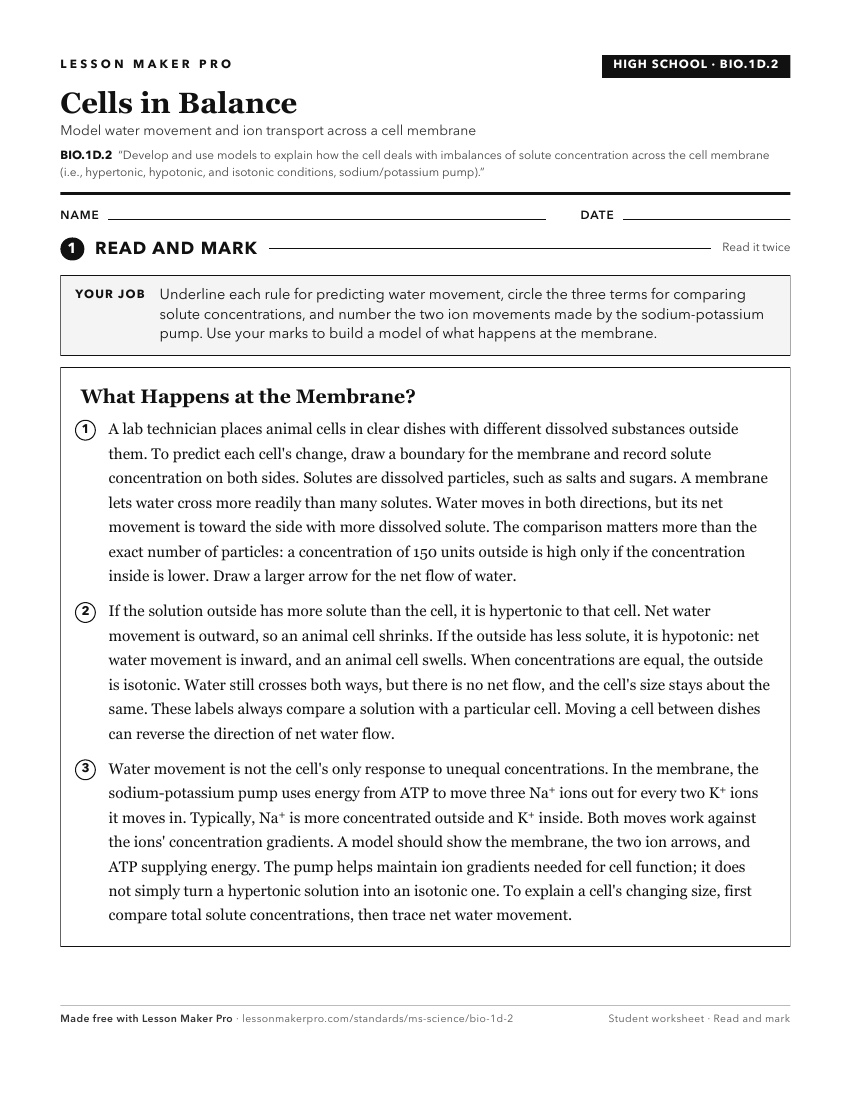
A ready-to-print activity worksheet aligned to BIO.1D.2, with an answer key for the teacher on its own page. No account needed.
PDF, US Letter, prints cleanly in black and white.
Download the worksheetKeep exploring
Related Standards
- L.6.1.3
Develop and use models to explain how specific cellular components (cell wall, cell membrane, nucleus, chloroplast, vacuole, and mitochondria) function together...
- BIO.1C.1
Develop and use models to explore how specialized structures within cells (e.g., nucleus, cytoskeleton, endoplasmic reticulum, ribosomes, Golgi apparatus, lysos...
- BIO.1D.1
Plan and conduct investigations to prove that the cell membrane is semi-permeable, allowing it to maintain homeostasis with its environment through active and p...
- FB.3.3
Compare and contrast active and passive cellular transport. Analyze the movement of water across a cell membrane in hypotonic, isotonic, and hypertonic solution...
Turn this exact standard into a lesson
Grade, subject, topic, and the complete standard are prefilled. Create one free, no account needed.
Also for this standard:Make a WorksheetMake a QuizMake a Sub Lesson