Mississippi Science BIO.1D.1
The Standard
- BIO.1D
- Students will describe the structure of the cell membrane and analyze how the structure is related to its primary function of regulating transport in and out of cells to maintain homeostasis.
Plan and conduct investigations to prove that the cell membrane is semi-permeable, allowing it to maintain homeostasis with its environment through active and passive transport processes.
2026 Mississippi College- and Career-Readiness Standards for Science · Cells as a System
Teacher's field guide
What This Standard Means
What Students Need to Do
- Students plan and run a controlled test with onion cells in water and saltwater. They use sketches to track water movement and concentration data to compare passive transport with energy-driven uptake of ions. They explain how these movements help cells keep conditions stable.
What Mastery Looks Like
- A student sketches onion cells before and after adding saltwater and explains why the cell contents pull away from the walls. Given concentration data, they can identify when movement needs energy and explain how a membrane controls what enters and leaves.
Common Misconceptions
- Students may think a cell membrane lets only water through, or that every substance crosses it freely. They may call all movement through a membrane protein active transport. Some think salt entering an onion cell makes it shrink, rather than water leaving it.
How to Assess It
- Exit ticket: Onion cell contents pull away from the walls in saltwater and recover in fresh water. Explain which way water moved each time, then explain how a root cell takes up ions when their concentration is higher inside than outside.
Lesson moves
Ways to Teach It
Place red onion cells in water, add 10% salt solution, then rinse with water and sketch changes under a microscope.
Ask: Root cells take in mineral ions even when ion levels are higher inside. What does that tell you about energy use?
Give pairs molecule, gradient, protein, and ATP cards; have them build examples of osmosis, diffusion, facilitated diffusion, and active transport.
Compare wilted lettuce before and after a water soak, then sketch how water movement into its cells changes its firmness.
Free download
Printable BIO.1D.1 Worksheet
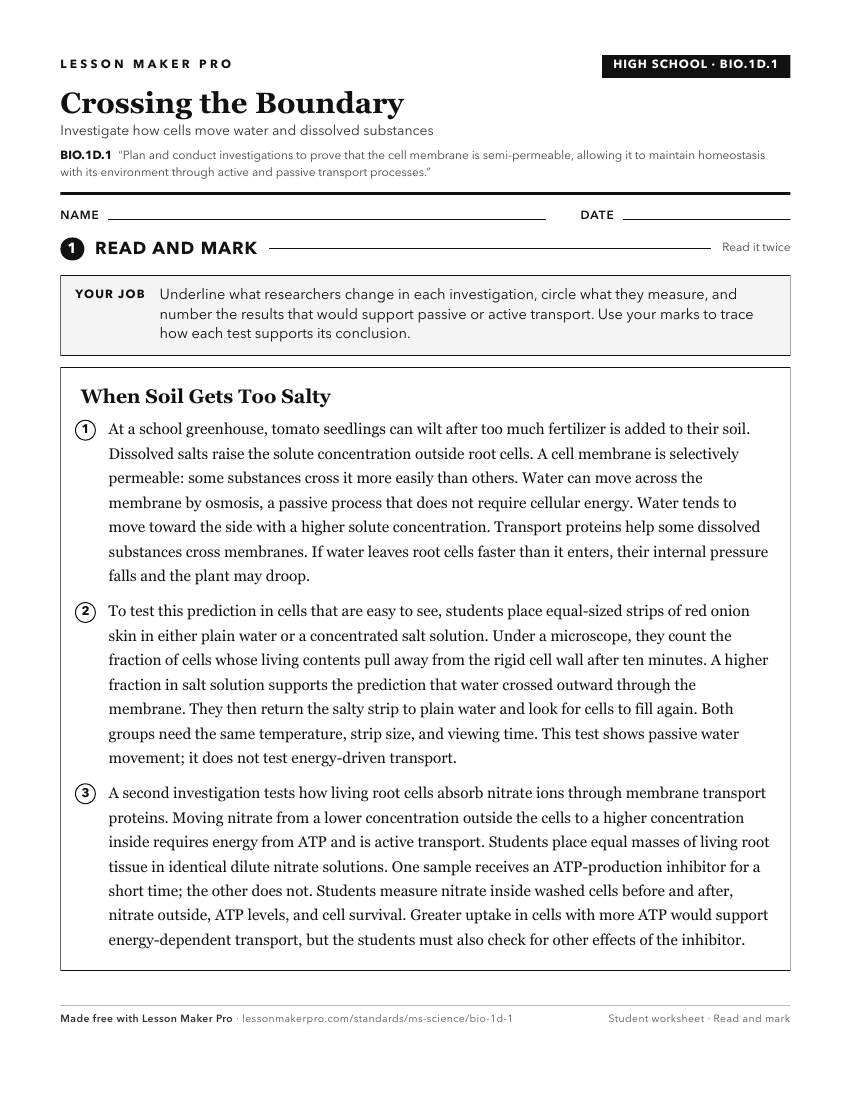
A ready-to-print activity worksheet aligned to BIO.1D.1, with an answer key for the teacher on its own page. No account needed.
PDF, US Letter, prints cleanly in black and white.
Download the worksheetKeep exploring
Related Standards
- BIO.1D.2
Develop and use models to explain how the cell deals with imbalances of solute concentration across the cell membrane (i.e., hypertonic, hypotonic, and isotonic...
- BIO.1D
Students will describe the structure of the cell membrane and analyze how the structure is related to its primary function of regulating transport in and out of...
- FB.2.5
Investigate how the properties of water (e.g., cohesion, adhesion, heat capacity, solvent properties) contribute to the maintenance of living cells and organism...
- HAP.3.2
Investigate specific mechanisms (e.g., feedback and temperature regulation) through which the skin maintains homeostasis.
Turn this exact standard into a lesson
Grade, subject, topic, and the complete standard are prefilled. Create one free, no account needed.
Also for this standard:Make a WorksheetMake a QuizMake a Sub Lesson