Mississippi Science HAP.3.2
The Standard
- HAP.3
- Students will investigate the structures and functions of the integumentary system, including the cause and effect of diseases and disorders.
Investigate specific mechanisms (e.g., feedback and temperature regulation) through which the skin maintains homeostasis.
2026 Mississippi College- and Career-Readiness Standards for Science · Integumentary System
Teacher's field guide
What This Standard Means
What Students Need to Do
- Students trace what happens when body temperature rises or falls. They connect temperature sensors, the brain, sweat glands, and skin blood vessels to the body's response.
What Mastery Looks Like
- Given a hot or cold scenario, students can explain how the brain signals the skin to respond. They can explain how sweat evaporation and wider blood vessels release heat, while narrower blood vessels reduce heat loss.
Common Misconceptions
- Students may think sweat cools the body as soon as it appears, rather than when it evaporates. They may also think skin blood vessels widen in the cold instead of narrowing.
How to Assess It
- On an exit ticket, ask: "Your body temperature rises during a run. What two changes happen in your skin, and how does each help cool you?"
Lesson moves
Ways to Teach It
Put a drop of water on each wrist, fan one wrist, and compare how quickly each dries and feels cool.
Ask why skin turns red and sweaty after running, and have students explain how each change lowers body temperature.
Give pairs cards showing a temperature rise, a brain signal, sweating, evaporation, and cooling; have them order the cards and identify the feedback.
Show a heat index chart, then ask why a runner's sweat cools less on a humid day.
Free download
Printable HAP.3.2 Worksheet
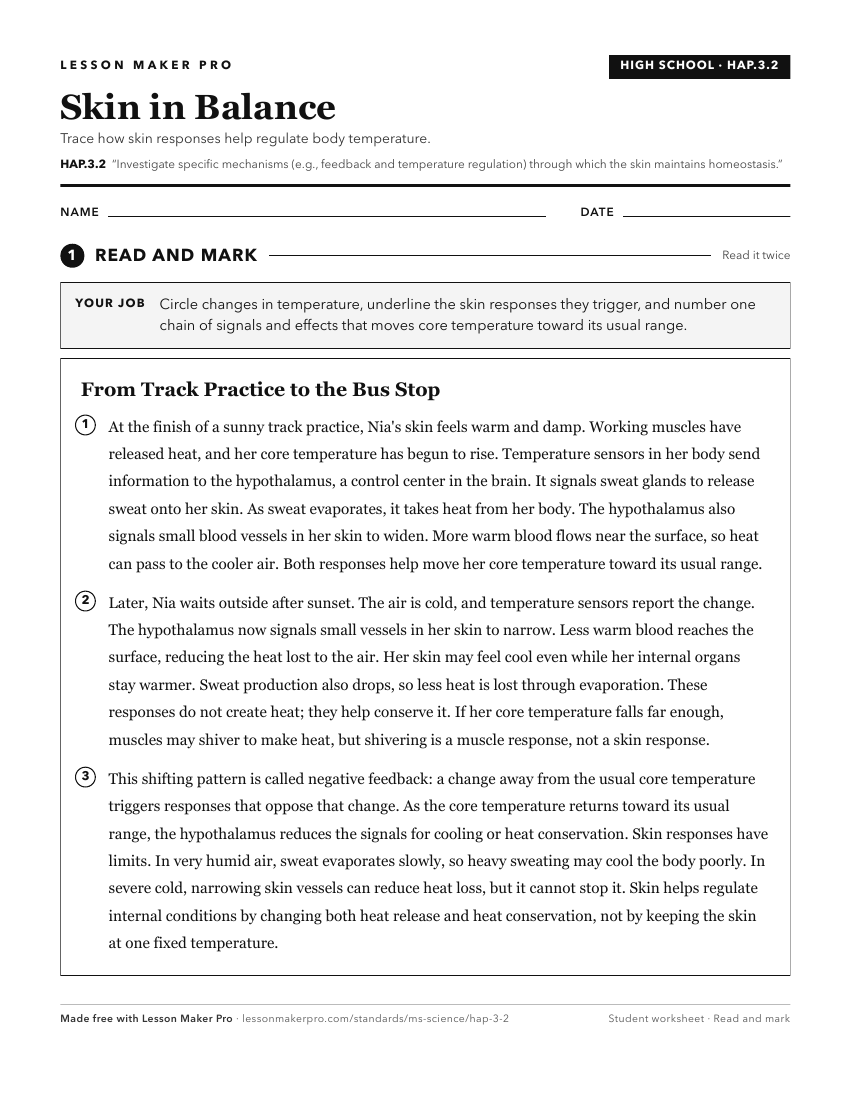
A ready-to-print activity worksheet aligned to HAP.3.2, with an answer key for the teacher on its own page. No account needed.
PDF, US Letter, prints cleanly in black and white.
Download the worksheetKeep exploring
Related Standards
- HAP.7.3
Model specific mechanisms through which the endocrine system maintains homeostasis (e.g., insulin/glucagon and glucose regulation; T3 / T4 and metabolic rates; ...
- BIO.1D.1
Plan and conduct investigations to prove that the cell membrane is semi-permeable, allowing it to maintain homeostasis with its environment through active and p...
- HAP.4.5
Construct explanations detailing how mechanisms (e.g., Ca2+ regulation) are used by the skeletal system to maintain homeostasis.
- FB.2.5
Investigate how the properties of water (e.g., cohesion, adhesion, heat capacity, solvent properties) contribute to the maintenance of living cells and organism...
Turn this exact standard into a lesson
Grade, subject, topic, and the complete standard are prefilled. Create one free, no account needed.
Also for this standard:Make a WorksheetMake a QuizMake a Sub Lesson