Mississippi Science HAP.7.3
The Standard
- HAP.7
- Students will demonstrate an understanding of the major organs of the endocrine system and the associated hormonal production and regulation.
Model specific mechanisms through which the endocrine system maintains homeostasis (e.g., insulin/glucagon and glucose regulation; T3 / T4 and metabolic rates; calcitonin/parathyroid and calcium regulation; antidiuretic hormone and water balance; growth hormone; and cortisol and stress).
2026 Mississippi College- and Career-Readiness Standards for Science · Endocrine System
Teacher's field guide
What This Standard Means
What Students Need to Do
- Students draw feedback loops for blood glucose and water balance. They label what changes, which hormone is released, where it acts, and how the body moves back toward its usual range.
What Mastery Looks Like
- A student can show that high blood glucose triggers insulin release, which helps muscle cells take up glucose and the liver store it. They can show that low blood glucose triggers glucagon release, which makes the liver release glucose. They can also explain how ADH helps the kidneys keep water when the body is low on water.
Common Misconceptions
- Students may say insulin raises blood glucose and glucagon lowers it. They may think ADH adds new water to the body, rather than helping the kidneys keep water already there. Some leave out the step where hormone release slows as conditions return to range.
How to Assess It
- Exit ticket: After a sugary snack, draw a feedback loop that names the hormone, its source, a target tissue, the tissue's response, and what slows hormone release.
Lesson moves
Ways to Teach It
Give pairs pancreas, insulin, glucagon, liver, and blood glucose cards; have them arrange separate high and low blood glucose loops.
Ask students to explain in writing why drinking little water can lead to less urine, naming ADH and the kidneys.
Call out 'blood calcium falls,' 'blood glucose rises,' or 'dehydration'; teams sketch the hormone, target tissue, and corrective response.
Use a sports drink label to ask how its sugar might affect insulin, then have students trace the response in muscle and liver.
Free download
Printable HAP.7.3 Worksheet
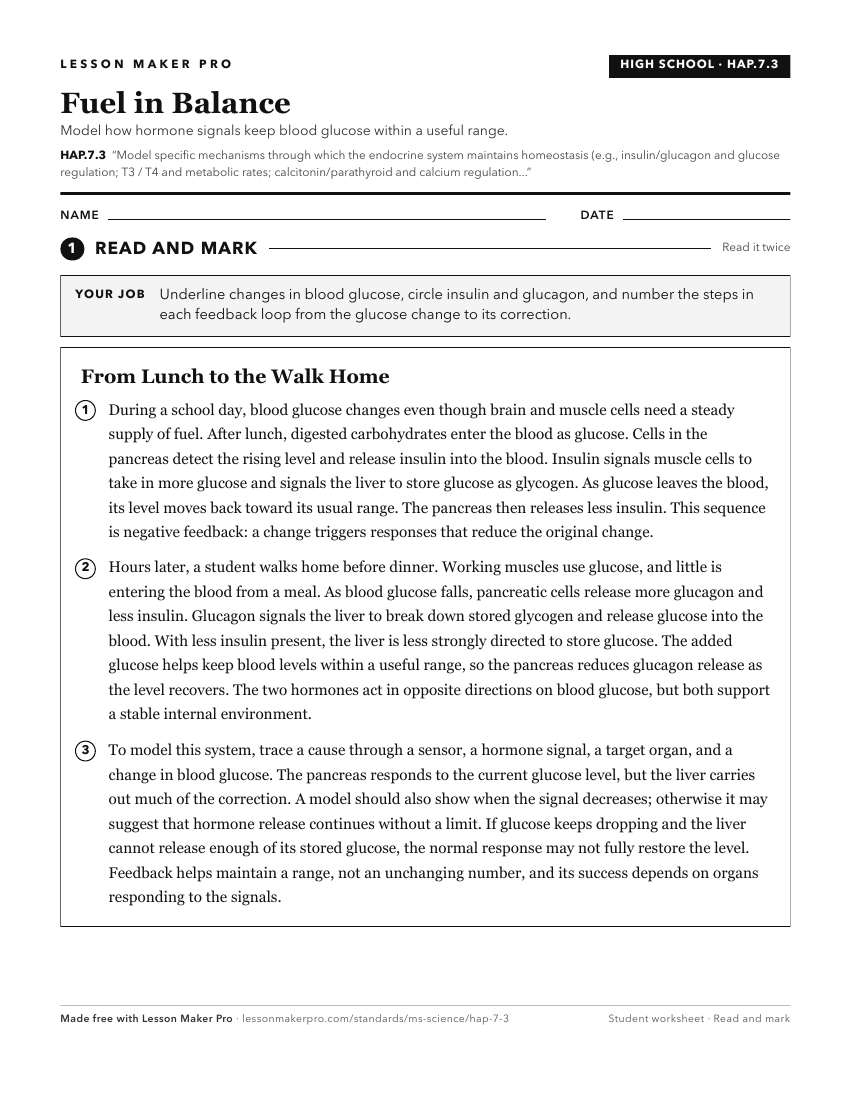
A ready-to-print activity worksheet aligned to HAP.7.3, with an answer key for the teacher on its own page. No account needed.
PDF, US Letter, prints cleanly in black and white.
Download the worksheetKeep exploring
Related Standards
- HAP.7.2
Discuss the function of each endocrine gland and the various hormones secreted.
- HAP.4.5
Construct explanations detailing how mechanisms (e.g., Ca2+ regulation) are used by the skeletal system to maintain homeostasis.
- HAP.3.2
Investigate specific mechanisms (e.g., feedback and temperature regulation) through which the skin maintains homeostasis.
- HAP.7.1
Obtain, evaluate, and communicate information to illustrate that the endocrine glands secrete hormones that help the body maintain homeostasis through feedback ...
Turn this exact standard into a lesson
Grade, subject, topic, and the complete standard are prefilled. Create one free, no account needed.
Also for this standard:Make a WorksheetMake a QuizMake a Sub Lesson