Mississippi Science BIO.1D
Standard Cluster
Students will describe the structure of the cell membrane and analyze how the structure is related to its primary function of regulating transport in and out of cells to maintain homeostasis. Plan and conduct investigations to prove that the cell membrane is semi-permeable, allowing it to maintain homeostasis with its environment through active and passive transport processes. Develop and use models to explain how the cell deals with imbalances of solute concentration across the cell membrane (i.e., hypertonic, hypotonic, and isotonic conditions, sodium/potassium pump).
2026 Mississippi College- and Career-Readiness Standards for Science · Cells as a System
Cluster contents
Standards in This Cluster
BIO.1D is a cluster heading. These are the individual standards under it.
- BIO.1D.1
Plan and conduct investigations to prove that the cell membrane is semi-permeable, allowing it to maintain homeostasis with its environment through active and p...
- BIO.1D.2
Develop and use models to explain how the cell deals with imbalances of solute concentration across the cell membrane (i.e., hypertonic, hypotonic, and isotonic...
Teacher's field guide
What This Cluster Means
What Students Need to Do
- Students identify the phospholipid bilayer and transport proteins, then explain how they control what crosses. They investigate which substances pass through a membrane model. They use models to predict water movement and explain when transport needs ATP.
What Mastery Looks Like
- Given cell and solution concentrations, students predict whether a cell swells, shrinks, or stays the same size. They explain how substances cross the bilayer or use transport proteins. They show the sodium-potassium pump using ATP to move three sodium ions out and two potassium ions in.
Common Misconceptions
- Students may think the membrane is a solid wall or that every substance needs a protein to cross it. They may blame a potato strip's mass change on salt entering it instead of water moving across its cells' membranes. Some think isotonic means water stops moving or that pumps work without ATP.
How to Assess It
- Exit ticket: Draw a cell membrane with phospholipids and a pump. Show which way water moves when the cell is placed in concentrated salt water, then explain why the pump needs ATP to move sodium against its gradient.
Lesson moves
Ways to Teach It
Fill dialysis tubing with starch solution, soak it in iodine solution, and check both sides for color to identify what crossed the model membrane.
Sketch a cell in fresh water and salt water; explain which way water moves in each and why.
Give pairs molecule and concentration cards; have them route oxygen, water, and sodium through a bilayer, channel, or ATP-powered pump.
Compare plain water, concentrated saline, and matching saline as IV fluids; predict what happens to red blood cells in each.
Free download
Printable BIO.1D Worksheet
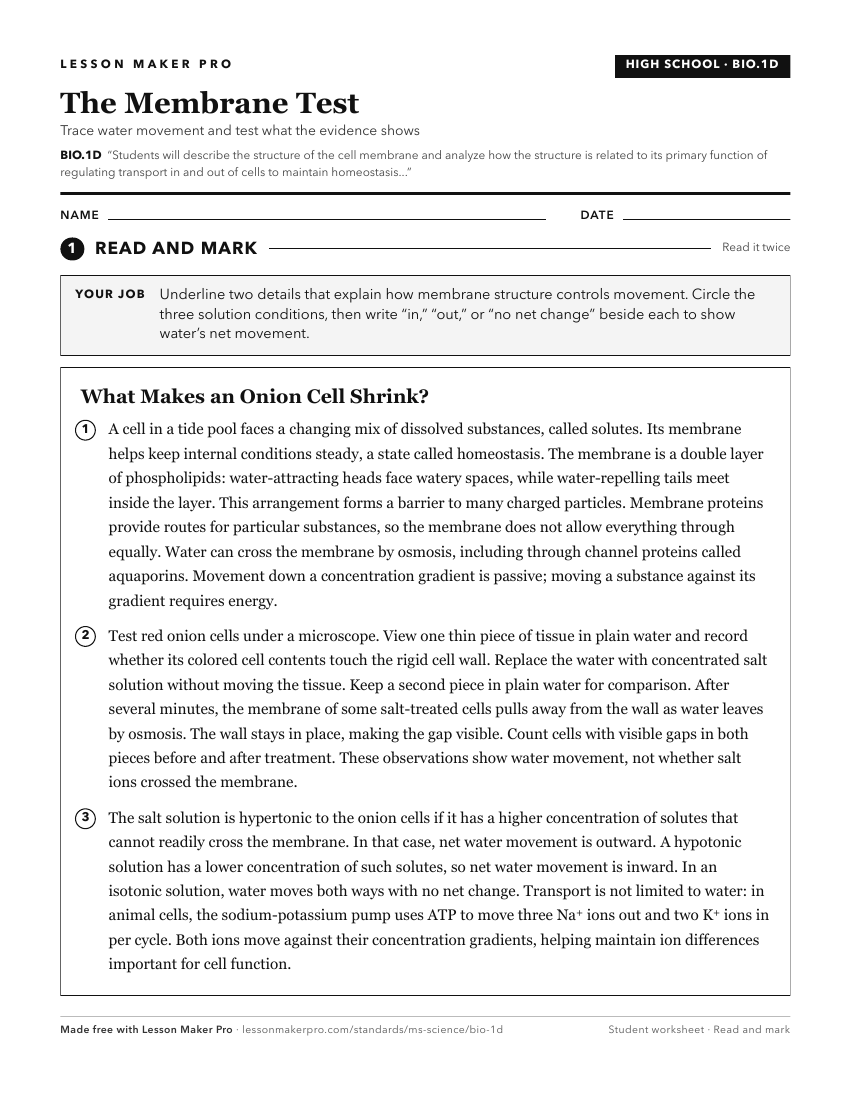
A ready-to-print activity worksheet aligned to BIO.1D, with an answer key for the teacher on its own page. No account needed.
PDF, US Letter, prints cleanly in black and white.
Download the worksheetKeep exploring
Related Standards
- FB.3
Students will demonstrate an understanding of how the structure of living organisms supports the essential functions of life.
- BIO.1B
Students will analyze the structure and function of the macromolecules that make up cells.
- HAP.9
Students will analyze the structure and functions of blood and its role in maintaining homeostasis.
Turn this cluster into a lesson
Grade, subject, topic, and the complete cluster are prefilled. Create one free, no account needed.
Also for this cluster:Make a WorksheetMake a QuizMake a Sub Lesson