Mississippi Science BIO.1B
Standard Cluster
Students will analyze the structure and function of the macromolecules that make up cells. Develop and use models to compare and contrast the structure and function of carbohydrates, lipids, proteins, and nucleic acids (DNA and RNA) in organisms. Design and conduct an experiment to determine how enzymes react given various environmental conditions (i.e., pH, temperature, and concentration). Analyze, interpret, graph, and present data to explain how those changing conditions affect the enzyme activity and the rate of the reactions that take place in biological organisms.
2026 Mississippi College- and Career-Readiness Standards for Science · Cells as a System
Cluster contents
Standards in This Cluster
BIO.1B is a cluster heading. These are the individual standards under it.
- BIO.1B.1
Develop and use models to compare and contrast the structure and function of carbohydrates, lipids, proteins, and nucleic acids (DNA and RNA) in organisms.
- BIO.1B.2
Design and conduct an experiment to determine how enzymes react given various environmental conditions (i.e., pH, temperature, and concentration). Analyze, inte...
Teacher's field guide
What This Cluster Means
What Students Need to Do
- Students build models of carbohydrates, lipids, proteins, DNA, and RNA. They compare how each molecule’s structure helps it work in cells. They design and run enzyme tests that change pH, temperature, and enzyme concentration, then graph and explain the results.
What Mastery Looks Like
- Students can identify each molecule’s parts and job, including how DNA stores instructions and RNA helps make proteins. They keep other conditions steady in an enzyme test, graph reaction rates, and use the data to explain changes in activity.
Common Misconceptions
- Students may think all these molecules are made of amino acids, or mix up the jobs of DNA and RNA. They may think enzymes are used up in a reaction or that more heat always makes an enzyme work faster.
How to Assess It
- Give students cards for starch, oil, catalase, DNA, and RNA, plus catalase foam heights after one minute at pH 4, 7, and 10: 1, 6, and 2 cm. Ask them to name each molecule’s job, graph the foam heights, and explain the pH pattern.
Lesson moves
Ways to Teach It
Wearing goggles, test yeast catalase with 3% peroxide at pH 4, 7, and 10; keep volumes constant and measure one-minute foam heights.
Ask students to sketch starch, a fat, a folded enzyme, and DNA, then write how each shape helps it do its job.
Sort cards showing sugars, glycerol and fatty acids, amino acids, and nucleotides into molecule groups, then match each group to a cell job.
Read a lactase supplement label, then predict how stomach acid might change the enzyme’s shape and its ability to break down lactose.
Free download
Printable BIO.1B Worksheet
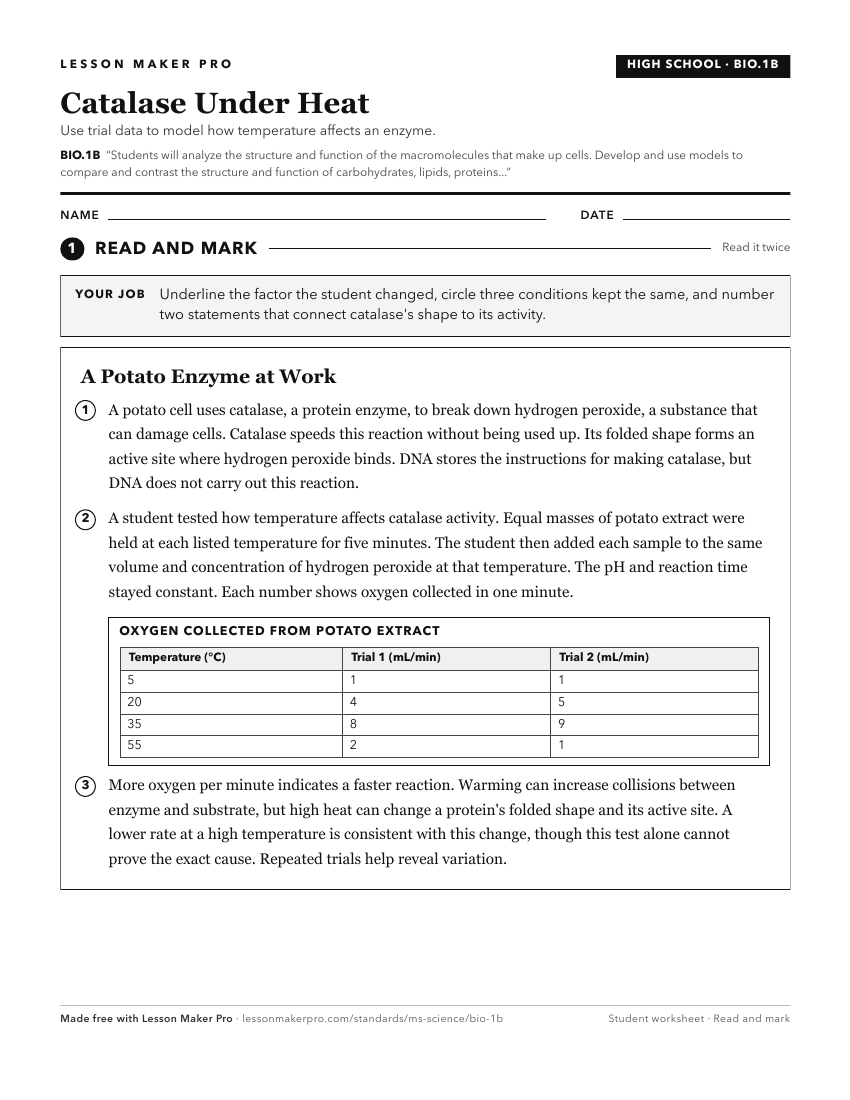
A ready-to-print activity worksheet aligned to BIO.1B, with an answer key for the teacher on its own page. No account needed.
PDF, US Letter, prints cleanly in black and white.
Download the worksheetKeep exploring
Related Standards
- FB.3
Students will demonstrate an understanding of how the structure of living organisms supports the essential functions of life.
- BIO.1D
Students will describe the structure of the cell membrane and analyze how the structure is related to its primary function of regulating transport in and out of...
- HAP.2
Students will demonstrate an understanding of the relationship of cells and tissues that form complex structures of the body.
- FB.2
Students will demonstrate an understanding of the structure and interactions of matter and how the organization of matter supports living organisms.
Turn this cluster into a lesson
Grade, subject, topic, and the complete cluster are prefilled. Create one free, no account needed.
Also for this cluster:Make a WorksheetMake a QuizMake a Sub Lesson