Mississippi Science BIO.1B.2
The Standard
- BIO.1B
- Students will analyze the structure and function of the macromolecules that make up cells.
Design and conduct an experiment to determine how enzymes react given various environmental conditions (i.e., pH, temperature, and concentration). Analyze, interpret, graph, and present data to explain how those changing conditions affect the enzyme activity and the rate of the reactions that take place in biological organisms.
2026 Mississippi College- and Career-Readiness Standards for Science · Cells as a System
Teacher's field guide
What This Standard Means
What Students Need to Do
- Students plan a fair test of how pH, temperature, or concentration affects an enzyme reaction. They measure the reaction, graph their data, and explain the pattern.
What Mastery Looks Like
- A student changes one condition at a time, repeats trials, and measures foam produced in 30 seconds. They label their graph and use it to explain when the enzyme works fastest.
Common Misconceptions
- Students may think heat always speeds up enzymes, even when high heat changes their shape. They may change two conditions at once or assume more foam always means more enzyme.
How to Assess It
- Exit ticket: Yeast and peroxide produced 1 cm of foam at 10°C, 4 cm at 25°C, and 0 cm at 60°C after 30 seconds. Graph the results and explain the result at 60°C.
Lesson moves
Ways to Teach It
In goggles, teams test yeast with 3% peroxide and dish soap in ice, room-temperature, and warm-water baths, measuring foam after 30 seconds.
Ask, 'Why might hot yeast produce less foam than warm yeast?' Have pairs support their answers with two points from their graphs.
Give pairs nine data cards for pH, temperature, and peroxide concentration; have them sort by variable and graph one set.
Show a stomach pH 2 card and an intestine pH 8 card; ask where the digestive enzyme pepsin works best and why.
Free download
Printable BIO.1B.2 Worksheet
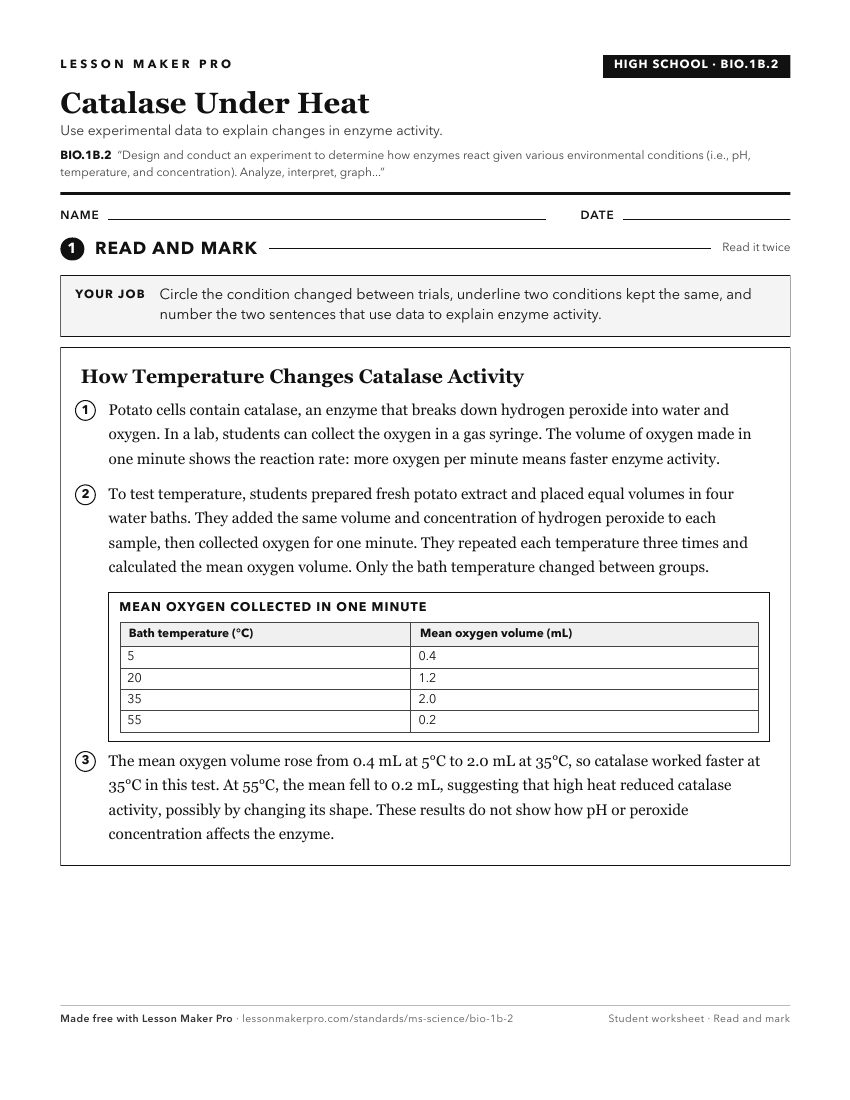
A ready-to-print activity worksheet aligned to BIO.1B.2, with an answer key for the teacher on its own page. No account needed.
PDF, US Letter, prints cleanly in black and white.
Download the worksheetKeep exploring
Related Standards
- P.7.5D.2
Design and conduct scientific investigations to support evidence that chemical reactions (e.g., cooking, combustion, rusting, decomposition, photosynthesis, and...
- HAP.13.5
Research and analyze the activity of digestive enzymes within different organs of the digestive tract, connecting enzyme function to environmental factors such ...
- CHE.1.2
Design and conduct experiments using appropriate measurements, significant figures, graphical analysis to analyze data.
- PHS.4.1
Design and conduct experiments to investigate physical and chemical changes of various household products (e.g., rusting, sour milk, crushing, grinding, tearing...
Turn this exact standard into a lesson
Grade, subject, topic, and the complete standard are prefilled. Create one free, no account needed.
Also for this standard:Make a WorksheetMake a QuizMake a Sub Lesson