Mississippi Science HAP.13.5
The Standard
- HAP.13
- Students will investigate the structures and functions of the digestive system, including the cause and effect of diseases and disorders.
Research and analyze the activity of digestive enzymes within different organs of the digestive tract, connecting enzyme function to environmental factors such as pH.
2026 Mississippi College- and Career-Readiness Standards for Science · Digestive System
Teacher's field guide
What This Standard Means
What Students Need to Do
- Students find information about enzymes in the mouth, stomach, and small intestine. They compare what each enzyme breaks down and use pH data to explain where it works best.
What Mastery Looks Like
- Students can match salivary amylase with starch in the mouth, pepsin with protein in the stomach, and pancreatic lipase with fat in the small intestine. Given an activity graph, they can predict how a pH change affects an enzyme and point to evidence.
Common Misconceptions
- Students may think stomach acid breaks down protein without help from an enzyme. They may also think salivary amylase keeps working at the same rate when it reaches the acidic stomach.
How to Assess It
- Exit ticket: Pepsin works best at pH 2, and salivary amylase works best at pH 7. Which is more active in a stomach at pH 2? Explain your choice.
Lesson moves
Ways to Teach It
Mix starch and dissolved amylase tablets in separate vinegar and water cups; after ten minutes, use iodine to compare the starch left.
Show a pH-activity graph for pepsin and amylase; ask students to explain why each works best in a different organ.
Give pairs enzyme, food, organ, and pH cards; have them build matching sets and explain one match.
Read an antacid label, then use a pepsin activity graph to predict how raising stomach pH affects protein digestion.
Free download
Printable HAP.13.5 Worksheet
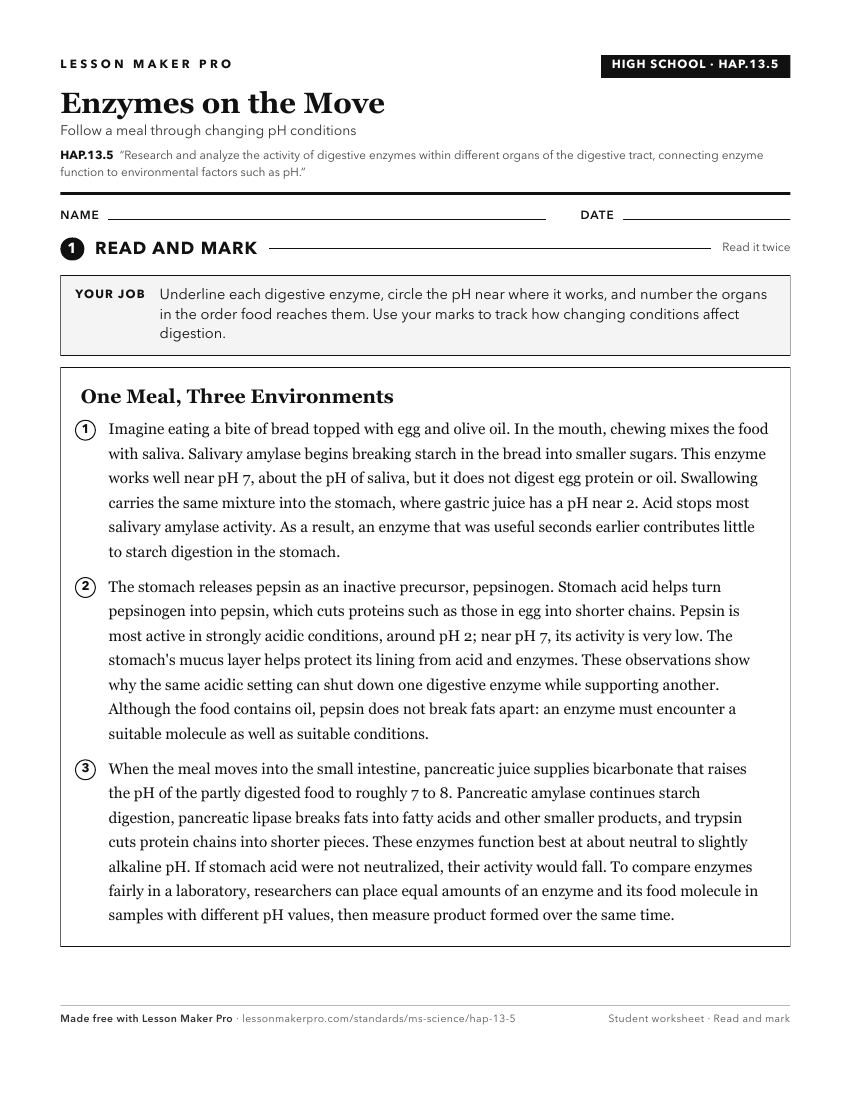
A ready-to-print activity worksheet aligned to HAP.13.5, with an answer key for the teacher on its own page. No account needed.
PDF, US Letter, prints cleanly in black and white.
Download the worksheetKeep exploring
Related Standards
- HAP.13.7
Research and analyze the causes and effects of various pathological conditions (e.g., GERD/acid reflux, stomach ulcers, lactose intolerance, irritable bowel syn...
- HAP.13.1
Analyze the structure-function relationship in organs of the digestive system.
- BIO.1B.2
Design and conduct an experiment to determine how enzymes react given various environmental conditions (i.e., pH, temperature, and concentration). Analyze, inte...
- HAP.13.4
Plan and conduct an experiment to illustrate the necessity of mechanical digestion for efficient chemical digestion.
Turn this exact standard into a lesson
Grade, subject, topic, and the complete standard are prefilled. Create one free, no account needed.
Also for this standard:Make a WorksheetMake a QuizMake a Sub Lesson