Mississippi Science HAP.9
Standard Cluster
Students will analyze the structure and functions of blood and its role in maintaining homeostasis. Describe the structure, function, and origin of the cellular components and plasma components of blood. Distinguish the cellular difference between the ABO blood groups and investigate blood type differences utilizing antibodies to determine compatible donors and recipients. Research and analyze the causes and effects of various pathological conditions (e.g., anemia, malaria, leukemia, hemophilia, and blood doping). Enrichment: Use an engineering design process to develop effective treatments for blood disorders (e.g., methods to regulate blood cell counts or blood doping tests). *
2026 Mississippi College- and Career-Readiness Standards for Science · Blood
Cluster contents
Standards in This Cluster
HAP.9 is a cluster heading. These are the individual standards under it.
- HAP.9.1
Describe the structure, function, and origin of the cellular components and plasma components of blood.
- HAP.9.2
Distinguish the cellular difference between the ABO blood groups and investigate blood type differences utilizing antibodies to determine compatible donors and ...
- HAP.9.3
Research and analyze the causes and effects of various pathological conditions (e.g., anemia, malaria, leukemia, hemophilia, and blood doping).
- HAP.9.4
Enrichment: Use an engineering design process to develop effective treatments for blood disorders (e.g., methods to regulate blood cell counts or blood doping t...
Teacher's field guide
What This Cluster Means
What Students Need to Do
- Students explain what red cells, white cells, platelets, and plasma do to keep the body stable. They trace blood cells to bone marrow and identify water and proteins in plasma. They use antibody reactions to check blood type and donor matches, then connect blood disorders to changes in blood function.
What Mastery Looks Like
- A student can explain how red cells carry oxygen, white cells fight infection, and platelets and plasma proteins help blood clot. They can read anti-A and anti-B test results and choose safe red-cell donors. Given a low hemoglobin result, they can explain why the patient may feel tired.
Common Misconceptions
- Students may think ABO letters name antibodies, rather than markers on red cells. They may call platelets whole cells or assume all bleeding problems come from too few platelets. They may also assume a high white cell count always means infection.
How to Assess It
- Exit ticket: A patient has a low red cell count, and their blood clumps with anti-A but not anti-B. Name their blood type, list compatible red-cell donors, and explain one likely symptom.
Lesson moves
Ways to Teach It
Use simulated blood, anti-A and anti-B test solutions, and a spotting tray to type four mystery samples by clumping.
Give pairs an anemia case and a hemophilia case; ask which blood component fails in each and what symptom follows.
Deal ABO donor and recipient cards; have students match safe red-cell transfusions and explain why two rejected matches are unsafe.
Show a cyclist's rising hematocrit chart; ask how blood doping could improve oxygen delivery while increasing clot risk.
Free download
Printable HAP.9 Worksheet
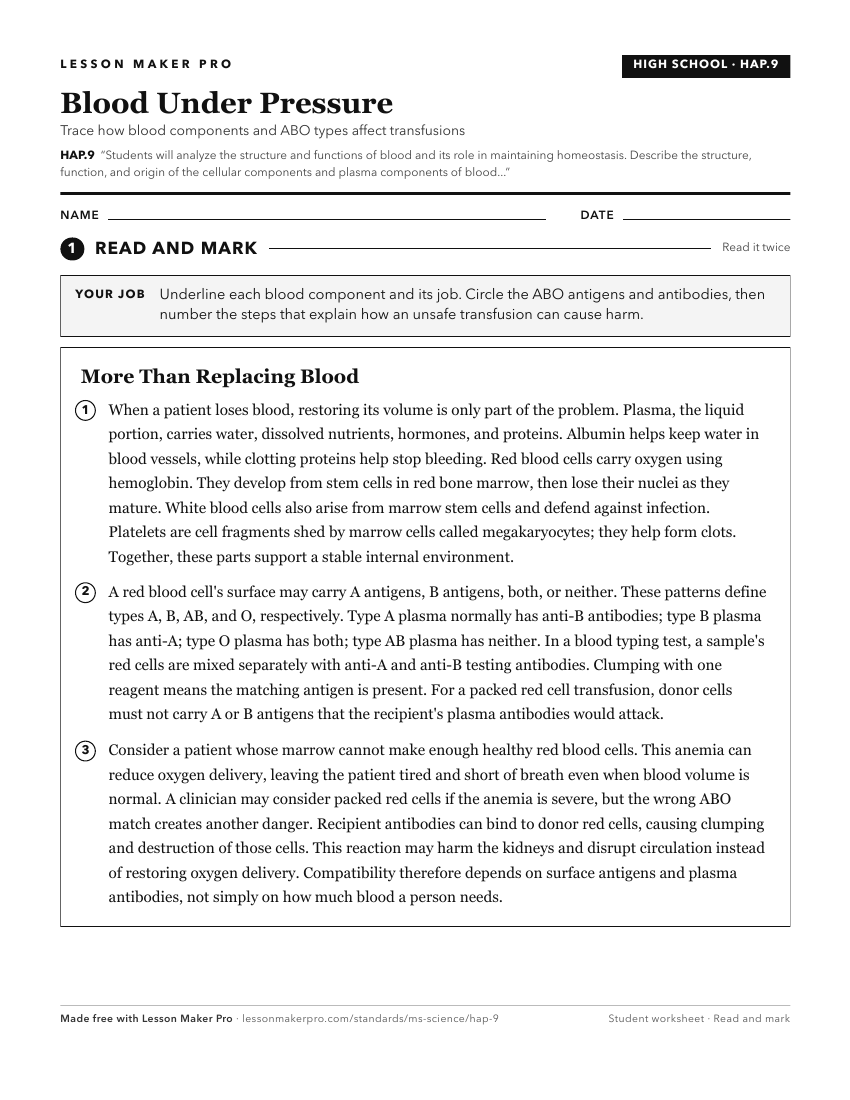
A ready-to-print activity worksheet aligned to HAP.9, with an answer key for the teacher on its own page. No account needed.
PDF, US Letter, prints cleanly in black and white.
Download the worksheetKeep exploring
Related Standards
- FB.3
Students will demonstrate an understanding of how the structure of living organisms supports the essential functions of life.
- BIO.1D
Students will describe the structure of the cell membrane and analyze how the structure is related to its primary function of regulating transport in and out of...
- L.4.1
Students will demonstrate an understanding of the organization, functions, and interconnections of the major human body systems.
- HAP.10
Students will investigate the structures and functions of the cardiovascular system, including the cause and effect of diseases and disorders.
Turn this cluster into a lesson
Grade, subject, topic, and the complete cluster are prefilled. Create one free, no account needed.
Also for this cluster:Make a WorksheetMake a QuizMake a Sub Lesson