Mississippi Science HAP.9.1
The Standard
- HAP.9
- Students will analyze the structure and functions of blood and its role in maintaining homeostasis.
Describe the structure, function, and origin of the cellular components and plasma components of blood.
2026 Mississippi College- and Career-Readiness Standards for Science · Blood
Teacher's field guide
What This Standard Means
What Students Need to Do
- Students identify red blood cells, white blood cells, platelets, and plasma in a blood diagram. They explain what each part does and where it comes from, including bone marrow for cells and platelets, and the gut and liver for plasma components.
What Mastery Looks Like
- They tell biconcave red cells, nucleated white cells, and tiny platelet fragments apart in a diagram. They connect red cells to oxygen transport, white cells to defense, platelets to clotting, and plasma to carrying dissolved materials. They trace blood cells and platelets to marrow, plasma water to the gut, and most plasma proteins to the liver.
Common Misconceptions
- Students may think platelets are whole cells or that plasma is just water with nothing dissolved in it. They may say white blood cells carry oxygen or that the liver makes blood cells.
How to Assess It
- Exit ticket: Draw and label red cells, white cells, platelets, and plasma. Add one job and source for each; name separate sources for plasma water and most plasma proteins.
Lesson moves
Ways to Teach It
Build a blood model with red clay discs, white clay balls, tiny paper dots, and water; label each part's job and source.
Ask: Why would a cut keep bleeding if a person had too few platelets but a normal red blood cell count?
Match red cell, white cell, platelet, and plasma picture cards to job cards and source cards labeled marrow, gut, and liver.
Show a mock blood test with a low platelet count and ask why the patient bruises easily despite a normal red cell count.
Free download
Printable HAP.9.1 Worksheet
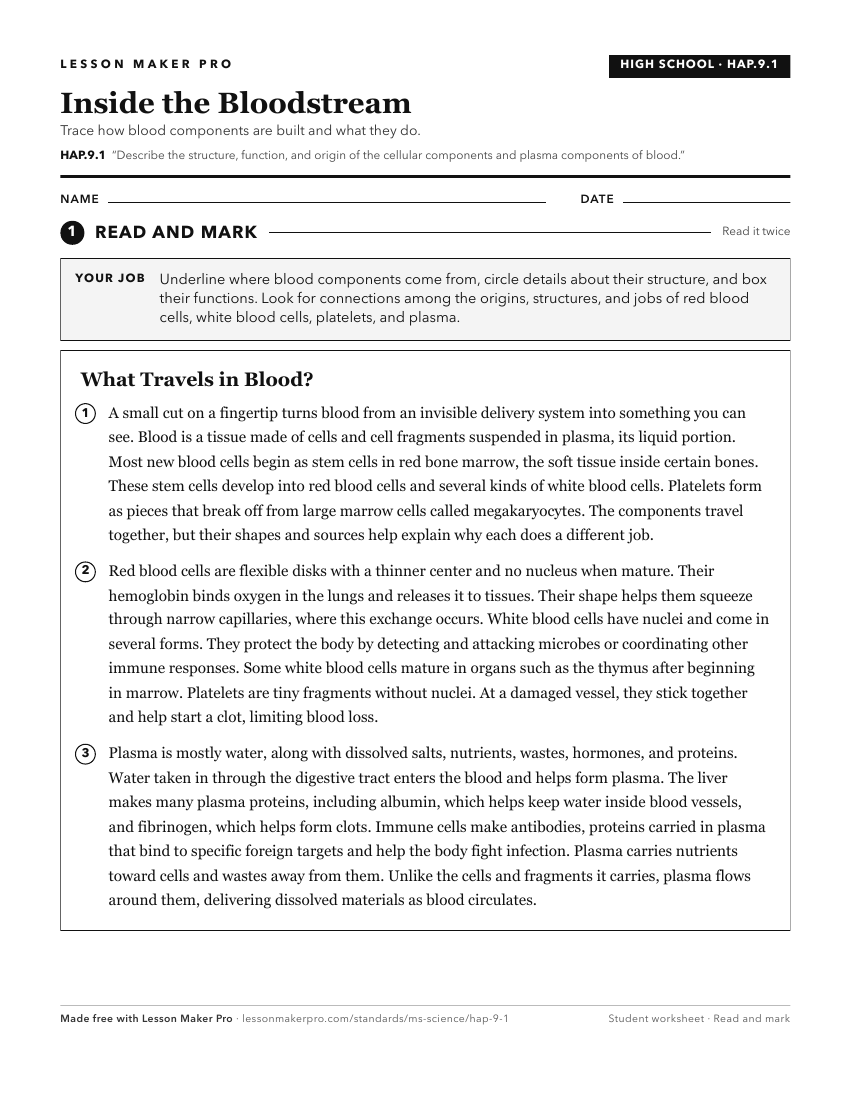
A ready-to-print activity worksheet aligned to HAP.9.1, with an answer key for the teacher on its own page. No account needed.
PDF, US Letter, prints cleanly in black and white.
Download the worksheetKeep exploring
Related Standards
- HAP.10.3
Investigate the structure and function of different types of blood vessels (e.g., arteries, capillaries, veins). Identify the role each plays in the transport a...
- HAP.6.3
Discuss the structure and function of the brain and spinal cord.
- BIO.1D
Students will describe the structure of the cell membrane and analyze how the structure is related to its primary function of regulating transport in and out of...
- HAP.9
Students will analyze the structure and functions of blood and its role in maintaining homeostasis.
Turn this exact standard into a lesson
Grade, subject, topic, and the complete standard are prefilled. Create one free, no account needed.
Also for this standard:Make a WorksheetMake a QuizMake a Sub Lesson