Mississippi Science HAP.10.3
The Standard
- HAP.10
- Students will investigate the structures and functions of the cardiovascular system, including the cause and effect of diseases and disorders.
Investigate the structure and function of different types of blood vessels (e.g., arteries, capillaries, veins). Identify the role each plays in the transport and the exchange of materials.
2026 Mississippi College- and Career-Readiness Standards for Science · Cardiovascular System
Teacher's field guide
What This Standard Means
What Students Need to Do
- Students compare the walls and valves of arteries, veins, and capillaries. They trace blood from the heart to body tissues and back, and show where oxygen, nutrients, and wastes move between blood and cells.
What Mastery Looks Like
- A student can identify an artery by its thick wall, a vein by its valves, and a capillary by its one-cell-thick wall. They can explain why exchange happens at capillaries and use flow direction, not oxygen level, to tell arteries from veins.
Common Misconceptions
- Students may think arteries always carry oxygen-rich blood and veins always carry oxygen-poor blood. They may also place oxygen exchange in arteries instead of capillaries.
How to Assess It
- On an exit ticket, have students draw the route from heart to muscle and back through all three vessel types. Ask them to mark flow direction, valves, and where oxygen leaves the blood.
Lesson moves
Ways to Teach It
Make vessel models from thick paper, mesh, and a straw with a paper flap; test which allows exchange or blocks backflow.
Ask: Why can oxygen leave blood more easily through a capillary wall than an artery wall? Have students use wall thickness in their answer.
Give pairs cards labeled thick wall, valve, and one-cell-thick wall; have them match each card to a vessel and explain their choices.
Show a photo of a blood pressure cuff on an upper arm; have students locate the brachial artery and explain why the cuff targets it.
Free download
Printable HAP.10.3 Worksheet
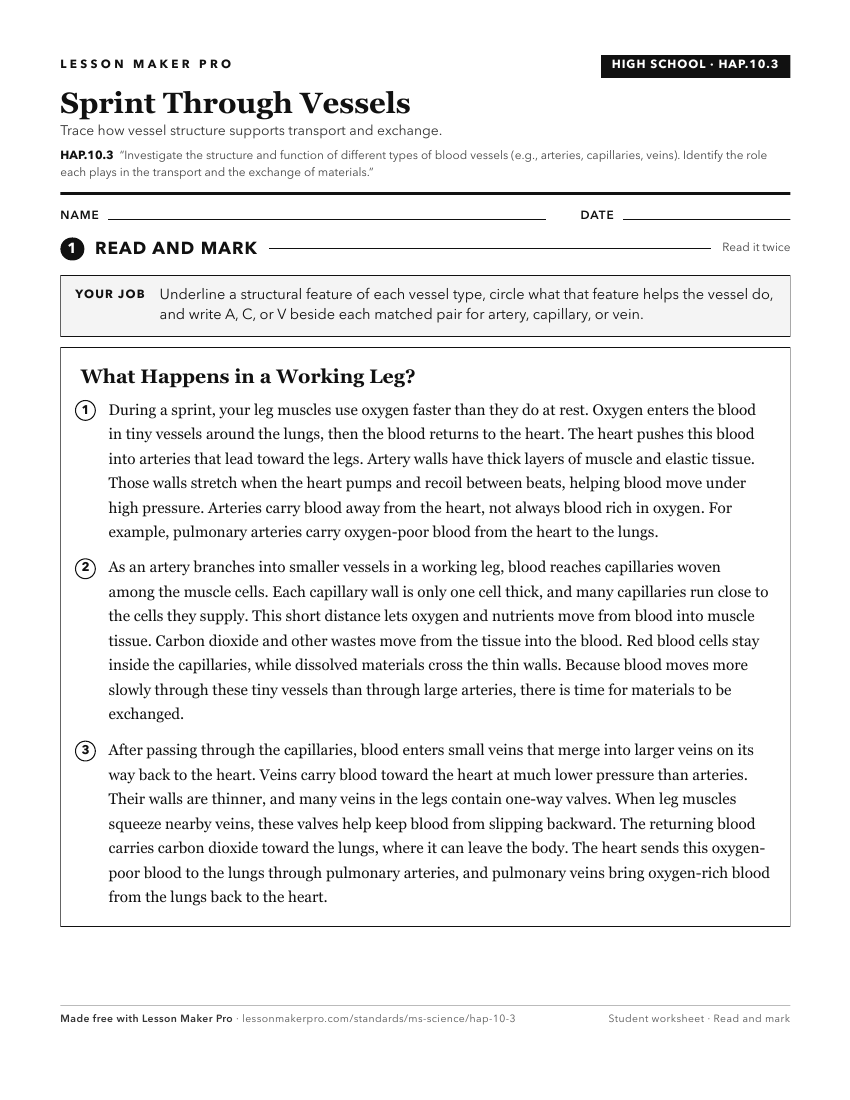
A ready-to-print activity worksheet aligned to HAP.10.3, with an answer key for the teacher on its own page. No account needed.
PDF, US Letter, prints cleanly in black and white.
Download the worksheetKeep exploring
Related Standards
- BIO.1D
Students will describe the structure of the cell membrane and analyze how the structure is related to its primary function of regulating transport in and out of...
- HAP.10
Students will investigate the structures and functions of the cardiovascular system, including the cause and effect of diseases and disorders.
- HAP.10.1
Design and use models to investigate the functions of the organs of the cardiovascular system.
- HAP.9
Students will analyze the structure and functions of blood and its role in maintaining homeostasis.
Turn this exact standard into a lesson
Grade, subject, topic, and the complete standard are prefilled. Create one free, no account needed.
Also for this standard:Make a WorksheetMake a QuizMake a Sub Lesson