Mississippi Science HAP.9.2
The Standard
- HAP.9
- Students will analyze the structure and functions of blood and its role in maintaining homeostasis.
Distinguish the cellular difference between the ABO blood groups and investigate blood type differences utilizing antibodies to determine compatible donors and recipients.
2026 Mississippi College- and Career-Readiness Standards for Science · Blood
Teacher's field guide
What This Standard Means
What Students Need to Do
- Students identify A and B markers on red blood cells and the antibodies in plasma. They use clumping with anti-A and anti-B test solutions to find a blood type. Then they work out which red cell donors and recipients are compatible.
What Mastery Looks Like
- A student can identify all four ABO types from test results. They can explain why a type A patient can receive A or O red cells but not B red cells: the patient’s anti-B antibodies react with B markers.
Common Misconceptions
- Students may put antibodies on red blood cells instead of in plasma. They may think clumping shows which antibody is in the sample, rather than which marker is on its red cells. Some mix up who type O red cells can be donated to with what a type O patient can receive.
How to Assess It
- Exit ticket: A sample clumps with anti-A but not anti-B. Name its ABO type, list its ABO-compatible red cell donors, and explain why one other type is incompatible.
Lesson moves
Ways to Teach It
Give groups red cell cutouts labeled A, B, both, or neither; have them match anti-A and anti-B cards to cells that would clump.
Ask pairs: Why can a type A patient receive type O red cells but not type B? Require markers and antibodies in the answer.
Play donor-recipient match with ABO cards; award a point only when a pair explains its match using a marker or antibody.
Give students a mock hospital chart for a type B patient; have them select ABO-compatible red cell units and note that Rh testing is still needed.
Free download
Printable HAP.9.2 Worksheet
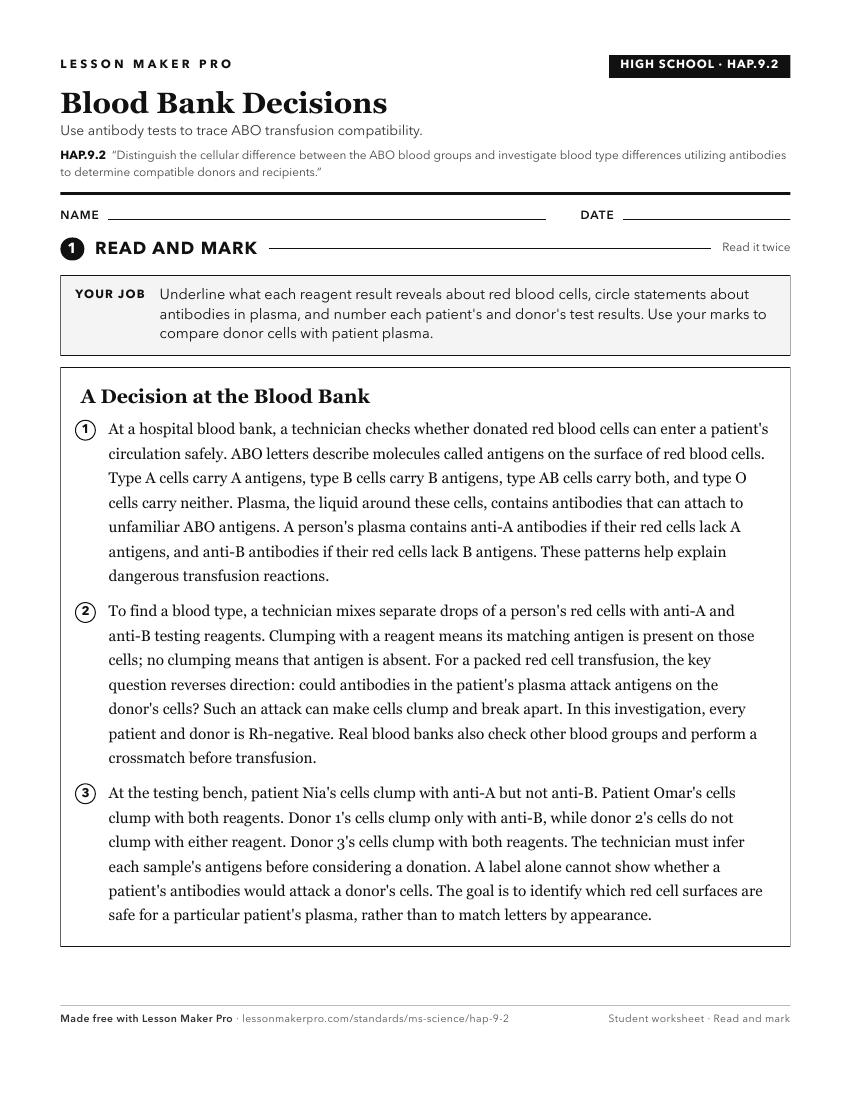
A ready-to-print activity worksheet aligned to HAP.9.2, with an answer key for the teacher on its own page. No account needed.
PDF, US Letter, prints cleanly in black and white.
Download the worksheetKeep exploring
Related Standards
- BIO.3B.3
Investigate traits that follow non-Mendelian inheritance patterns (e.g., incomplete dominance, codominance, multiple alleles in human blood types, and sex-linka...
- HAP.9.3
Research and analyze the causes and effects of various pathological conditions (e.g., anemia, malaria, leukemia, hemophilia, and blood doping).
- HAP.11.5
Differentiate the role of B-lymphocytes and T-lymphocytes in the development of humoral and cell-mediated immunity and primary and secondary immune responses.
- HAP.11.6
Investigate various forms of acquired and passive immunity (e.g., fetal immunity, breastfed babies, vaccinations, and plasma donations).
Turn this exact standard into a lesson
Grade, subject, topic, and the complete standard are prefilled. Create one free, no account needed.
Also for this standard:Make a WorksheetMake a QuizMake a Sub Lesson