Mississippi Science BIO.3B.3
The Standard
- BIO.3B
- Students will analyze and interpret data collected from probability calculations to explain the variation of expressed traits within a population.
Investigate traits that follow non-Mendelian inheritance patterns (e.g., incomplete dominance, codominance, multiple alleles in human blood types, and sex-linkage).
2026 Mississippi College- and Career-Readiness Standards for Science · Reproduction and Heredity
Teacher's field guide
What This Standard Means
What Students Need to Do
- Students predict offspring traits when both alleles show, neither allele fully masks the other, or a trait has more than two allele forms in a population. They also track traits carried on the X chromosome through families.
What Mastery Looks Like
- Students can use parent genotypes to list possible flower colors and blood types in offspring. They can read an X-linked family chart and explain why a father does not pass his X chromosome to his sons.
Common Misconceptions
- Students may think pink flowers mean the alleles themselves blended, or that AB blood is a separate allele. They may think one person carries all three ABO alleles or that fathers pass X-linked traits to sons.
How to Assess It
- Exit ticket: Parents have AO and BO blood genotypes. List their children's possible blood types, explain how AB blood differs from pink flowers produced by red and white parents, and say whether a father passes his X chromosome to a son.
Lesson moves
Ways to Teach It
Have students pair red and white allele cards, then attach a pink flower card to show incomplete dominance.
Ask students to write why a person with AB blood has both A and B markers, rather than a blend.
Give pairs four X-linked color-vision crosses to solve, then have them match each cross to possible child outcomes.
Give students a mock blood bank report with A and B antigen test results and ask them to identify the person's blood type.
Free download
Printable BIO.3B.3 Worksheet
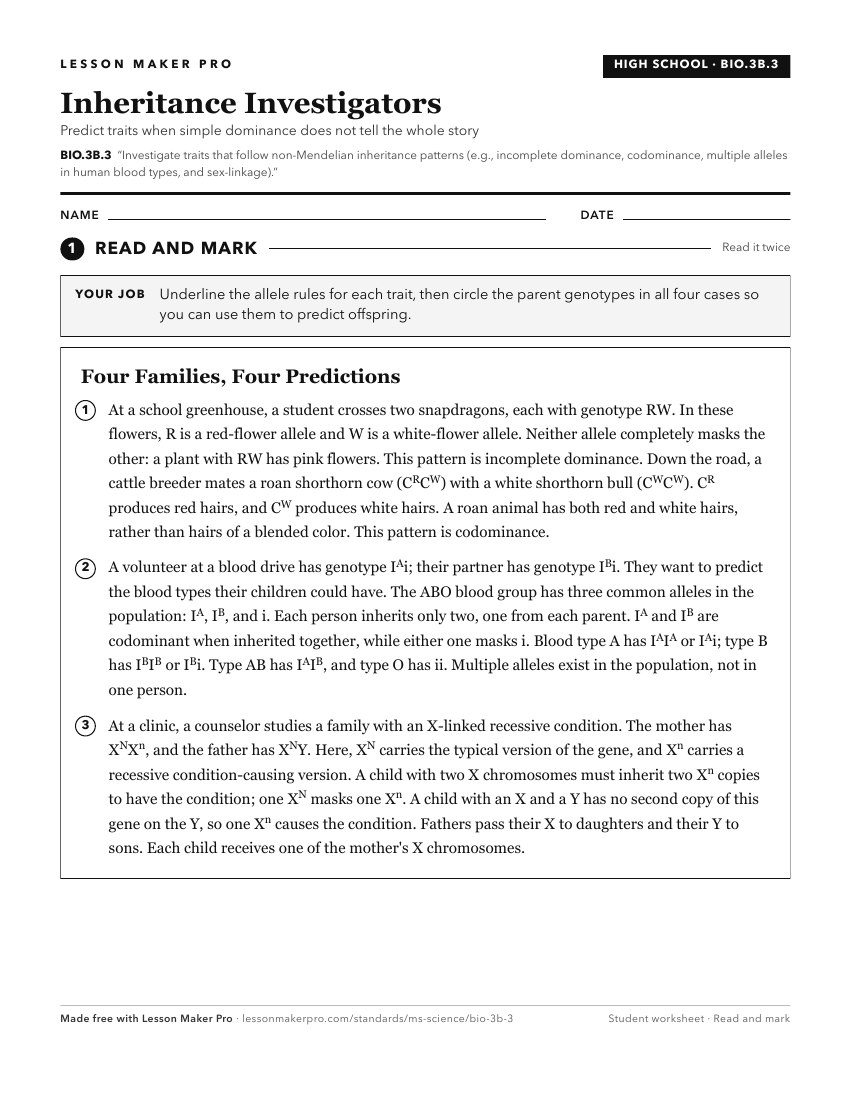
A ready-to-print activity worksheet aligned to BIO.3B.3, with an answer key for the teacher on its own page. No account needed.
PDF, US Letter, prints cleanly in black and white.
Download the worksheetKeep exploring
Related Standards
- GEN.4.4
Construct pedigrees from observed phenotypes. Analyze and interpret data to determine patterns of inheritance and disease risk.
- GEN.4.3
Investigate traits that follow non-Mendelian inheritance patterns (e.g., incomplete dominance, codominance, multiple alleles, autosomal linkage, sexlinkage, pol...
- FB.4.3
Use models (e.g., Punnett squares) and mathematical reasoning to describe and predict patterns of inheritance of single genetic traits from parents to offspring...
- BIO.3B.4
Analyze and interpret data (e.g., pedigrees, family, and population studies) regarding Mendelian and complex genetic traits (e.g., sickle-cell anemia, cystic fi...
Turn this exact standard into a lesson
Grade, subject, topic, and the complete standard are prefilled. Create one free, no account needed.
Also for this standard:Make a WorksheetMake a QuizMake a Sub Lesson